BTC - Bitcoin
 USDTERC20 - USDT ERC20
 ETH - Ethereum
 BNB - Binance
 BCH - Bitcoin Cash
 DOGE - Dogecoin
 TRX - TRON
 USDTTRC20 - USD TRC20
 LTC - LiteCoin

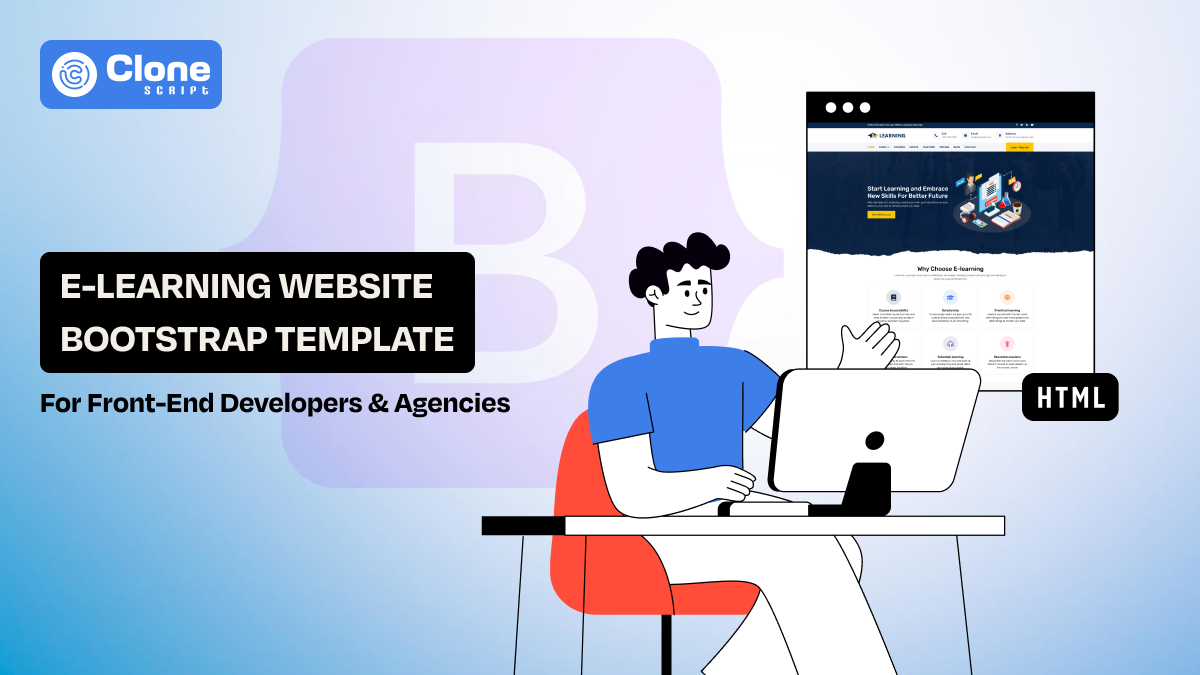
E-Learning Website Bootstrap Template: Best Way for Agile Front-end Development
Learning Management System (LMS) website projects are often amplified in their difficulty when timelines are shortened, and client expectations are sometimes unrealistic. Continuously rebuilding course listings, dashboards, and responsive layouts increases the amount of time required for the project to be completed. It limits the amount of development that can occur on other ongoing concurrent projects. A structured Bootstrap eLearning website template allows for a consistent front-end baseline that provides a level of control, while also speeding up the time to deliver the project.
What Developers Expect From an E-Learning Website Template Built With Bootstrap
Developers expect clean and semantic HTML, a logical separation of components, and predictable class naming according to how Bootstrap works. It will be a starting point for building a new project rather than simply being a theme.
The following are the developer's main requirements for a quality education website template:
-
Clean HTML structure: Having clean logical markup makes it easier for the developer to read, refactor, and integrate with the back-end system when working with multiple frameworks.
-
Component-based layouts: Enabling the reuse of UI components, such as sections, will help the developer to extract or replace components without breaking the layout.
-
Responsive grid implementation: When a developer uses the grid properly, the header and footer items and their controls will all appear in the same position regardless of the device, and therefore, there will be less CSS to override.
All of the above will determine whether the template is a benefit to a developer (saves time) or a long-term liability (technical debt).
Why Bootstrap Is Still the Preferred Framework for LMS Front-ends
Bootstrap continues to be the best option for agencies that are developing LMS front-ends due to the expected structure of the framework, the familiarity of developers with it, and the enhanced ability for agencies to hand off their work to clients in a much simpler manner. It reduced maintenance costs associated with systems that involve multiple developers and project time.
The following are the two main reasons why agencies continue to use Bootstrap for building online learning websites:
-
Client-side framework familiarity
Many of the LMS platform dashboards are Bootstrap-based. Therefore, it is much easier for the agency to create a front-end that aligns with the client and to extend and maintain it without introducing any new front-end dependencies for the agency to account for.
-
Predictable grid and layout system
Bootstrap provides developers with one predictable grid that behaves responsively. It results in fewer layout regressions when members modify the source code and accelerates the QA process for all types of screen sizes across an education website.
-
Lower developer onboarding cost
New website developers can comprehend and modify any Bootstrap codebase quickly, which lowers ramp-up time for a team that is adding members or handing projects off to new groups of developers.
-
Stable component behavior
With well-documented components, documents are not modified in unexpected ways when UI changes occur, allowing agencies to provide a stable outcome on the development of new features for the learning management website.
-
Smooth white-label transitions
Bootstrap allows agencies to maintain the integrity of their layouts while changing their brand's look and feel when providing services to multiple clients. This makes it easier for agencies to recycle website templates for different client implementations.
Using this front-end framework in development will be a good option for both the developer and clients.
Common LMS Pages Agencies Rebuild on Every Project
There are very few differences in the front-end requirements for most platforms across different industries or target audiences. Each time an agency develops an LMS site, they design and lays out the same web pages in the same way, creating inefficiencies for agencies managing multiple projects.
Typical recurring pages include:
-
Course listing pages
From a structured grid of course categories, filters, and prices in a way that allows content to scale as new categories and filters are added over time.
-
Course detail pages
Designing a particular course detail page includes video previewing, curricula, instructor details, and relevant actions related to enrolling in courses.
-
Instructor profiles:
The page provides a common presentation of teaching professional qualifications information, where the courses are associated with all instructors. This builds trust in and differentiates instructors from one another.
-
Student dashboards
The user interface provides a visual representation of how much students have progressed through their enrolled courses, as well as how to interact with their accounts.
A pre-built HTML front-end website template saves you from repeating the groundwork to design these pages.
Overview of the E-Learning Web Template (Frontend-Ready)
This is an online learning template specifically designed for agencies to support professional development workflows. It delivers a Bootstrap-based structure to support front-end development.
Rather than bundling back-end assumptions and designs into the template, it is focused solely on delivering the front-end design and user experience (UX) to developers.
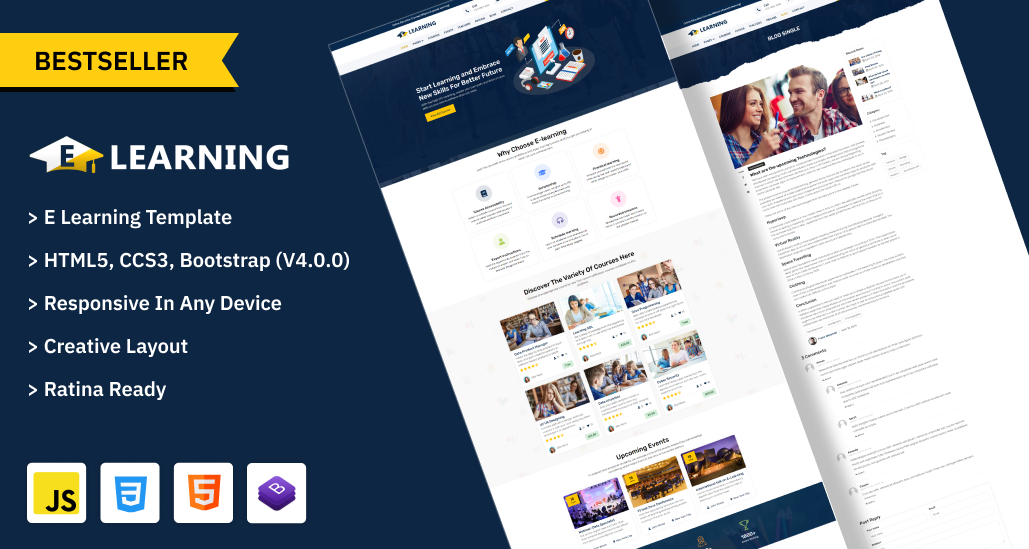
Therefore, when developers receive the files, they contain organized HTML files with consistent layout patterns and reusable user interface (UI) sections that can connect to any LMS back-end, application programming interface (API), and content management system (CMS). This allows developers to build sites with the same level of flexibility as if they were creating a site from scratch while reducing initial build time.
How This Education Template Reduces Front-end Development Time
When projects are designed and built using an LMS, the time it takes to complete front-end efforts is often under-estimated. Significant time is consumed in designing responsive layouts, aligning components for visual balance, and testing different devices during the initial back-end integration phase.
Use of the template significantly reduces the time to deliver a project through:
-
Eliminating UI design phases: Because the layouts are pre-built, developers do not have to spend time creating wireframes, visual design phases, and getting client approvals on design.
-
Providing ready page structures: The page structures provided with the template enable developers to begin their projects with functional HTML page layouts as opposed to blank HTML files.
-
Reducing QA iterations: The consistency in the responsive nature of the templates reduces the number of iterations of the UI that need to go through quality assurance (QA) for layout-related bugs across multiple types of devices.
Using this template will allow agencies to have faster project timelines for developing and designing front-end solutions without sacrificing the control of code quality.
White-Label and Customization Advantages for Agencies
Most agencies create and deploy a unique visual identity every time they release a project. To accomplish this, they must create a fully-functional website using a template that allows for white-labeling without re-creating the layout. Therefore, the template we developed allows agencies to configure their CMS and HTML page layouts using all brandable elements within the CSS and at the component level.
Benefits of customizing the education website template:
-
Easy brand replacement: Ability to easily replace brand elements (i.e., colors, fonts, assets) without re-creating the markup for the layout.
-
Modular section reuse: The reuse and re-arrange components in various modular web design sections to accommodate multiple client needs.
-
Scalable for multiple clients: They can create multiple sites per client by using only one base template.
This will enable agencies to receive increased ROI on their investment in the template and essentially make the template an asset instead of a one-time purchase.
Front-end & Back-end Integration Flexibility
We designed the LMS e-learning Bootstrap Template as a front-end layer with respect to a back-end application to enable the use of any back-end application's custom logic, API, or dashboard, as well as a headless architecture for content management systems (CMS).
Here is the summary of front-end and back-end integration capabilities:
-
Works with any LMS back-end
The template can be utilized with any back-end application because the template uses clean, framework-neutral HTML. You may integrate it with Laravel, Django, or Node.js, or create a custom-built LMS back-end system without changing the core layout structure of the template.
-
API-ready frontend architecture
The layouts are planned for dynamically binding data using REST or GraphQL API services, while also being able to keep markup on the front-end intact and easy-to-maintain.
-
Compatible with custom dashboards
The template can extend or replace UI components on the dashboard to support role-based experiences for student, teacher, or admin users. As the UI design and UX principles for dashboards are continually implemented, it increases the usability of the platform.
-
Supports CMS and headless setups
It integrates easily with traditional CMS systems or headless content delivery solutions, allowing for flexible content delivery to users without the need to rework the front-end of the site.
One thing to note: website templates do not replace custom development. They remove redundant front-end effort. eLearning website development agencies gain speed and consistency while focusing on custom work that delivers real client value.
Who Benefits Most From This Bootstrap E-Learning Template
This template was designed for teams that want to deliver LMS front-end solutions in a fast, consistent manner repeatedly and not design or develop "one-off" visual experiments or custom UI systems.
Ideal users are the following:
-
Web development agencies supporting EdTech clients: Agencies will produce consistent front-end deliveries of an LMS, supporting multiple clients with less design time and creating a familiar interface across many education-based clients.
-
Freelancers managing multiple education website builds: Freelancers will have an existing front-end framework that can be reused to deliver projects faster while providing professional-looking UI on multiple online learning website development projects.
-
Product teams validating MVPs: Product teams will be able to launch a functional eLearning website MVP faster, receive feedback earlier, and revise their product with new back-end development without the delay of changing the UI design of the product.
-
SaaS teams building internal training platforms: Internal training platforms have established reliable and maintainable user interfaces (UI), without the need to invest heavily in bespoke front-end systems or lengthy design cycles.
The value of internal training in the predictability of their structure, speed to deliver, and their long-term reusability, versus simply the visual appeal of the platform.
Using the Template as a Long-Term Agency Asset
This Bootstrap template is an agency project for use as a reusable front-end base for agencies that require an online training solution. It provides a consistent basis to deliver the same way every time, helps shorten the time to onboard new team members, and increases the efficiency of using the front-end across multiple LMS training projects.
How web development agencies benefit in the long-term from this eLearning template:
-
Standardized frontend workflows
Using the same front-end structure on different projects reduces decision fatigue for the different teams and promotes consistency of implementation across all the different developers working on the agency team.
-
Faster developer onboarding
New developers to the agency using the template will easily understand the layout and components, allowing for a very short ramp-up period on all active online learning website projects.
-
Improved estimation accuracy
Due to the defined front-end scope of the Bootstrap template, agencies can provide a more accurate delivery timeline as well as cost estimates within that timeframe, thus reducing the risk of delivering against client expectations.
-
Reduced long-term maintenance effort
By establishing a consistent UI pattern across multiple client LMS deployments, updates, bug fixes, and feature enhancements become much easier to manage.
-
Higher return on investment:
The website template acts as a one-time development benefit for each deployment, therefore, providing an agency with multiple uses for the same front-end work, creating a scalable long-term asset for the agency.
Final Thoughts: Ship Education Website Projects Faster With Less Front-end Overhead
An eLearning website template is a strategic asset to developers and agencies while eliminating redundant work and allowing for continued technical control of the project. A Bootstrap template establishes a framework for an education website, so that you can concentrate on developing high-performing integrated solutions for clients' businesses.
If your objective is to have a consistent LMS front-end delivery system, have fewer components that take time to build, and still retain a high degree of flexibility, then a customizable template is a logical and scalable option to consider.