BTC - Bitcoin
 USDTERC20 - USDT ERC20
 ETH - Ethereum
 BNB - Binance
 BCH - Bitcoin Cash
 DOGE - Dogecoin
 TRX - TRON
 USDTTRC20 - USD TRC20
 LTC - LiteCoin

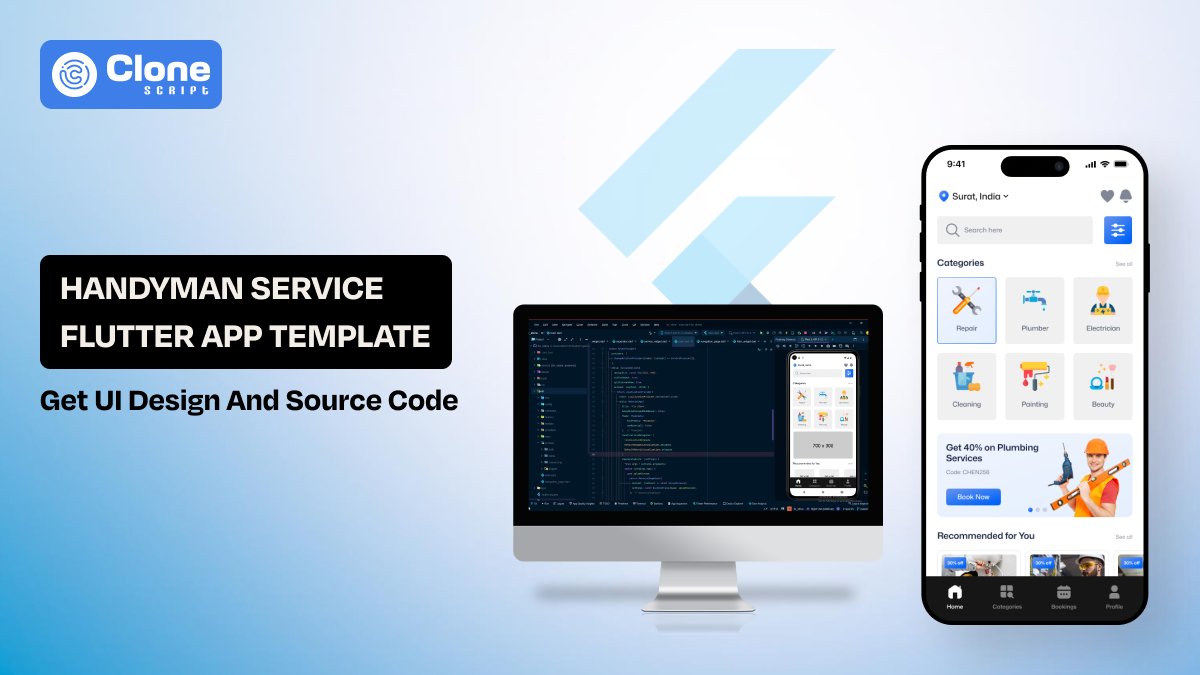
Handyman Service Flutter App Template with Booking & Admin Dashboard
Launching a handyman marketplace traditionally requires backend engineering, DevOps setup, API integrations, and mobile deployment pipelines. However, no-code or low-code Flutter templates have reduced technical barriers significantly.
In 2026, over 48% of startups use pre-built frameworks or templates to accelerate MVP deployment. Instead of writing core booking logic, you configure service categories and pricing structures, commission percentages, payment gateways, branding and UI assets, and push notification settings.
The process typically involves installing the Flutter project, connecting it to a back-end (Firebase, Laravel, Node.js), configuring environment variables, and deploying builds to app stores. This reduces launch timelines from months to weeks.
How to Launch a Handyman Marketplace Without Coding Using a Flutter Template
A Handyman Service Flutter App Template changes the execution model. Instead of building authentication systems, booking engines, payment modules, and admin dashboards manually, teams configure an existing marketplace architecture. The workflow typically includes:
-
Installing the Flutter project
-
Connecting it to a backend (Firebase, Node.js, Laravel, or similar)
-
Configuring environment variables and API endpoints
-
Setting commission rates and service categories
-
Customizing UI branding
-
Deploying builds to Google Play and the App Store
This process can reduce launch time from six months to under eight weeks, depending on customization depth. More importantly, it shifts engineering effort from infrastructure building to product refinement.
That refinement becomes meaningful only when the underlying handyman booking app includes the correct feature set and operational controls, which brings us to the key capabilities required in a production-grade solution.
Key Features of a Handyman Booking App with Admin Dashboard
A handyman booking app is not simply a service listing platform. It is a transactional marketplace with multi-role logic, payment flows, scheduling constraints, and operational analytics. If any of these layers are underdeveloped, scalability becomes difficult.
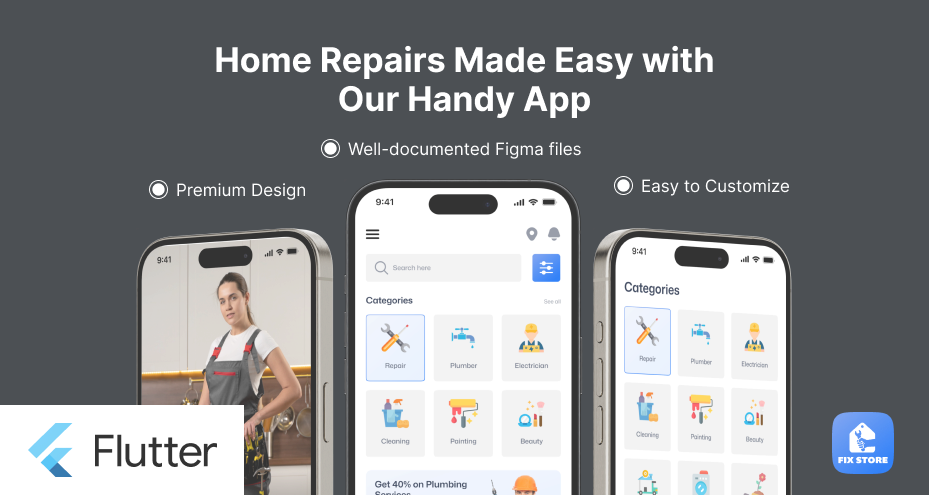
At a minimum, a production-ready handyman service app template should include:
-
Structured Booking Management
The booking engine must support a full lifecycle, from when a request is submitted to when the provider is assigned or accepted. After it, the service goes into the process for completion, cancellation, or raise dispute.
Each state transition should trigger notifications and update back-end records. Otherwise, poorly designed lifecycle management leads to inconsistent job tracking and user dissatisfaction.
-
Real-Time Notifications
Push notifications are critical in on-demand systems. Research indicates that apps using timely notifications experience up to 30% higher engagement rates compared to silent systems. Consider that notifications should cover booking confirmations, provider arrival updates, payment confirmations, and review requests.
-
Integrated Payment Processing
Secure in-app payments reduce cancellation rates and increase trust. The system should support escrow-based payment holding, commission deduction logic, provider payout tracking, and refund handling. App templates that lack configurable commission logic require later architectural rework.
-
Admin Analytics Dashboard
The admin dashboard is the control center of the marketplace. It should provide booking volume metrics, revenue tracking, commission summaries, active provider counts, cancellation statistics, and customer acquisition insights.
Centralized analytics improve decision-making and operational visibility. Platforms with structured dashboards often report measurable improvements in workflow efficiency because data replaces guesswork.
However, features alone do not ensure a stable marketplace. The real strength of a handyman service app template lies in how it manages role-based interactions across customer, handyman, and admin panels.
Customer, Handyman & Admin Panels: Complete Marketplace Workflow Explained
A handyman marketplace operates as a three-role ecosystem. Every role requires isolation, permissions, and clearly defined data access rules.
-
Customer Panel
The customer interface focuses on usability and clarity. Core functions include the following:
-
Browsing service categories (plumbing, roofing, house cleaning, etc.)
-
Selecting date and time slots (morning, afternoon, evening)
-
Viewing provider ratings (2-star average, 3-4 star good, and 5-star excellent)
-
Making secure payments and confirming the booking confirm
-
Tracking job progress in real-time
-
Submitting reviews as per the service experience
From a UX standpoint, friction must be minimized. Booking should take no more than a few screens. Having a performance lag directly affects conversion rates.
-
Handyman Panel
The handyman or service provider panel functions as an operational dashboard. Providers should be able to:
-
Set availability as per the convenience with easy access.
-
Accept or reject bookings for providing smooth process to customers.
-
View service details from the customer’s side and make a judgment for booking.
-
Navigate to the customer location with the integrated location access for service.
-
Mark service status updates as in progress, completed, or disputed.
-
Track earnings through filters like daily, weekly, and monthly.
Transparency in earnings and commission deductions reduces disputes and builds trust within the ecosystem.
-
Admin Dashboard
The admin panel gives fluency to the entire system. But it comes with the following responsibilities:
-
User management (customers and providers), where admins have to approve or disapprove both users.
-
A commission configuration that could be transparent for service providers.
-
Dispute resolution in a professional manner does not matter from who raises it, a customer or a handyman service provider.
-
Analytics monitoring for new customer sign-ups, how many service providers are leaving the platform, the average spend from customers, commission chart, etc.
-
Service category management according to the user’s preferences and providers’ availability.
-
Platform configuration for security patch and flaws exposure with proper solution, expanding the service to new locations, offering advanced features, etc.
A properly architected role-based system ensures data separation and reduces exposure risks. Security becomes particularly critical when payment processing and personal information are involved, which leads directly to the technical advantage of using Flutter for such an application.
Why Choose Flutter for Your On-Demand Handyman Service App?
Flutter has worked as a practical cross-platform framework for transactional applications. Instead of maintaining separate Android and iOS codebases, mobile development teams work from a single Dart-based codebase.
This architectural decision delivers measurable benefits, such as:
-
Reduced duplication of UI components
-
Faster iteration cycles
-
Simplified bug tracking
-
Lower long-term maintenance costs
You may not believe the fact: cross-platform frameworks can reduce ongoing maintenance effort by up to 40% compared to maintaining parallel native applications.
Flutter’s widget-based system allows precise UI control, while its rendering engine ensures consistent visual output across devices. For an on-demand handyman booking app, this matters because a consistent user experience reduces support overhead.
Additionally, Flutter integrates efficiently with REST APIs, Firebase services, and third-party SDKs for payment gateways and notifications. Performance benchmarks show that well-optimized Flutter apps handle transactional flows with near-native responsiveness.
Choosing Flutter does not eliminate back-end complexity, but it consolidates app front-end development. That match is particularly beneficial when implementing flexible revenue strategies within a handyman service app template.
Business Models You Can Build with a Handyman Service App Template
A structured handyman marketplace must support adaptable monetization. Rigid revenue models limit growth potential.
Common business models include:
-
Commission-Based Model
The platform earns a percentage per completed booking. Commission rates typically range between 10% and 25%, depending on market positioning.
-
Subscription Model
In this model, service providers pay a recurring fee for platform access. This stabilizes revenue but requires strong provider value propositions.
-
Lead Generation Model
Customers post service requests, and providers pay to access leads. This model works well in competitive urban markets where service is frequently booked.
-
Hybrid Model
In this business model, combining subscription and commission strategies creates diversified income streams.
The global gig economy continues expanding, with projections estimating hundreds of billions in value within the next few years. Flexible revenue architecture ensures that a handyman booking app can adapt to evolving market conditions.
How the app earns its design directly influences cost planning, making it necessary to evaluate the financial structure of launching a handyman marketplace without coding.
Cost Breakdown: Launching a Handyman Marketplace Without Coding in 2026
Custom mobile app development of a multi-vendor service marketplace exceeds $50,000 when factoring in back-end development, UI/UX design, QA & testing, and deployment.
Using a Flutter handyman service app template significantly reduces upfront cost categories. It's typical expense areas include:
-
Template licensing fee
-
Back-end hosting (AWS, Firebase, DigitalOcean)
-
Payment gateway transaction fees
-
UI customization and branding
-
App store publishing fees
The cost of these mentioned ones can vary depending on the template provider. Some providers only give UI design and source code accessibility, while others offer a ready-to-use software application at a relatively high cost.
But you can’t ignore that template-based deployment can reduce initial capital requirements by 50–70% compared to full custom builds. More importantly, predictable cost structures make budgeting transparent for clients.
Lower initial investment broadens accessibility, which raises an important question about who should consider using a handyman service Flutter app template.
How to Customize and White-Label Your Handyman Booking App
White-labeling software converts a generic handyman service Flutter app template into a client-specific digital product. Instead of altering core architecture, customization focuses on controlled configuration layers that preserve scalability while aligning the platform with brand and operational requirements.
Customization typically occurs across three primary layers:
-
Branding Layer
This layer ensures visual identity consistency across the mobile app and admin dashboard.
-
Logo replacement: Replace default branding assets with the client’s official logo files to maintain visual consistency and strengthen brand recognition.
-
Typography adjustments: Configure font families, weights, and hierarchy to align with brand guidelines and improve readability across all screens.
-
Color palette alignment: Apply primary and secondary brand colors throughout UI components to ensure cohesive design language and user familiarity.
-
Splash screen and onboarding visuals: Customize introductory screens with branded graphics and messaging to create a strong first impression.
Now, branding in app become an asset for business, and you have to prioritize it.
-
Business Logic Configuration
This layer defines how the handyman marketplace generates revenue and manages operational workflows. Proper configuration ensures the platform aligns with the client’s pricing strategy, provider incentives, and regional service dynamics.
-
Commission percentages: Configure dynamic or fixed commission rates per service category to control platform margins and ensure sustainable revenue generation.
-
Service category structuring: Organize services into clearly defined categories and subcategories to improve discoverability, booking accuracy, and operational segmentation.
-
Regional pricing adjustments: Implement location-based pricing rules to account for labor cost variations, demand density, and competitive market positioning.
-
Availability and scheduling rules: Define provider availability windows, buffer times, and booking limits to prevent overbooking and optimize service fulfillment efficiency.
These configurations directly influence cash flow stability, provider retention, and overall marketplace performance.
-
Integration Layer
The integration layer connects the handyman booking app to external infrastructure and third-party services that enable secure transactions, communication, monitoring, and scalability.
-
Payment gateway configuration: Integrate secure payment processors to handle transactions, automate commission deductions, manage refunds, and ensure PCI-compliant processing.
-
SMS and email notification providers: Connect messaging services to deliver booking confirmations, status updates, OTP verification, and transactional alerts in real time.
-
Analytics integrations: Implement tracking tools to monitor user behavior, booking trends, revenue metrics, and conversion funnels for data-driven optimization.
-
Cloud hosting setup: Deploy back-end infrastructure on scalable cloud environments to ensure uptime reliability, load balancing, and secure data storage.
Without properly configured integrations, even a well-designed marketplace cannot operate reliably in production.
Proper customization ensures the final product reflects the client’s brand identity while preserving the structural integrity of the underlying handyman marketplace architecture. Once these layers are configured, the platform moves from template deployment to a fully operational, market-ready handyman booking solution.
Conclusion
The on-demand handyman industry continues to expand as consumer behavior shifts toward mobile-first booking experiences. For development teams and entrepreneurs, using a responsive Flutter template provides a technically sound, scalable, and cost-efficient path to launching a marketplace.
Instead of investing months in foundational architecture, teams can deploy faster, reduce engineering risk, and focus on optimization, growth, and user acquisition.