BTC - Bitcoin
 USDTERC20 - USDT ERC20
 ETH - Ethereum
 BNB - Binance
 BCH - Bitcoin Cash
 DOGE - Dogecoin
 TRX - TRON
 USDTTRC20 - USD TRC20
 LTC - LiteCoin

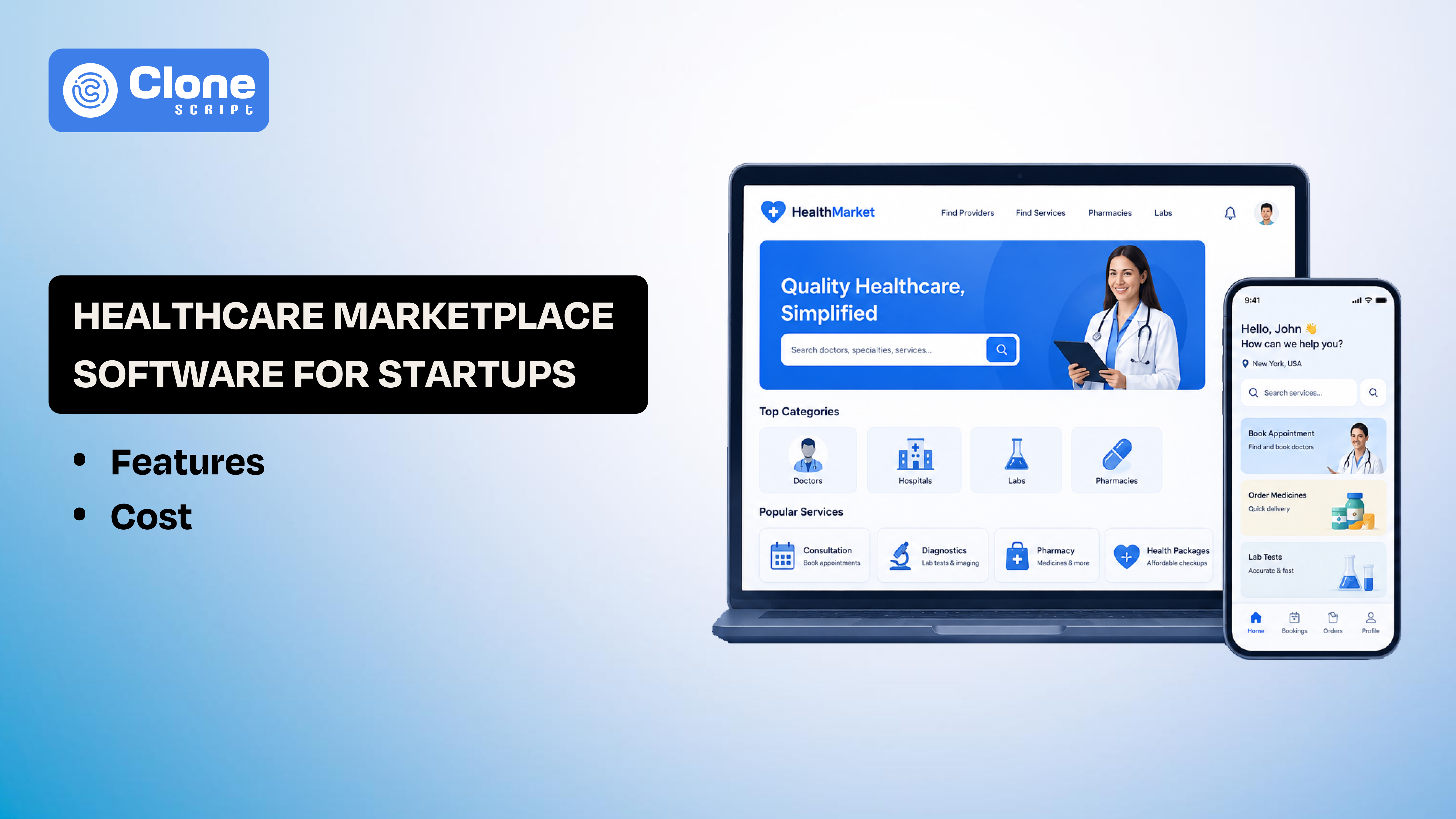
Healthcare Marketplace Software for Startups: Features & Cost
Every startup founder entering healthcare thinks the same thing at first: there’s a gap in the market, and technology can fix it.
Sometimes that’s true.
But healthcare is not likely to make an app for food delivery, ride-sharing, or even fintech. It is slower, more regulated, emotionally charged, and deeply dependent on trust. That means building a healthcare marketplace is not just about writing code or launching an app like Tata 1mg in India. It is about designing a system people will rely on for decisions that directly affect their health.
That changes everything.
For startups, healthcare marketplace software can absolutely become a scalable business. But only if the product solves a real operational problem, not just a digital convenience issue.
Why Healthcare Marketplaces Are Becoming a Startup Priority
The healthcare industry is undergoing a structural shift.
Patients increasingly expect care to be delivered through digital-first experiences. According to recent market projections, the global digital health market is expected to surpass $1 trillion before 2030, driven by telemedicine adoption, remote patient monitoring, and AI-enabled health services.
That scale creates room for startups.
But the more important trend is fragmentation.
Healthcare remains divided across providers, pharmacies, labs, and insurers. Marketplaces solve this by acting as a centralized distribution layer.
For startups, that means opportunity in sectors where inefficiency already exists.
High-growth healthcare marketplace segments:
-
Virtual consultations
-
Online pharmacy services
-
Lab and diagnostics booking
-
Home healthcare coordination
-
Chronic disease support platforms
-
Mental wellness ecosystems
A 2026 industry report showed that over 74% of patients prefer digital scheduling and online provider access when available. That preference is not temporary. It reflects a permanent behavioral change.
Startups that build around this expectation are not chasing trends; they are aligning with long-term consumer demand.
What Healthcare Marketplace Software Really Includes
A healthcare marketplace is often misunderstood as a telemedicine solution.
That definition is too narrow.
Marketplace software supports multiple vendors and service categories inside one platform. It allows users to compare, choose, transact, and manage healthcare interactions across providers.
It functions more like an ecosystem than a single-purpose app.
Typical marketplace participants include:
-
Independent health professional doctors
-
Clinics and hospitals
-
Pharmacies
-
Diagnostics labs
-
Wellness coaches
-
Insurance partners
This structure creates a network effect.
As more providers join, service variety increases. As more users engage, provider value grows. That cycle strengthens the platform.
This is why marketplace models scale more efficiently than standalone healthcare apps.
A single-provider app may attract users. A marketplace can dominate an entire service category.
For example, a startup focused on maternal healthcare could build a marketplace where expecting mothers book gynecologists, schedule diagnostic scans, order supplements, and access virtual counseling in one platform. Instead of solving one isolated problem, the marketplace supports the full care journey.
Features That Define Successful Healthcare Marketplace Software
Technology alone does not make a platform viable.
The right features determine whether the system becomes trusted and scalable.
-
Multi-Role Access Control
Healthcare involves different stakeholders with different permissions.
Your platform must support:
-
Patient dashboards
-
Provider workspaces
-
Admin oversight panels
-
Support and operational roles
Without structured access control, operational complexity increases quickly.
-
Smart Search and Matching
Patients do not want endless provider lists but want to access relevant options in less time.
The healthcare marketplace website and app search systems should include:
-
Specialty filters
-
Pricing ranges
-
Insurance compatibility
-
Language preferences
-
Availability windows
-
Location targeting
Studies show that platforms with intelligent matching systems can improve booking conversion by up to 35% compared to basic search flows.
-
Appointment and Workflow Automation
Manual coordination slows growth when handling multiple professionals and users at the same time.
Essential automation includes:
-
Real-time scheduling
-
Reminders and notifications
-
Follow-up prompts
-
Recurring care plans
-
Cancellation handling
Operational efficiency directly impacts retention.
-
Secure Payments and Billing Logic
Healthcare platforms use multiple revenue models.
These may include:
-
Consultation fees
-
Subscriptions
-
Comissions
-
Bundled care packages
-
Insurance reimbursements
Flexible billing infrastructure is critical for monetization.
Consider a pediatric care marketplace. Automated reminders for vaccinations and follow-up visits can reduce missed appointments while increasing repeat engagement. That turns a scheduling tool into a retention engine.
The Cost Reality: What Startups Should Budget For
Healthcare marketplace software can range widely in cost depending on complexity.
Estimated development investment in 2026:
-
Basic MVP: $10,000–$30,000
-
Growth-stage platform: $30,000–$60,000
-
Enterprise ecosystem: $60,000–$250,000+
These numbers reflect software build costs only.
The broader investment picture includes:
-
Legal compliance preparation
-
Cubersecurity implementation
-
Infrastructure scaling
-
Customer acquisition
-
Provider onboarding
-
Support operations
In healthcare, post-launch expenses often equal or exceed development budgets within the first 18 months. The timeline of a mobile app for a one-and-all healthcare solution can increase to 5-14 months.
That surprises many first-time founders.
And it is one reason undercapitalized healthtech startups struggle.
A startup launching a mental health counseling marketplace with video consultations may spend closer to the MVP range. But a multi-vendor ecosystem connecting pharmacies, insurers, and chronic care specialists will move into enterprise-level costs because of integrations and compliance layers.
The Hidden Cost Most Founders Ignore
Research consistently shows that 88% of users abandon digital health services after one poor experience.
The most expensive part of a healthcare marketplace is not coding.
It is trust-building.
Patients are sharing sensitive information. Providers are protecting professional credibility.
Any friction damages confidence.
That means investment must also go into:
-
Privacy systems
-
Transparent communication
-
Onboarding education
-
Customer support responsiveness
-
Platform reliability
In other words, one failure can erase months of acquisition effort.
That makes user experience a revenue issue. Not just a design concern.
Take a diabetes-focused healthcare startup. It may begin with virtual consultations, but long-term value comes from adding medication reminders, monthly nutrition coaching, lab result tracking, and wearable device syncing. That transforms a single service into an ongoing care ecosystem.
Why Clone Script Solutions Are Becoming a Strategic Choice
Founders assume custom healthcare website development is the only serious route.
That assumption is outdated.
For early-stage startups, speed-to-market frequently matters more than architectural perfection.
Websites and app clone script solutions allow startups to launch faster using proven marketplace frameworks.
Instead of rebuilding standard modules, teams can focus on customization and growth strategy.
Advantages of clone script deployment:
-
It can reduce initial costs related to app UI design, front-end, and back-end development.
-
There is a shorter launch cycle to be followed.
-
Pre-tested workflows can manage the entire development task.
-
Easier MVP validation keeps the launch less risky.
-
There are scalable upgrade paths.
This is especially valuable in healthcare, where market timing can determine funding opportunities.
A startup that launches in four months has a significant learning advantage over one still building after a year.
Why All Clone Scripts Are Relevant for Healthcare Startups
All Clone Script startups have a practical foundation for healthcare marketplace deployment.
The positioning is not about copying another business model exactly. It is about using an established framework to reduce technical overhead.
For founders entering competitive healthcare niches, efficiency matters.
Instead of spending resources on standard marketplace mechanics, our teams can invest in:
-
Specialized service offerings
-
Trust frameworks
-
Patient retention systems
-
Provider partnerships
That creates differentiation where it matters.
The right clone script is not a shortcut.
It is a strategic accelerator.
Contact us, and we will connect you to make such a next-generation healthcare system for your specified goal and within the budget.
A Smarter Approach: Build for Lifetime Care Value
Many startups focus only on transactions.
That limits growth.
The stronger model is recurring care engagement.
Healthcare is rarely a one-time event.
It is ongoing.
Platforms that support long-term relationships create higher retention and stronger revenue predictability.
Examples of continuity-based services:
-
Monthly wellness memberships
-
Chronic disease monitoring
-
Medication refill programs
-
Annual preventive care bundles
-
Ongoing mental health subscriptions
Subscription-driven healthcare models have shown 30% to 50% higher customer lifetime value compared to appointment-only services.
That changes the economics of the business.
Recurring engagement creates stability.
And stability attracts investors.
Final Thoughts
Healthcare marketplace software represents one of the most promising startup opportunities in 2026.
But the market rewards discipline, not just ambition.
Success depends on building platforms that solve operational problems, create trust, and support long-term care relationships.
The best startups will not compete on features alone.
They will compete on ecosystem design.
For founders seeking faster entry and lower technical risk, solutions like All Clone Script provide a practical route to launch and validate faster.
In healthcare, timing matters.
But sustainable value comes from building systems people rely on. Not just the apps they download.
FAQs
-
What makes patients switch to a new healthcare platform?
Convenience, transparent pricing, faster access, and personalized care experiences encourage patients to choose newer digital healthcare platforms.
-
How can startups reduce provider dropout rates?
Reliable bookings, simplified workflows, timely payouts, and strong communication keep healthcare providers active and committed.
-
Is mobile-first design necessary in healthcare platforms?
Yes, mobile-first design improves accessibility, convenience, and patient engagement across healthcare services.
-
What role does AI play in healthcare marketplaces?
AI enhances patient triage, automates scheduling, improves recommendations, and supports better operational efficiency.
-
Should healthcare marketplaces partner with insurers early?
Insurance partnerships help improve affordability, increase trust, and expand healthcare accessibility to every user need a service.
-
How do startups validate healthcare demand quickly?
Start with one niche audience, test engagement, and scale only after proving consistent demand. Do not go anymore for multiple service categories.
-
What increases patient retention after the first use?
Personalized follow-ups, recurring services, and long-term care plans strengthen loyalty. Implement the strategies for that and monitor them in real-time.
-
Can healthcare marketplaces scale internationally?
Yes, with localized compliance, regional partnerships, and multilingual support systems, it is possible to make a healthcare platform internationally.
-
Why do users abandon healthcare apps after signing up?
There are issues related to poor onboarding, unclear benefits, and frustrating user experiences that reduce continued engagement, which make users abandon the app.
-
What creates long-term competitive advantage in healthtech?
Trusted provider ecosystems, seamless care journeys, and continuity-based services sustain leadership in healthcare. It is required to consider what users want.