BTC - Bitcoin
 USDTERC20 - USDT ERC20
 ETH - Ethereum
 BNB - Binance
 BCH - Bitcoin Cash
 DOGE - Dogecoin
 TRX - TRON
 USDTTRC20 - USD TRC20
 LTC - LiteCoin

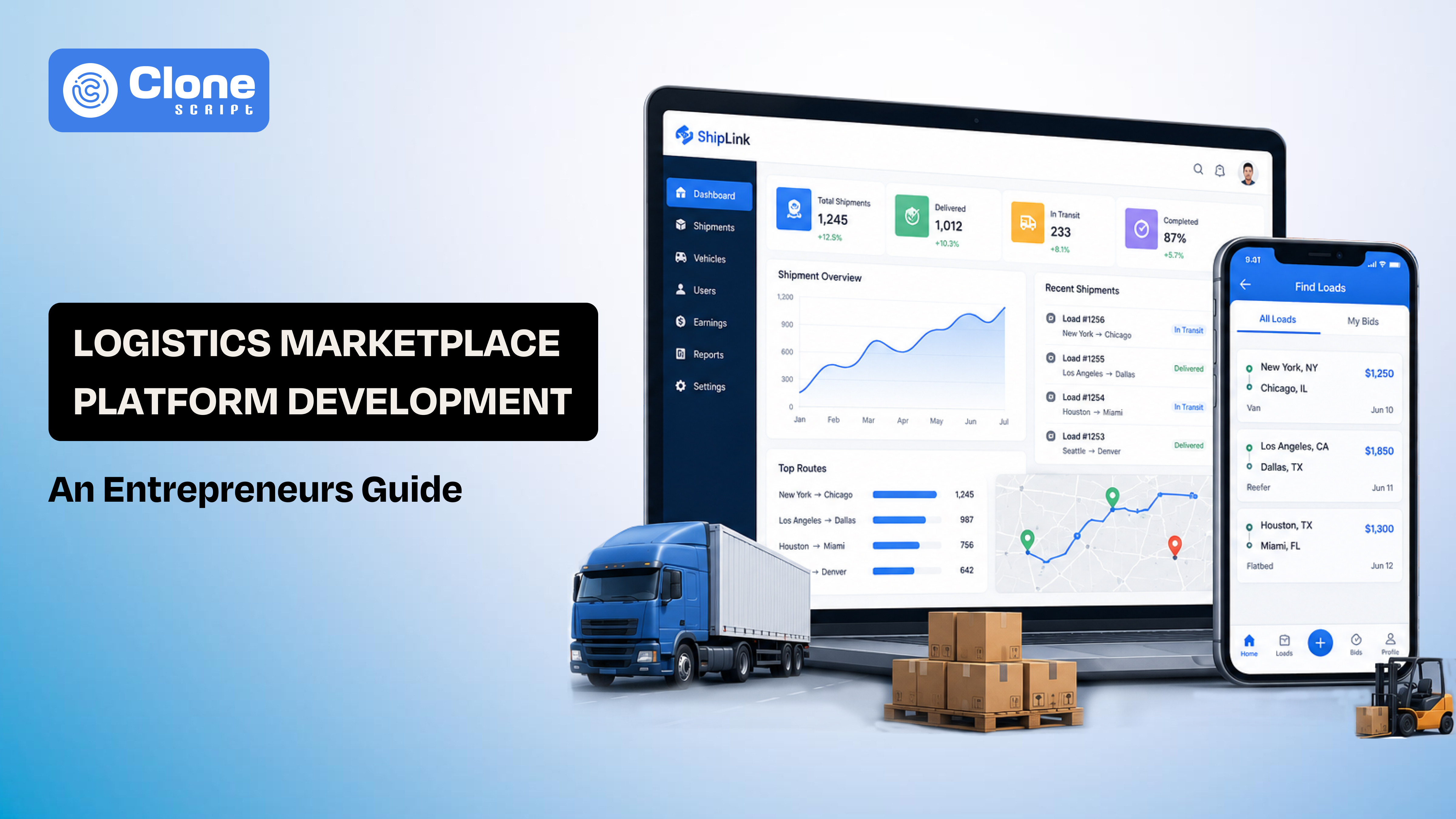
Logistics Marketplace Platform Development Guide for Entrepreneurs
Every delayed shipment tells the same story: disconnected systems, manual coordination, and too many middle layers. While goods move faster than ever, the logistics industry still struggles with fragmented operations that slow businesses down.
That inefficiency creates an opening for entrepreneurs. Instead of investing in fleets or warehouses, startups can build digital marketplaces that connect demand with logistics providers in real time.
In 2026, businesses are not simply looking for transportation. They want visibility, automation, and flexible fulfillment networks through one seamless platform.
This is why logistics marketplace website development has become a high-potential startup model, turning operational gaps into scalable digital businesses.
For founders, the opportunity is clear: build the platform that simplifies logistics, and you become the infrastructure behind modern supply chains.
Why Logistics Marketplace Platforms Are Growing in 2026
The global logistics market surpassed USD 11.23 trillion in 2025, and projections indicate it will continue expanding as e-commerce, manufacturing, and cross-border trade increase. At the same time, the digital freight brokerage segment alone is expected to grow aggressively due to automation and real-time freight matching.
This growth is not accidental. Traditional logistics systems remain fragmented, slow, and overly dependent on manual communication. Entrepreneurs are solving that gap with marketplace platforms.
What is driving this growth?
-
Rising e-commerce demand for faster fulfillment
-
Carrier fragmentation, with many operators running small fleets
-
Need for visibility through live tracking and analytics
-
Pressure to reduce empty miles and operational inefficiencies
-
Shift toward AI-powered supply chain optimization
A logistics marketplace platform works like a digital command center. It connects businesses needing transportation with service providers offering capacity.
Think of it as the logistics version of ride-hailing but for freight, warehousing, and delivery ecosystems.
Entrepreneurs entering now are not just launching software. They are building infrastructure for modern trade.
And because logistics remains one of the least-modernized trillion-dollar sectors, the opportunity is far from saturated.
The Unique Concept: The “Control-Tower Marketplace” Model
Most logistics platforms focus only on shipment booking. That is a narrow play.
A stronger concept for startups is the Control-Tower Marketplace Model.
Instead of acting only as a freight matching tool, your platform becomes a centralized digital layer that manages the entire logistics lifecycle.
What does this include?
-
Shipment booking
-
Carrier onboarding
-
Real-time tracking
-
Route optimization
-
Warehousing integration
-
Payment settlement
-
Analytics dashboard
-
Customer communication tools
This creates higher retention because users stay within your ecosystem.
For example, a startup serving regional manufacturers could offer:
-
Carrier matching for transportation
-
Temporary warehouse booking
-
Customs support integration
-
Last-mile delivery coordination
That means one transaction can generate multiple revenue streams.
This model is powerful because logistics buyers increasingly prefer single-platform efficiency over managing multiple vendors.
In practical terms, the Control-Tower Marketplace gives startups a defensible moat.
Anyone can launch a booking portal.
Few build a full operational layer.
That difference determines long-term scalability.
Business Revenue Models for Logistics Marketplace Startups
Before app development begins, entrepreneurs must define monetization. The revenue model for the marketplace has to be defined.
A logistics marketplace is only valuable if the revenue structure supports sustainable growth.
1. Commission-Based Model
You earn a percentage on every successful shipment or service booking. This marketplace model is best for freight matching platforms. You can charge a 8%–15% transaction fee.
2. Subscription Model
In a subscription model, businesses pay monthly for premium features. It's suitable for SaaS-style logistics dashboards. Tiered pricing for analytics, automation, and API access can be offered.
3. Lead Generation Model
Here, service providers pay for qualified leads that are in B2B marketplaces. In this marketplace business model, the platform works as a mediator.
4. Hybrid Model
This logistic platform model combines commissions, subscriptions, and premium services. The hybrid model is the strongest choice for scalable startups in 2026.
Why?
Because logistics margins can fluctuate, and relying only on commissions creates revenue volatility.
Diversified monetization protects long-term profitability.
Startups that bundle financial tools, insurance, or route intelligence often outperform booking platforms.
That is where higher-margin opportunities exist.
Logistics Marketplace Platform Development Essential Features
A successful logistics marketplace platform must solve real operational pain points.
Professional UI and design are not enough.
Functionality determines adoption.
-
For Shippers
-
Instant freight quote calculator
-
Service comparison dashboard
-
Live shipment tracking
-
Invoice and payment portal
-
Review and rating system
-
For Carriers / Providers
-
Fleet availability management
-
Route scheduling tools
-
Driver assignment system
-
Earnings dashboard
-
Document uploads
-
For Admin
-
Commission controls
-
Dispute resolution tools
-
User verification system
-
Business intelligence dashboard
-
CRM integration
Advanced 2026 features
-
AI route optimization
-
Predictive pricing engine
-
IoT-based asset tracking
-
Carbon footprint reporting
-
Automated contract generation
Platforms that add intelligence layers become more valuable over time.
That means your product should evolve beyond transactions into operational decision-making.
This shift is where startups gain enterprise-level customers.
Development Approaches: Custom Build vs Clone Script
Entrepreneurs often face a major decision early in development.
Should they build from scratch or use a ready-made solution?
The answer depends on speed, budget, and business goals.
-
Custom Development
Advantages
-
Fully tailored architecture
-
Unique workflows
-
Scalable for enterprise complexity
Challenges
-
High development cost
-
Long launch timeline
-
Requires technical leadership
A custom logistic app development build can take 8–18 months, depending on the scope.
For startups, that delay can weaken market momentum.
-
Clone Script Development
Advantages
-
Faster deployment
-
Lower upfront investment
-
Proven marketplace framework
Challenges
-
Requires customization for differentiation
This is where All Clone Script becomes strategically relevant.
As a clone script website and app solution provider, All Clone Script enables entrepreneurs to launch logistics marketplace platforms without building core infrastructure from scratch.
That reduces risk and accelerates go-to-market execution.
Instead of spending months on back-end architecture, founders can focus on partnerships, operations, and customer acquisition.
For startups, speed often matters more than perfection.
A validated market entry beats a delayed masterpiece.
Why All Clone Scripts Fit Logistics Marketplace Startups
Logistics startups need more than code.
They need a launch-ready business engine.
All Clone Script supports this by offering scalable marketplace frameworks designed for digital business models.
Why it works for logistics entrepreneurs
-
Ready-to-customize marketplace architecture
-
Mobile and web app compatibility
-
Faster MVP launch cycle
-
Lower development overhead
-
Scalable backend for future integrations
For founders testing regional freight, warehousing, or delivery ecosystems, this approach creates agility.
Instead of committing massive capital to uncertain assumptions, they can launch, validate, and iterate.
That startup discipline is critical.
Especially in logistics, where operational realities shift quickly.
A clone-based foundation allows entrepreneurs to adapt faster than competitors tied to expensive custom builds.
And in high-growth sectors, adaptability is currency.
Real-World Example: Regional Freight Aggregator Startup
Imagine a startup in India targeting SME manufacturers.
These businesses often struggle to find reliable transport for mid-sized shipments.
The startup launches a logistics marketplace connecting:
-
Local truck operators
-
Warehousing partners
-
last-mile delivery services
Using a clone-script-powered platform, they go live in 90 days.
Within six months:
-
1,200 registered businesses
-
400 carrier partners
-
3,500 completed shipments
Revenue streams include:
-
10% commission per booking
-
Monthly subscription for premium dashboards
-
Insurance partnerships
This model scales city by city.
The startup avoids heavy fleet ownership while earning through digital coordination.
That is the power of marketplace-led logistics entrepreneurship.
Challenges Entrepreneurs Must Prepare For
The opportunity is strong, but execution is not simple.
Logistics marketplaces face structural complexity.
Key challenges
-
Supply Reliability
Carrier quality varies. The solution is to add secure verification systems and real-time performance scoring.
-
Pricing Volatility
Fuel costs and demand spikes affect rates. Integrate dynamic pricing tools into the software and manage the costs.
-
User Trust
Businesses need confidence in delivery commitments. Transparent tracking and service guarantees that.
-
Regulatory Compliance
Cross-border and regional transport laws differ. Solution: legal advisory integrations.
The most successful founders treat these as platform design problems, not operational excuses.
If your software reduces friction, adoption increases.
That principle should guide every product decision.
Final Thoughts: The Future Belongs to Logistics Ecosystems
Logistics is no longer just transportation.
It is becoming an interconnected digital ecosystem.
Entrepreneurs who build logistics marketplace platforms today are positioning themselves at the center of that shift.
The strongest opportunities will not come from owning trucks.
They will come from owning coordination layers.
That means software, data, automation, and network effects.
A logistics marketplace platform is not merely a startup product.
It is infrastructure for modern commerce.
And with scalable solutions like All Clone Script, founders can enter the market faster, test ideas efficiently, and build toward long-term growth.
In a sector worth trillions, even solving one regional inefficiency can create a highly valuable business.
The next major logistics brand may not be a carrier.
It may be the platform that connects them all.
FAQs
-
What problem does a logistics marketplace solve for businesses?
It removes manual coordination, reduces delays, and gives businesses instant access to verified logistics providers through one platform.
-
Can small businesses use logistics marketplace platforms effectively?
Yes, small businesses gain affordable shipping access, competitive pricing, and operational flexibility without long-term logistics contracts.
-
What makes a logistics marketplace different from traditional logistics software?
Marketplace platforms connect multiple service providers, while traditional software usually manages internal logistics operations only.
-
Are logistics marketplace platforms profitable in regional markets?
Regional markets offer strong profitability due to underserved demand, fragmented providers, and growing digital adoption.
-
What technology stack is ideal for logistics marketplace development?
Cloud infrastructure, scalable APIs, mobile frameworks, AI tools, and secure payment systems create a reliable foundation.
-
How do logistics marketplaces attract service providers?
They offer higher order visibility, digital management tools, and faster payment cycles for logistics partners.
-
What is the biggest risk in launching a logistics marketplace?
Failing to balance demand and supply early can reduce trust and weaken platform engagement.
-
Can logistics marketplaces expand into global operations?
Yes, with compliance support, multilingual systems, and cross-border integrations, global expansion becomes achievable.