BTC - Bitcoin
 USDTERC20 - USDT ERC20
 ETH - Ethereum
 BNB - Binance
 BCH - Bitcoin Cash
 DOGE - Dogecoin
 TRX - TRON
 USDTTRC20 - USD TRC20
 LTC - LiteCoin

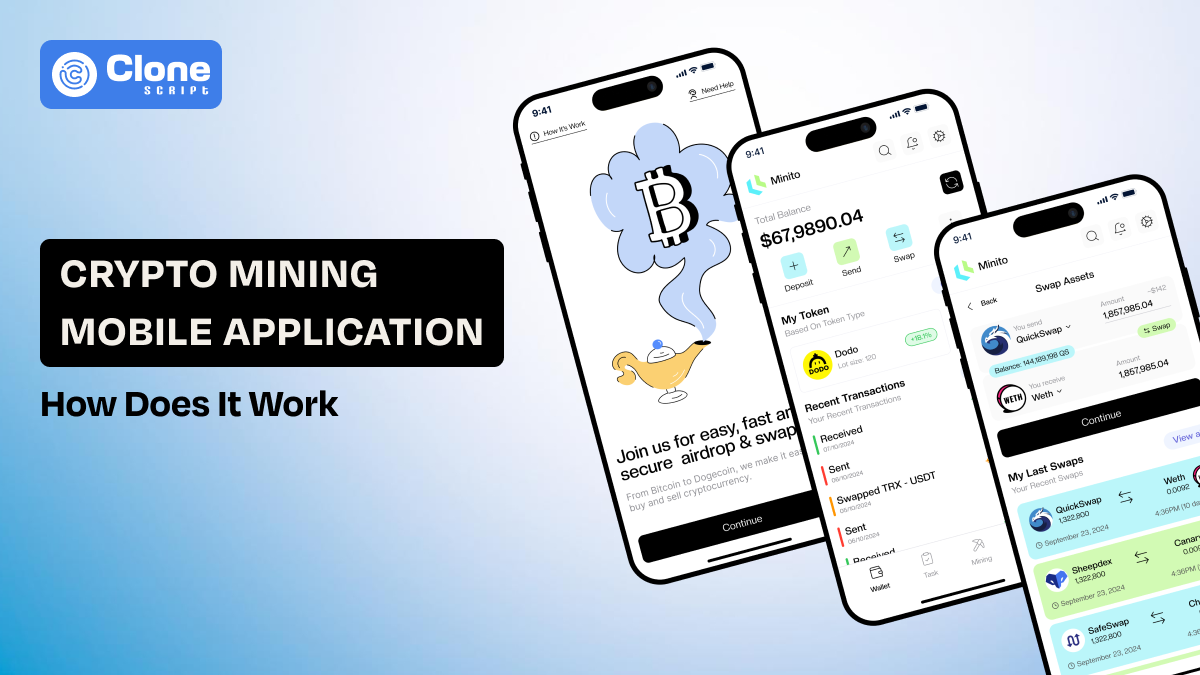
How Does a Cryptocurrency Mining Mobile Application Work
Mining cryptocurrency on a mobile application doesn’t need an introduction. Traditionally, in crypto mining, ASICs or GPUs are deployed. Apps are despite having these tools. Without pushing users and operators in a complex and distributed mining process, mobile apps offer access to data, earnings, and system health.
In this guide, we will explain how cryptocurrency mining works and how mobile apps fit into the ecosystem. You can also see how mining app templates simplify secure development.
What Is Cryptocurrency Mining?
Cryptocurrency mining is a distributed consensus mechanism that validates transactions and secures a blockchain network. Miners collect unconfirmed transactions, bundle them into blocks, and compete to add those blocks to the chain.
In the app, each mining operation involves several core components to comply with security:
-
Nodes, which maintain the blockchain ledger and validate data.
-
Miners, who perform cryptographic computations.
-
Networks, which propagate transactions and blocks.
Here, one thing is clear: mobile applications do not replace miners or nodes. Instead, they integrate with this ecosystem by communicating with mining pools, cloud mining services, or back-end servers management to control hardware.
For developers, the mobile app is a client-facing layer that visualizes mining activity and manages user interactions. They have to create it with the best practices.
How Does Cryptocurrency Mining Work?
Four steps are involved for cryptocurrency mining:
-
Transaction validation:
This is the first step.
When users send cryptocurrency, the transaction is broadcast to the network.
Then, miners collect these unconfirmed transactions in a memory pool and validate them.
The Validation includes verifying: sufficient balance, correctness for digital signatures, and whether the transaction follows protocol rules.
-
Block formation:
After validation, the second step is that a miner groups multiple transactions into a block.
Each block contains the details of transaction data, timestamp, hash of the previous block, and a unique identifier called a nonce. This structure links blocks together, forming a strong blockchain.
-
Hashing and Nonce Generation
Here, crypto miners attempt to generate a hash that fulfills the network’s difficulty target. This is done by repeatedly changing the nonce and computing the hash until the output meets predefined criteria. A trial-and-error process is computationally intensive and ensures network security.
-
Block verification and reward logic
Once a miner finds a valid hash, the block is broadcast to other nodes for verification.
Nodes independently check the block’s validity. If approved, the block is added to the blockchain, and the miner receives a reward. This can include, usually, a combination of newly minted coins and transaction fees.
How Mobile Apps Interact with Mining?
Crypto apps do not perform heavy mining computations. Instead, they act as a bridge between users and the mining infrastructure, representing the following:
-
Displaying real-time mining progress and hash rates
-
Showing pool shares and reward statistics
-
Managing wallet addresses and payouts
-
Sending notifications about pool downtime or network changes
This information becomes important for users to know what to do next. The best part is that the app interface is simple to understand, and even beginners can understand the complex terms of the blockchain network.
What is Proof of Work in Crypto Mining?
Proof of Work (PoW) is a mechanism that checks every block added to the chain is validated through computation to prevent tampering and maintain trust in the network.
Mining apps depend on PoW to display accurate data, like hash rates, completed shares, and rewards, without performing the intensive calculations themselves.
However, the apps are not designed to consume high energy and processor strain. But they connect to mining pools and cloud mining services through API and manage PoW.
What are Cryptocurrency Mining Algorithms Developers Should Know?
To mine BTC, ETH, or any other cryptocurrencies, the mining algorithms work. Before you implement them, know the famous choices:
-
SHA-256: Used by Bitcoin. This algorithm is optimized for ASIC miners. Mobile apps usually act as monitoring tools for these farms, tracking hash rates and earnings without performing the mining themselves.
-
Ethash: Originally designed to limit ASIC advantages, Ethash favors GPU mining. While Ethereum has moved to Proof of Stake, other coins still use it, and apps must support compatible pools.
-
RandomX: This CPU-friendly and memory-intensive algorithm is popular among privacy-focused coins. Apps tracking RandomX rigs focus on performance metrics and stability.
-
Scrypt: Used by Litecoin and similar cryptocurrencies, Scrypt requires high memory, influencing how mining apps calculate efficiency and monitor farm output.
Knowing the algorithm informs how the app collects data, visualizes performance, and integrates with pool APIs. Choosing the right algorithm ensures accurate data presentation and a smooth user experience.
What are the Types of Cryptocurrency Mining Models?
Cryptocurrency mining operates in several models, and apps need to align with the right one to provide meaningful functionality.
-
Solo Mining: This involves mining independently without a pool. It is rarely practical for mobile apps, as the chances of successfully mining a block are extremely low, and hardware requirements are high.
-
Pool Mining: The most widely used model. Apps connect users to mining pools, monitor submitted shares, and calculate proportional rewards, offering real-time insights into mining performance.
-
Cloud Mining: This model is entirely API-driven. Users rent hash power from remote servers, while apps manage contracts, track earnings, and handle withdrawals securely.
For the crypto mining mobile app launch, pool and cloud mining models are the most scalable, efficient, and user-friendly options.
What Mobile Apps Actually Control Between Mining Hardware and Software?
Cryptocurrency mining depends on specialized hardware, ASICs, GPUs, and CPUs. This hardware performs the heavy cryptographic calculations that secure the blockchain. Mobile apps don’t directly control this hardware; they aren’t responsible for overclocking, voltage settings, or processing power.
Instead, mobile apps serve as management and monitoring tools. From it, users get insight and control over their mining operations. They handle tasks such as:
-
Monitoring hash rates, uptime, and mining efficiency
-
Managing connections to mining pools
-
Tracking wallet balances and payouts
-
Displaying performance data in an intuitive interface
This separation keeps apps lightweight, efficient, and focused on delivering actionable information without overloading the device.
What is the Architecture of a Cryptocurrency Mining App?
A mining mobile application must be built on a well-structured, modular architecture to have reliability, scalability, and long-term maintainability.
-
Front-end
The front-end app development is commonly developed using Flutter or React Native to support iOS and Android cross-platform deployment. Its responsibility is to present mining data clearly through dashboards, charts, alerts, and account views while keeping the interface responsive and lightweight.
-
Back-end
The back-end layer acts as the application’s core. It handles user authentication, aggregates mining statistics, manages business logic, and communicates with mining pools or cloud mining providers through secure APIs.
-
Pool and node integration
This forms the data integrity of a mining mobile application. Through well-defined APIs, the app retrieves real-time statistics such as hash rate, accepted shares, rejected shares, and current balances.
-
Wallet and transaction services
It handles the financial side of the application. They securely store wallet addresses, track payout history, and reflect earnings accurately based on pool reports. These services must be reliable and tamper-resistant to maintain user trust.
-
Security and scalability layers
To support growth, security and scalability are essential. Encryption protects data in transit, rate limiting prevents abuse, and cloud-based scaling maintains the app stability and responsiveness even as the number of active users increases.
Each layer of the system plays a specific role while remaining loosely joined to avoid performance issues.
What are the Key Features of Every Mining App?
A successful mining app is not just about displaying numbers; it must offer clarity, reliability, and control to users managing mining operations. Below are the essential features every crypto mining app should include.
-
Real-Time Mining Dashboard: The dashboard is the core element of the app. It should display live hash rate, active miners, uptime, accepted and rejected shares, and daily or monthly earnings in a clear and readable format.
-
Wallet Integration: Secure wallet integration allows users to view balances, track payouts, and verify transaction history without exposing private keys. Maintaining accuracy and transparency are important here.
-
Pool Management and Switching: Users should be able to connect to different mining pools and switch between them easily. This feature helps optimize rewards and respond to pool performance issues.
-
Alerts and Notifications: Push notifications inform users about miner downtime, payout confirmations, or abnormal performance. From it, they can take action once they are notified.
-
Admin and Analytics Panel: For operators, an admin panel provides insights into user activity, pool performance, and overall system health. This can make for smooth operations and scalability.
These features together create a mining app that is practical, trustworthy, and user-focused.
What are the Challenges in the Crypto Mining App?
Developing a mining app is not just a UI task. It involves solving real technical, security, and operational problems. Here are challenges that directly impact how these apps are designed and maintained.
-
Limited mobile performance: Smartphones are not built for continuous cryptographic workloads. Battery drain, thermal throttling, and hardware wear make direct mining on mobile devices impractical.
-
Security exposure: Mining apps interact with wallets, pool APIs, and user accounts. Poorly secured endpoints can lead to API misuse, unauthorized access, or payout manipulation. This can be resolved before it arises.
-
Infrastructure reliability: Mining data must be fetched in real time. Unstable pool APIs or network delays can result in inaccurate dashboards and user distrust.
-
Regulatory and compliance risks: Cryptocurrency regulations vary by region and evolve frequently, affecting user onboarding, payouts, and data handling.
-
Development cost and complexity: Building secure back-end services, analytics, and scalable systems from scratch requires significant time, expertise, and financial investment.
Addressing these challenges early is important to delivering a stable and trustworthy application.
Why Ready-Made Cryptocurrency Mining App Templates Make a Choice?
App templates come with the UI design, code, and features, even integration that makes a month's development cycle limited to a week for launch.
-
It reduces development time:
Ready-made mining app templates eliminate the need to build core features from scratch. Essential modular design, UI components such as dashboards, pool integrations, and wallet tracking are already in place with Flutter source code. This allows faster project execution.
-
Cost efficiency:
The cost of mining apps for iOS and Android, or even web, reaches thousands of dollars. With a template, you can save it and invest in secure back-end systems, security, and testing. It maintains the functionality of the app and makes it useful.
-
Proven architecture:
Custom mining app comes with fresh features that are sometimes unfamiliar to miners. However, the research phase eliminates the risks. If you need to market the app faster, the template solution built on tested workflows reduces technical risks along with implementation errors.
-
Built-in security layers:
Most premium app templates include encrypted API communication, authentication mechanisms, and access control to protect sensitive data. This can save time for the back-end team to integrate the functionality and test it for the expected output.
-
Customization flexibility:
The myth is that template customization doesn’t remove the generic feel. The reality is different. Developers can adapt the user interface, add new mining pools, or extend features based on business needs.
-
Scalable foundation:
Flutter templates are designed to support future growth for startups, agencies, and long-term mining platforms. Managing the traffic, data privacy, and security is a task of server-side development, but the base is solid with the templates.
Using these solutions, you can make a secure and advanced mining app with minimal effort, optimized quality, and ease of use.
Here are some examples of the Flutter templates to look for.
-
Crypto Cloud Mining App Template
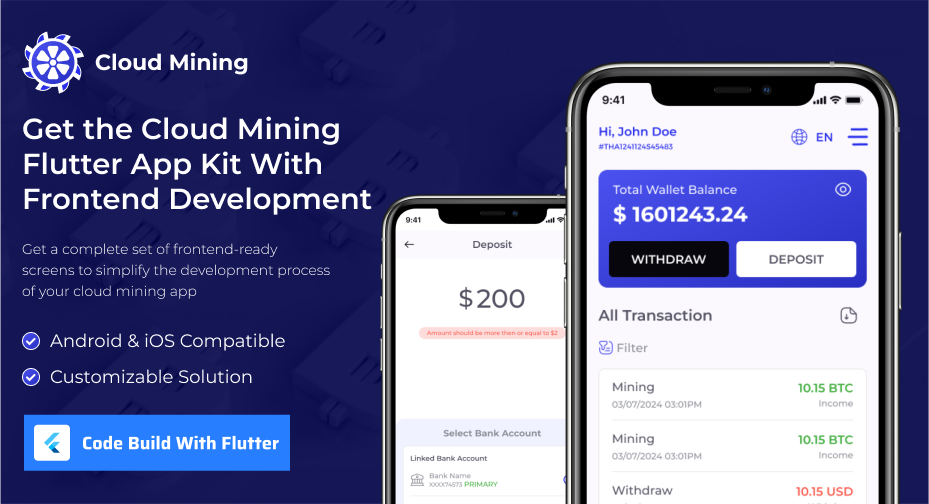
Launch a professional cloud mining experience without building from scratch. This Flutter-based cloud mining app template lets users rent hash power, monitor performance in real time, track daily earnings, manage active contracts, and withdraw payouts securely. Built with scalability in mind, it delivers a stable, high-performance interface suitable for growing mining platforms.
-
Bitcoin Mining App Template
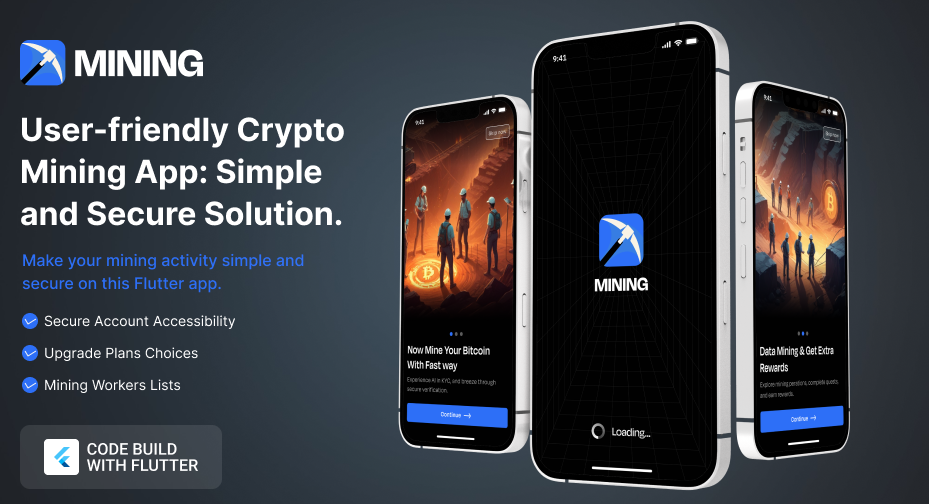
Power your Bitcoin mining platform with a ready-to-deploy Flutter app template tailored for ASIC-based operations. Users can monitor mining pools, track hash rates, view payout histories, and connect wallets effortlessly. The streamlined UI ensures transparency, while the robust backend-ready structure (subject to integration) supports high-volume mining environments.
-
GEMNETWORK - Crypto Athene Clone App Template
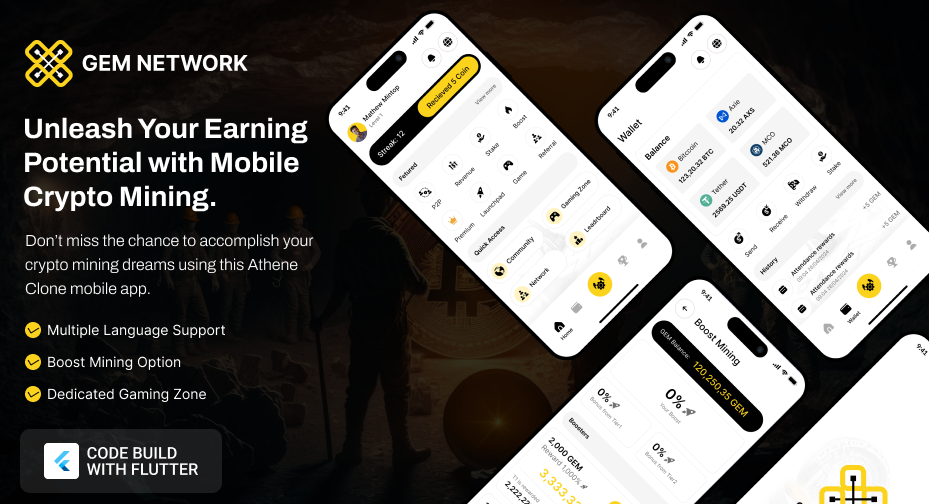
Build a community-driven crypto mining ecosystem inspired by Athene-style platforms. This Flutter Athene clone app template supports referral-based growth, reward and level tracking, cloud mining dashboards, and engagement-focused features. Ideal for startups aiming to scale fast through network effects and user incentives.
-
TAPSWAP Crypto Mining App Template
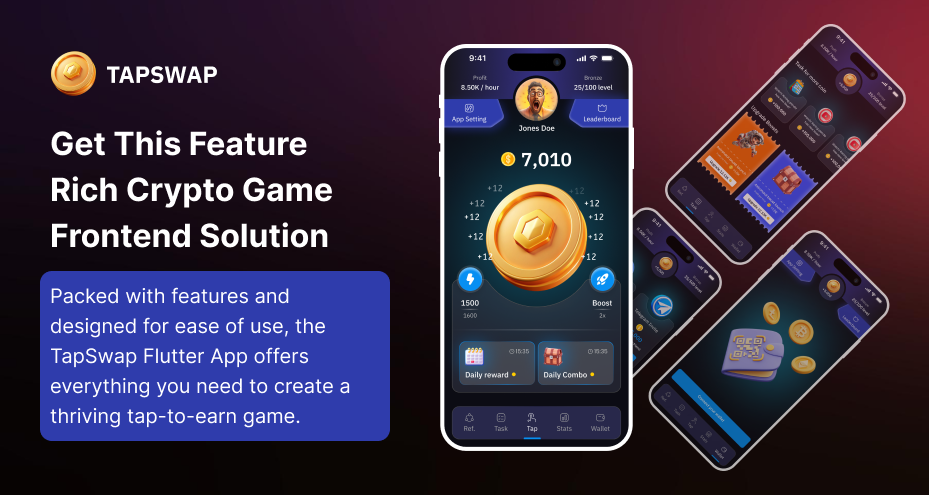
Turn mining into an engaging experience with a tap-to-earn Flutter crypto mining app template. Designed for gamified mining platforms, it enables reward distribution, real-time activity tracking, and high user retention through interactive mechanics. A strong fit for projects targeting mass adoption and daily user engagement with T2E game development.
For heavy and complex crypto mining apps development, the right approach is to start with the client’s requirements and choose the template. Then, to expand it for growth, the custom tech stack and integration will save both time and resources.
Final Thoughts
Even though AI in web development is making the task easier, the challenges and risks are coming frequently. To tackle it, the agile methodology works ideally for you to optimize the design, features, and tech stack. Choosing the app template saves hours in development and gives the base for a ready-to-launch crypto mining application on the Play Store and web.
FAQs
-
Can you mine cryptocurrency directly on a mobile phone?
No. Mobile phones cannot perform real crypto mining due to hardware, battery, and thermal limitations. Apps act as dashboards and management tools, not mining hardware.
-
How does a crypto mining app work without ASICs or GPUs?
Mining apps connect to external mining infrastructure, such as ASIC farms, GPU rigs, or cloud mining providers, through APIs. They fetch and display real-time data like hash rate, rewards, and uptime.
-
What are the main types of cryptocurrency mining models?
The three primary models are: Solo mining (rarely suitable for apps), Pool mining (most common and scalable), and Cloud mining (API-driven, contract-based). Most mobile apps focus on pool and cloud mining.
-
Why use a ready-made crypto mining app template?
Mining app templates reduce development time, lower costs, provide tested architecture, include built-in security layers, and allow fast customization for business-specific needs.
-
Do crypto mining apps store private keys?
No. Secure mining apps never store private keys. They only manage public wallet addresses and payout data to ensure user safety and trust.
-
Who should use crypto mining app templates?
Crypto startups, mining pool operators, cloud mining platforms, agencies, and Web3 founders looking for faster go-to-market and reduced technical risk benefit most.
-
What can a mining app control between hardware and software?
Mining apps do not control hardware settings like overclocking or voltage. They manage monitoring, pool connections, wallet tracking, payouts, and performance analytics.