BTC - Bitcoin
 USDTERC20 - USDT ERC20
 ETH - Ethereum
 BNB - Binance
 BCH - Bitcoin Cash
 DOGE - Dogecoin
 TRX - TRON
 USDTTRC20 - USD TRC20
 LTC - LiteCoin

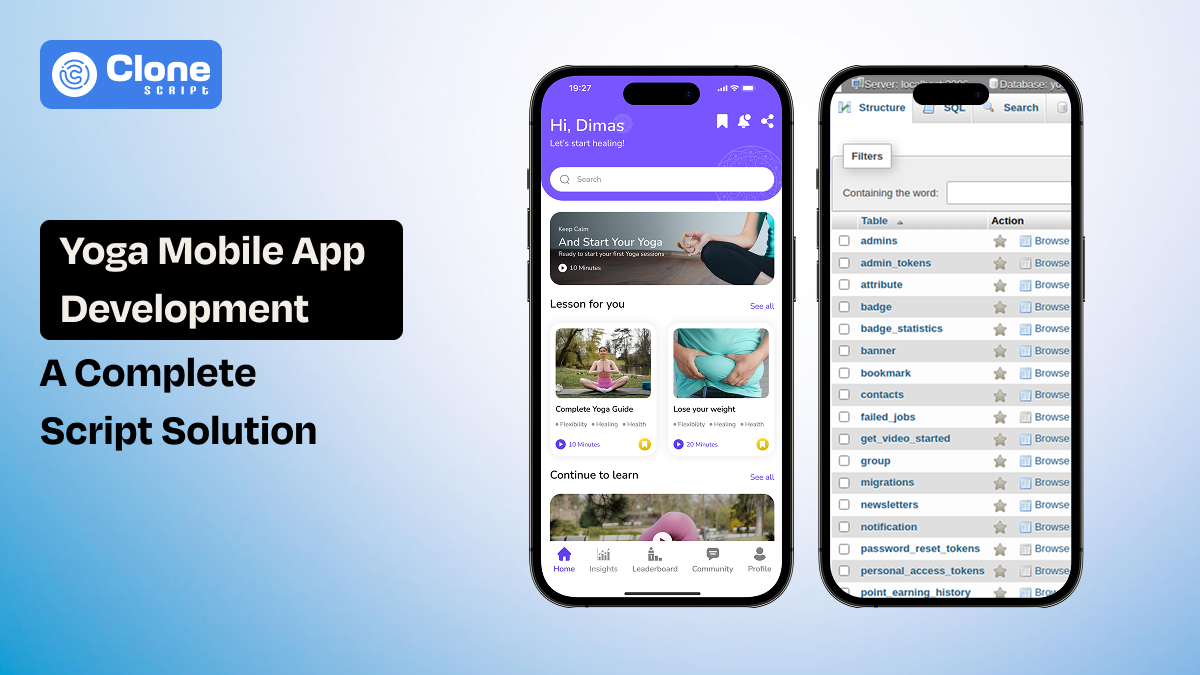
Build a Professional Yoga Training Mobile App With a Complete Script: An Agile Way for Today’s Needs
When a client asks you to develop a yoga mobile app with a minimal budget, you naturally wonder how it can even be possible. But, yes, it can be possible using a yoga app clone script that comes with yoga mobile app UI design to front-end and back-end support. It is a smart and budget-friendly choice.
You already know that building a mobile app from scratch is rarely as clean as it looks on paper. Requirements change. Features expand. Timelines slip.
Yoga apps, despite looking simple on the surface, are not simple to execute well. Video delivery, scheduling, subscriptions, progress tracking, and admin control all add layers you can’t ignore.
This is why choosing a yoga app script is not about cutting costs. It’s about choosing a development path that keeps you in control. This article is helpful for a development team who searching for a white-label solution to accomplish the yoga app development project with a top-quality service in an agile way.
What Clients Expect From a Budget-Friendly Yoga App?
When you work with yoga instructors, studios, or small wellness startups, you quickly notice a pattern. Most of them are not tech-first businesses. They are experience-first businesses. They care deeply about how the app feels to the user, but they don’t want to pay for months of back-end development engineering to get there.
You’re expected to balance three things at once:
-
Professional quality: The app must not feel cheap, as it is made with generic templates. Users compare it instantly with polished fitness apps already on the market.
-
Reasonable cost: Your client wants a predictable budget. Unexpected invoices damage client trust more than technical bugs. They will not agree to increase the budget later.
-
Fast delivery: Many yoga businesses work around seasons, instructor availability, or marketing campaigns. Delays in app development cost them real revenue.
Coincidentally, clients need flexibility in the app. Today, they want recorded sessions. Next month they want live classes. Three months later, they want subscriptions and challenges.
If you build everything from scratch, every one of those changes becomes expensive. If you start with a yoga class mobile app script, those changes become configuration and iteration, not reinvention.
Now, let’s see why agile development methodology is preferable in a yoga coaching mobile application.
Why Agile Development Works Best for Yoga Mobile Apps?
Yoga app projects rarely come with fully frozen requirements. Even when clients think they know exactly what they want, they change their minds once they see the first build-like prototype in Figma.
Agile development fits this reality because it allows you to:
-
Ship usable features early. Are they focusing on live yoga classes? You can implement it. If they need a conversion-driven pricing table, it can be done; if they require challenges to integrate it also happen.
-
Gather real feedback instead of assumptions. Once the features are implemented, the users can experience and give suggestions on what works well or what doesn’t. This saves time on rebuilding later, which increases overall costs.
-
Adjust priorities without ripping apart your codebase. By knowing what the client needs first, like a prototype or a feature experience, it can be preferred first, and the coding efforts can be optimized.
But the condition is that agile methodology only works when your foundation is stable. If your core architecture is shaky, every sprint becomes damage control.
When user flows, data models, and admin logic are already in place, then what?
You save time, reduce repetitive work, and complete the project before the deadline.
The complete white-label app scripts are optimized and support agile development instead of fighting it. You already have user flows, data models, and admin logic in place. Your sprints focus on refinement, not survival.
Instead of spending two weeks wiring authentication, you spend two days improving onboarding. Instead of debugging payment logic, you fine-tune subscription rules. In essence, agile becomes productive, not generic.
It’s a time to look at the features generally available in market-ready apps for yoga training.
6 Core Features Required in a Professional Yoga Mobile App
You can’t afford to “figure these out later.” If your app misses core features, users leave quietly and don’t come back.

-
User Accounts and Profiles
This is the first and most important feature of the app. Here, you need proper user registration, login, and profile management. This isn’t just about access, it’s about personalization. Users expect their preferences, progress, and history to follow them every time they open the app.
-
Structured Yoga Class Library
The classes the user attended, and the next steps, have to be organized properly in a way that makes sense to real users, not developers. Filtering by level, duration, instructor, or goal is not optional. If users can’t find the right class in seconds, they won’t search: They close the app and uninstall it.
-
Video Session Management
In yoga apps, the video session has become important to connect with thousands of users worldwide. Whether the instructor is looking to offer expert recorded sessions or live ones, the video should work smoothly, responsively, and consistently on every device.
-
Scheduling and Booking
If your app includes live or guided sessions, scheduling is mandatory. Users want to see upcoming classes, book slots for personalized training, and receive reminders without confusion. This feature can be important for getting users who are actively looking for an expert recommendation for personal fitness goals.
-
Progress Tracking
Yoga users may not track calories, but they track consistency. They check how they completed sessions, streaks, and milestones from day 1 to day 15 and so on. By showcasing achievements with motivational messages like “you’ve done it,” you keep users engaged long-term.
-
Online Payments Option
To accept the subscription fees online from users, the integration of a payment gateway is important. They can make payments through credit/debit cards, mobile banking, digital wallets, etc. For more options, you can accept payments in cryptocurrencies, too, like ETH or BTC.
4 Advanced Yoga App Features That Improve User Retention
Once the basic features are stable, this is where your app either grows or stalls. We are mentioning the advanced features of the yoga app.
-
Live Classes and Real-Time Interaction
Live sessions turn a static app into a community experience. They also introduce complexity: scheduling, streaming reliability, and attendance tracking. Having this module ready in a script saves you weeks of trial and error.
-
Leaderboards and Challenges
Yoga apps benefit from light gamification. Users want to find their names in a competition list. So, when the apps have different kinds of challenges and streaks with leaderboards that motivate users. This feature helps them not break the calm nature of yoga practice.
-
Push Notifications
Though spending thousands of dollars on marketing a yoga app, the push notifications do it for free. Improving user retention can be easily done with this feature, like reminding upcoming live sessions, payment scheduling, leaderboard achievement, and personalized recommendations, etc. Used poorly, they cause uninstallations. You need fine control over when and how notifications work in real-time.
-
Search and Smart Discovery
Implementing AI (Artificial Intelligence) in the mobile app works as a personalized assistant for users. As your content library grows, search becomes essential. Users won’t scroll endlessly to find the right class. AI systems help them to experience new classes based on their interests.
Advanced features should feel optional to the client, but available to you as a developer. That’s exactly what a modular yoga app script provides.
Knowing the features of online yoga apps is useful, but what the challenges associated with them is also important to know.
What are the Common Technical Challenges in Yoga App Development?
If you’ve ever built a wellness or fitness app from the ground up, you already know where things get painful.
-
Video optimization eats time. For example, 720p is a standard HD option, but it does not work well when the internet connection is not stable. You have to optimize for the best quality, as it does not affect the user experience.
-
Subscription logic creates edge cases. There are two logics: per-class subscriptions or month-wise payments. Some users prefer one while others like to get it in bundled offers. You have to talk with the client about what kind of subscription they want and implement it accordingly.
-
Admin panels grow messy fast. Yoga instructors need full control to upload videos, manage users, payments, and content changes. This requires more work to do as per their custom requirement.
-
Scaling issues appear earlier than expected. You assume the client needs a 500-user optimized app, but then they reach 5000, then what happens? You want to do the work now for it.
You also face hidden costs: QA and testing cycles stretch longer, bugs appear in unrelated areas, and timelines slip even when your code quality is good.
When clients ask why development takes longer than expected, explaining technical debt doesn’t help. Avoiding that debt in the first place does.
A ready-made yoga app script doesn’t eliminate challenges, but it removes the avoidable ones.
Why a Complete Yoga App Script Makes a Good Option for Developers?
Choosing a clone script solution with front-end and back-end gives leverage to the developer:
-
A tested architecture is already available. There is no need to plan the requirements and analyze them for acceptance. You can proceed further as soon as possible.
-
Predictable development timelines. As the UI design is appropriate, the coding is done in a recommended style, and the testing is easy, you can give the project a thumbs-up.
-
Reusable patterns like UI components and modular designs are available across projects. The icons, illustrations, images, sections, charts, and other assets are used in the app for brand consistency.
-
Faster onboarding for team members. Working with multiple developers, the script allows them to start work on the specific requirement rather than building it from the ground up.
Instead of estimating every feature from scratch, you work from known components. That alone improves accuracy, reduces stress, and builds client trust.
More importantly, you stop solving the same problems repeatedly. Your energy goes into solving new problems like custom workflows, branding, and unique client needs.
That’s how you scale as a developer or agency.
The question is, what is the choice for getting a yoga mobile app script and integrating it into the development flow?
We have it.
FitYoga App Script: A Ready-Made Foundation for Agile Development
When you look at the FitYoga App Script specifically, what matters is not the feature list. It’s how those features are structured.

In this script, you will get the following:
-
A Flutter-based mobile app for iOS and Android. We emphasize Flutter for cross-platform development. You can deploy the same code for the web version if the client wants.
-
A backend designed for real user volume. The back-end development has already been done in the script with the database design. So, you don’t have to be involved in the server-side coding tasks.
-
An admin panel that actually reduces support requests. The complete web admin panel helps you to manage the platform with ease.
-
UI assets that speed up branding changes. The yoga app Figma UI design is added to the prototype visualization, and you can take approval for it from the client.
This matters because agile development depends on iteration speed. When your script already separates user logic, content management, and admin controls cleanly, you can change one area without breaking another.
In essence, you’re not fighting the codebase. You’re building on it.
How Developers Can Customize a White-label Yoga App Script for Client Needs?
It’s a smart way to choose a clone script for the yoga app development, but what if the client wants customization? This is where you prove your value as a developer.
-
Branding
The white-label script is already optimized to adapt brand colors, fonts, layouts, and images. It means the app feels good for the client’s business, not a template-based one.
-
Feature Scope
If instructors need a competition organizing feature, then you can add it through a front-end and set it up with the back-end systems. You decide what to enable now and what to delay.
-
Monetization Logic
You can implement different kinds of revenue-generating options for the app, like subscriptions, in-app purchase integration, free trials, and premium content access. These rules vary wildly between clients. A flexible script lets you adjust without rewriting logic.
-
Integrations
To make the entire yoga mobile application work, third-party integrations from analytics, marketing tools, and payment gateways can be added without destabilizing the app. You can test every function before going on the web and handing over the app to the client.
We recommended that customization should feel intentional, not forced. A premium yoga app script supports that approach.
Cost Comparison: Custom Yoga App vs Script-Based Development
Now, the main factor comes: the cost of yoga app development. Look, you have two options: 1. Go with a custom-designed app from scratch, and 2. Use the script as a white-label solution. Which one suits your project depends on the client’s priorities and your efforts to put on.
The following comparison is based on typical small-to-mid scale yoga app projects with up to 10,000 users and standard monetization features.
Factor |
Custom Build |
White-label Script |
|---|---|---|
|
Upfront cost |
Usually high |
Lower initial investment |
|
Development time |
Around 3-6 months |
1-2 months |
|
Success rate |
Risky (introducing a new model) |
High (users already being familiar) |
|
Maintenance |
Requires more effort |
Easy to update with minimal work |
|
UI design |
Based on brand goals |
Pre-designed but customizable |
|
Tech stack |
Customizable |
Predefined but extensible |
|
Advanced Features |
Supports advanced features |
Need re-work to add |
|
Cost* |
$2000 - $50,000+ |
$1500 - $2500 |
* The cost of yoga app development is approximate. It may be changed.
For most yoga businesses, the script-based solution simply makes more sense. For you as a developer, it reduces working in the traditional development way on every project. It’s a smart option to opt for.
Go-to-Market Faster With a Yoga App Minimal Viable Product (MVP)
Launching an MVP is not about implementing fewer features for less work. It’s about validating direction.
With a yoga app script white-label solution, you can do:
-
Launch core functionality quickly. For example, a user registration through social channels, Google account with enhanced security.
-
Gather real user feedback. Take details about how the color is used, where the navigation bar should be, what payment options to include, and what rules to set for the yoga competition.
-
Improve based on actual usage, not guesses. Based on the features and experience, get information about what’s working well and where change is needed.
Clients appreciate seeing something real early. It builds confidence and often leads to extended development phases instead of cancellations.
Here, app development completion matters. Scripts give you that advantage without sacrificing quality.
Who Should Use a Ready-Made Yoga App Script?
Generally, a complete development script, also known as a white-label solution, requires setup as well, and for that, the following personas can use it. You benefit most from a yoga app script if:
-
You’re a freelancer managing multiple clients. Accomplishing the project within a timeline and with minimal effort can be useful.
-
You run a small or mid-sized development agency. Working with 15-50 developer colleagues and maintaining other projects, the script is the right solution.
-
You build wellness apps repeatedly. For niche-specific app development, you can depend on the scripts as they allow you to offer a quick solution to the client.
-
Your clients value speed and cost control. When a client needs a custom yoga app with a budget, a script can be a perfect choice, as they get a functional and live app on the web.
If every project starts from zero, your growth stays limited. Scripts change that equation.
Final Thoughts
Choosing a yoga app script is not about avoiding development work. It is about reducing unnecessary complexity, controlling costs, and delivering stable applications faster. For developers working with budget-conscious clients, a complete yoga app clone script provides the balance between flexibility, speed, and long-term scalability.