BTC - Bitcoin
 USDTERC20 - USDT ERC20
 ETH - Ethereum
 BNB - Binance
 BCH - Bitcoin Cash
 DOGE - Dogecoin
 TRX - TRON
 USDTTRC20 - USD TRC20
 LTC - LiteCoin

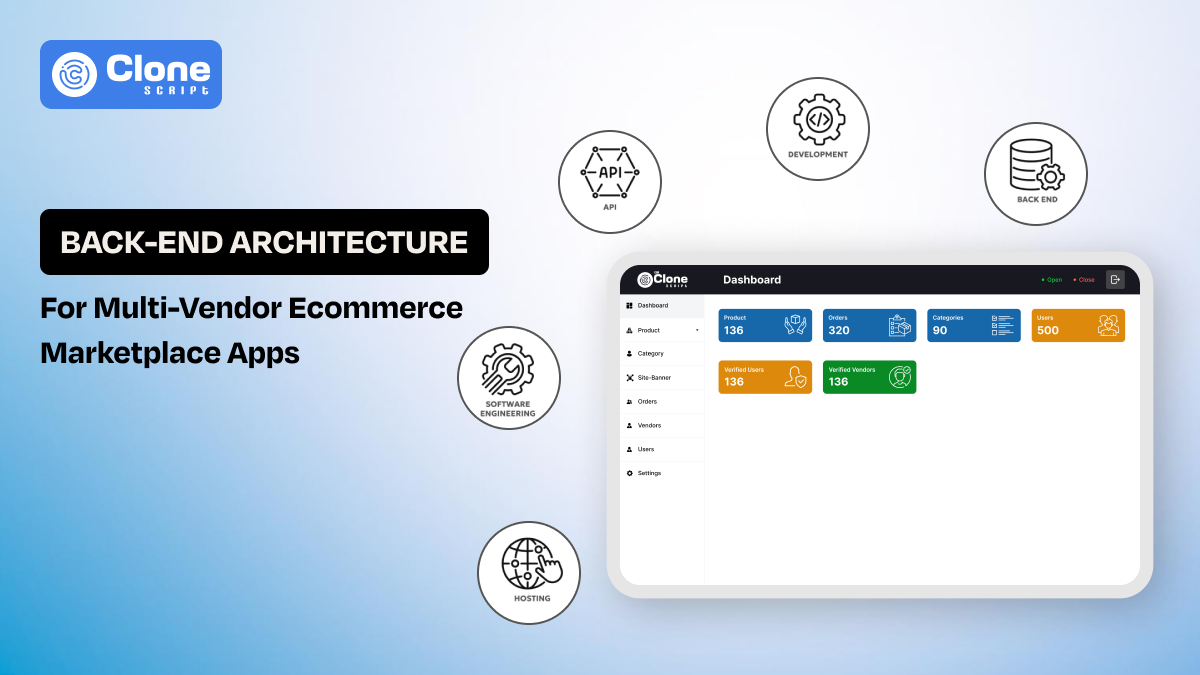
Back-End Architecture for Multi-Vendor Ecommerce Marketplace Apps
Launching a multi-vendor ecommerce marketplaces are infrastructure-heavy system. Unlike single-store ecommerce apps, marketplaces must support multiple sellers, dynamic commissions, complex order flows, and scalable transaction processing.
Platforms like Amazon, Flipkart, and Etsy did not scale because of front-end design. They scaled because their back-end architecture was engineered for multi-tenancy, distributed workloads, and high concurrency.
If you plan to launch a marketplace without coding or build one from scratch, understanding back-end architecture is non-negotiable. This guide breaks down the complete architectural structure without oversimplifying the technical depth.
Why Back-End Architecture Determines Marketplace Success
A complete marketplace back-end must support 1,000+ vendors, 1M+ SKUs, and thousands of concurrent users per minute without facing issues. It manages automated commission splits (5–30%), provides real-time notifications in milliseconds, facilitates secure payment settlements, and offers vendor-level analytics dashboards.
When architecture is weak, order failures spike during peak traffic, commission calculations drift, and settlement delays increase. Scaling the platform will then cost 2–3× more than planned. Back-end architecture is a technical detail that directly controls growth, profitability, and platform trust.
Architectural Layers of Multi-Vendor Ecommerce Marketplace
A scalable multi-vendor marketplace back-end development is structured into three tightly integrated layers, each made for performance and control.
-
Presentation Layer
This layer includes web apps, mobile applications, admin dashboards, and vendor panels. It handles user interaction but should remain decoupled from business logic. In modern architecture (2026 standards), the front-end communicates strictly through APIs.
Best practice: Adopt an API-first model and enable headless commerce capability to support omnichannel experiences and faster UI iterations.
-
Application Layer (Business Logic)
This is the operational core. It manages vendor onboarding, product approvals, order lifecycle orchestration, automated commission calculations (often 5–30%), refunds, and dispute resolution. Most marketplace complexity exists here, especially during high-traffic events.
-
Data Layer
This layer stores product catalogs, vendor records, transaction logs, inventory states, and settlement data. It is required to manage overall security for the application.
Critical recommendation: Apply vendor-level data isolation and implement proper indexing for search-heavy queries to maintain speed at scale.
Essential Back-End Modules in Marketplace Apps
A production-ready marketplace requires tightly integrated modules designed for scale, security, and financial accuracy.
-
Authentication & Role Management
First, support buyer, vendor, admin, and sub-admin roles with strict permission boundaries. Then, implement JWT-based authentication for stateless sessions and apply Role-Based Access Control (RBAC) to prevent privilege escalation and cross-vendor access.
-
Vendor Management System
This module handles KYC verification, document uploads, approval workflows, commission configuration (typically 5–30%), and performance analytics dashboards. The system must support 1,000+ concurrent vendors without query slowdowns or reporting lag.
-
Product Catalog Engine
A scalable catalog supports unlimited SKUs, vendor-specific pricing, attribute-based filtering, and bulk imports. For high-performance search across 100K–1M products, integrate Elasticsearch with category-based indexing.
-
Inventory Synchronization
Real-time stock updates prevent overselling in the app. Use atomic database transactions and queue-based inventory processing to handle high-volume order bursts reliably. This maintains the overall load of the system that not result in issues that vendors have to face.
-
Order Management System (OMS)
The OMS must orchestrate multi-vendor cart splitting, vendor-specific shipping, live status tracking, and partial refunds. Only a common failure point in weak architectures puts the credibility at risk.
-
Payment & Commission Engine
Make sure to allow split payments, automated commission deductions, vendor payouts, and refund adjustments. Integrate secure payment gateways like Stripe, Razorpay, or PayPal, and maintain full PCI compliance to protect transaction integrity.
Architecture Models for Marketplace Apps
Your architectural model directly affects performance, scalability, infrastructure cost, and long-term maintainability. Choosing the wrong model can double operational expenses within 12–18 months.
-
Monolithic Architecture
A monolithic system runs on a single codebase with unified deployment. With this architecture, the advantages are very helpful. For example, faster MVP development could be possible with a 30-40% quicker time. At the same time, monolithic architecture makes debugging easier due to centralized logic. Also, the lower initial infrastructure cost is driving adoption for this system.
There are also limitations. Like, when you need to scale it, it requires you to duplicate the entire application. Additionally, tight coupling increases technical debt. In this architecture, codebase complexity grows rapidly beyond 100K+ lines.
This model is best suited for early-stage MVP marketplaces that are validating demand before heavy traffic.
-
Microservices Architecture
Independent services manage authentication, orders, payments, vendor management, and analytics. They can depend on a microservices architecture because it offers advantages like horizontal scalability under high traffic. Also, the fault isolation (one service failure doesn’t crash the platform). By choosing this architecture, you can have independent deployments and updates.
The challenges of this architecture require advanced DevOps and orchestration. Deploying a microservice, it requires higher infrastructure and monitoring costs. It also increased system complexity.
Microservice is best suited for high-growth marketplaces expecting 10,000+ daily active users.
-
Serverless Architecture
Event-driven execution using cloud-managed services and the serverless architecture becomes important. This system's advantages include pay-per-execution pricing, automatic scaling, and minimal server maintenance.
The limitations of serverless architecture are cold-start latency issues and dependency on cloud provider ecosystems.
This architecture is best suited for startups validating marketplace ideas with controlled traffic expectations.
Prominent Database Design for Multi-Vendor Systems
Database architecture directly determines query speed, transaction reliability, and long-term scalability. In multi-vendor marketplaces handling 100K–1M+ products and thousands of daily transactions, poor schema planning becomes a performance bottleneck.
Here is an overview of what you have to consider.
-
SQL vs NoSQL
Choose based on workload characteristics:
|
Use Case |
Recommendation |
|---|---|
|
High-volume transactions, ACID compliance |
PostgreSQL |
|
Flexible product attributes, dynamic schemas |
MongoDB |
|
Complex systems with mixed workloads |
Polyglot persistence (SQL + NoSQL combined) |
Transactional consistency (orders, payments, settlements) should always prioritize relational databases.
-
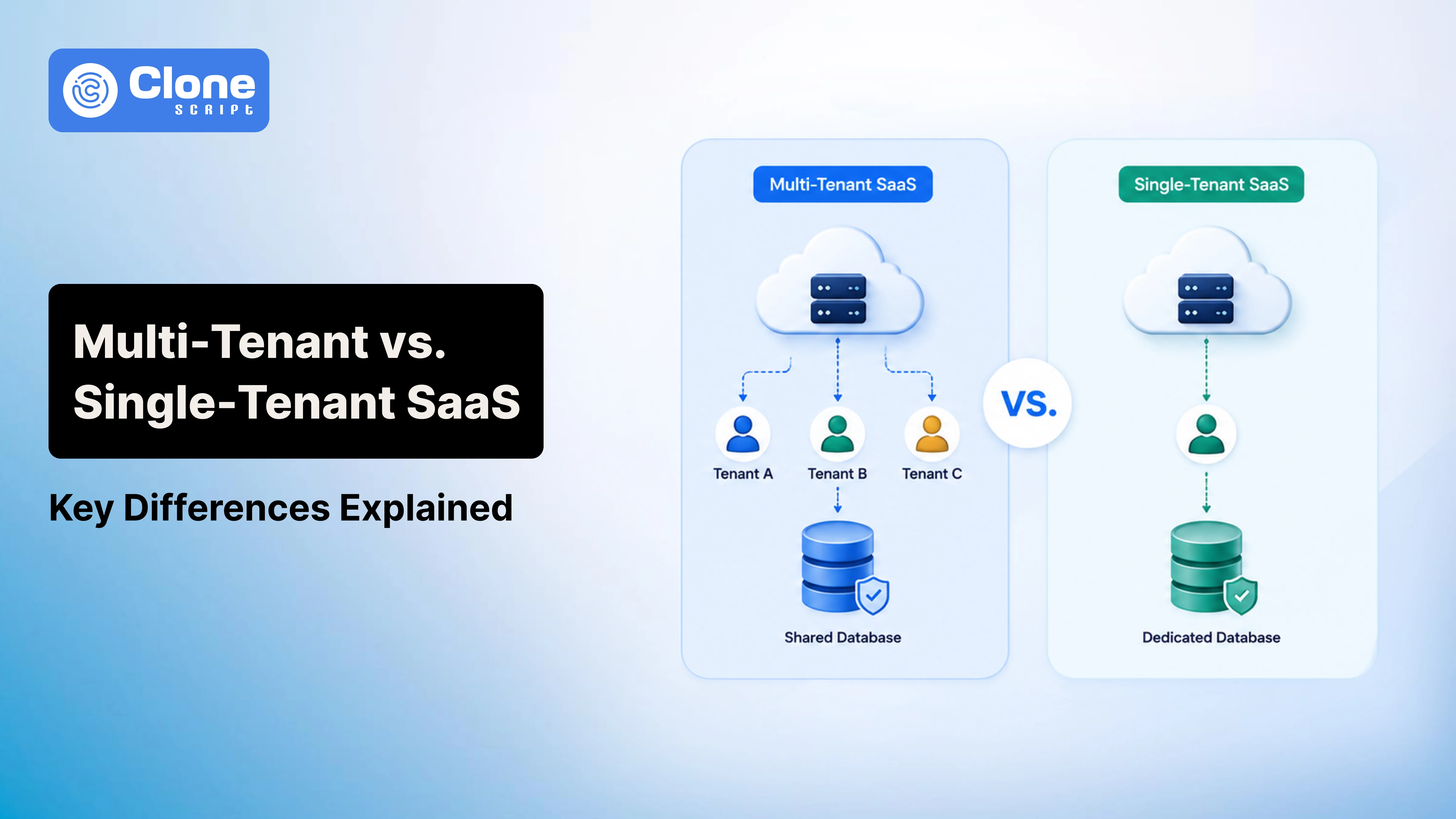
Multi-Tenant Strategy
There are three common models to implement for the marketplace:
-
Shared database, shared schema
-
Shared database, separate schema
-
Separate database per vendor
For most startups, a shared database with vendor ID isolation provides the best balance between cost and scalability. It simplifies maintenance while ensuring logical separation of vendor data.
-
Caching Strategy
To reduce ecommerce platform database load by 40–70% during peak traffic, you have to apply these ways:
-
Use Redis for session and frequently accessed data caching.
-
Implement a CDN for image and media assets.
-
Enable query-result caching for popular product listings.
Strategic caching prevents database overload and improves response times under high concurrency.
API Architecture Becomes Important for Ecommerce Marketplace
Modern marketplace applications are API-driven systems, where every interaction, product browsing, cart updates, payments, and vendor actions flow through structured endpoints. A well-designed API layer ensures scalability, security, and maintainability across web, mobile, and third-party integrations.
-
REST vs GraphQL
REST remains widely adopted due to its simplicity and predictable resource-based structure. It works well for standardized operations such as order creation, authentication, and vendor management. REST is easier to cache and simpler to implement for MVP marketplaces.
GraphQL, on the other hand, allows clients to request only the data they need. This reduces over-fetching and improves performance in complex product catalogs with multiple attributes. It is particularly useful when mobile apps require optimized payload sizes.
In high-scale environments, some platforms combine both approaches depending on the use case.
-
API Gateway
An API gateway acts as the centralized control layer. It manages authentication and token validation along with support for rate limiting to prevent abuse. This is also important for intelligent request routing to services and managing logging and performance monitoring.
For microservices-based marketplaces, an API gateway is essential to maintain system integrity and observability.
Marketplace App’s Security Architecture.
Marketplace platforms process sensitive financial data, personal identities, and transaction records, making security architecture a core operational requirement, not a feature add-on. A single breach can erode vendor trust and trigger regulatory penalties.
Here are the critical components to know.
-
Role-Based Access Control (RBAC): Apply strict permission boundaries between buyers, vendors, admins, and sub-admins.
-
HTTPS Enforcement: All data in transit must use TLS encryption to prevent interception.
-
Data Encryption at Rest: Encrypt databases and backups to secure stored payment and identity data.
-
Payment Tokenization: Avoid storing raw card data. Use gateway-issued tokens instead.
-
Secure File Upload Validation: Scan vendor-uploaded documents and media to prevent unneeded payloads.
-
Fraud Detection Systems: Implement behavior monitoring to detect false transactions or account misuse.
Ongoing Security Operations
-
Conduct regular penetration testing (at least annually).
-
Maintain strict dependency patching cycles.
-
Continuously monitor emerging CVEs affecting your tech stack.
Security in marketplaces is a continuous engineering discipline, not a one-time implementation.
Scalability & Performance Engineering in the Marketplace.
Marketplace traffic is rarely linear. A platform may handle 2,000 concurrent users on a normal day and spike to 20,000+ during sales or festive campaigns. Vendor onboarding drives additional load through bulk product uploads and catalog indexing. Architecture must be engineered for these unpredictable surges.
Prepare the marketplace app for the following: new sales generating 5–10× normal traffic, vendor onboarding spikes with thousands of SKU imports, and seasonal traffic peaks during holidays or campaign launches.
Infrastructure strategies to implement.
-
Load Balancers: Distribute incoming requests evenly across servers to prevent overload.
-
Horizontal Scaling: Add additional application instances instead of upgrading a single server.
-
Message Queues (RabbitMQ / Kafka): Handle asynchronous tasks like email notifications, inventory updates, and payment confirmations.
-
CDN Integration: Offload static assets (images, videos, scripts) to reduce origin server pressure.
Asynchronous processing is required. It separates heavy background tasks from real-time user interactions, preventing request issues and maintaining consistent response times under high concurrency.
DevOps & Deployment Strategy in Ecommerce Marketplace.
A scalable marketplace back-end cannot depend on manual deployments or reactive maintenance. As traffic grows beyond 5,000–10,000 daily active users, operational complexity increases exponentially. DevOps automation becomes essential to maintain uptime, deployment speed, and system stability.
Core components to focus on.
-
CI/CD Pipelines: Automate testing and deployment to reduce release cycles from weeks to hours while minimizing production errors.
-
Docker Containerization: Package services with consistent runtime environments, eliminating “works on my machine” issues.
-
Kubernetes Orchestration: Manage container scaling, service discovery, and auto-healing during infrastructure failures.
-
Centralized Logging (ELK Stack): Aggregate logs across services for faster debugging and root-cause analysis.
-
Real-Time Monitoring: Track CPU usage, memory, response times, and error rates to detect anomalies before users are affected.
Without structured DevOps processes, scaling leads to downtime, deployment conflicts, and untraceable failures. Automation ensures predictable growth and operational resilience.
Build vs Buy: Should You Launch a Marketplace Without Coding?
This decision directly impacts capital expenditure, time-to-market, and long-term scalability. Founders must evaluate technical capacity, funding runway, and growth projections before committing.
Option 1: Custom Development
Building ecommerce multivendor marketplace from scratch provides complete architectural ownership with advantages like full control over infrastructure and feature roadmap. There is a custom scalability aligned with projected traffic (10K–100K+ users) and flexible integration with third-party services.
The disadvantages of custom development are higher costs 2-4x than upfront investment that startups can’t afford. Also, a 6–12 months average development timeline has to be wait. It requires an experienced technical team and DevOps support.
Custom development is suitable for well-funded startups with long-term technical vision.
Option 2: White Label / Clone Script Marketplace
Pre-built marketplace frameworks significantly reduce complexity. Using the white-label marketplace launching time will be reduced from months to some weeks than months. It also demands lower upfront investment with pre-configured back-end architecture.
Built-in vendor management, payment, and commission modules are also available.
When it comes to the challenges for clone scripts, the limited deep-level architectural customization makes it tough to have a branded marketplace. There is a requirement for dependence on the solution provider for core updates.
For non-technical founders aiming to launch a marketplace without coding, white-label solutions provide the most practical entry path. As traction grows, migration to microservices-based custom infrastructure becomes strategically viable.
Tech Stack Recommendations in Marketplace App (2026)
Selecting the right tech stack determines development velocity, scalability ceiling, and long-term maintenance cost. In 2026, cloud-native and API-first stacks dominate marketplace infrastructure.
-
Back-end Frameworks
Prefer these back-end frameworks in development.
-
Node.js (Express / NestJS): This is ideal for high-concurrency environments. Non-blocking I/O makes it suitable for real-time updates and event-driven workflows.
-
Django: Django is a strong framework for rapid development with built-in admin, ORM, and security features. It is excellent for transaction-heavy systems.
-
Laravel: Developer-friendly PHP framework with robust ecosystem support and faster MVP development cycles.
Using a server-side framework as per the requirement makes the task optimzed.
-
Databases
In the marketplace, database selection plays a key role.
-
PostgreSQL: This is the best for transactional consistency, ACID compliance, and complex relational queries (orders, settlements).
-
MongoDB: It is suitable for flexible product schemas and dynamic attribute management.
Database technology is required to make a platform more secure.
-
Cloud Infrastructure
Here are options for a cloud server that manages the entire store on the web.
-
AWS: It is known for a mature ecosystem with advanced scalability tools.
-
GCP: For Strong data analytics and container support, you can use this cloud service.
-
Azure: Known for its enterprise-focused integrations and hybrid cloud capabilities.
The proper cloud infrastructure makes the performance more perfect.
-
Search Engine
Elasticsearch enables high-speed filtering, full-text search, and scalable indexing for 100K–1M+ SKUs. Prefer it for a responsive and fast-loading marketplace.
-
Payment Gateways
There are two choices.
-
Stripe: It is known for global payment processing with strong API support.
-
Razorpay: This is optimized for Indian market transactions and compliance.
Payment gateway integration is required for accepting online payments, processing transactions, and issuing refunds securely.
Conclusion
Marketplace success is not determined by UI design. It is determined by stability under load, accurate commission logic, secure payment processing, vendor satisfaction, and seamless scaling.
Whether you choose custom microservices or launch a marketplace without coding using a white-label back-end, the architectural foundation must be strategically planned.
Build smart. Scale deliberately. Develop for growth from day one.