BTC - Bitcoin
 USDTERC20 - USDT ERC20
 ETH - Ethereum
 BNB - Binance
 BCH - Bitcoin Cash
 DOGE - Dogecoin
 TRX - TRON
 USDTTRC20 - USD TRC20
 LTC - LiteCoin

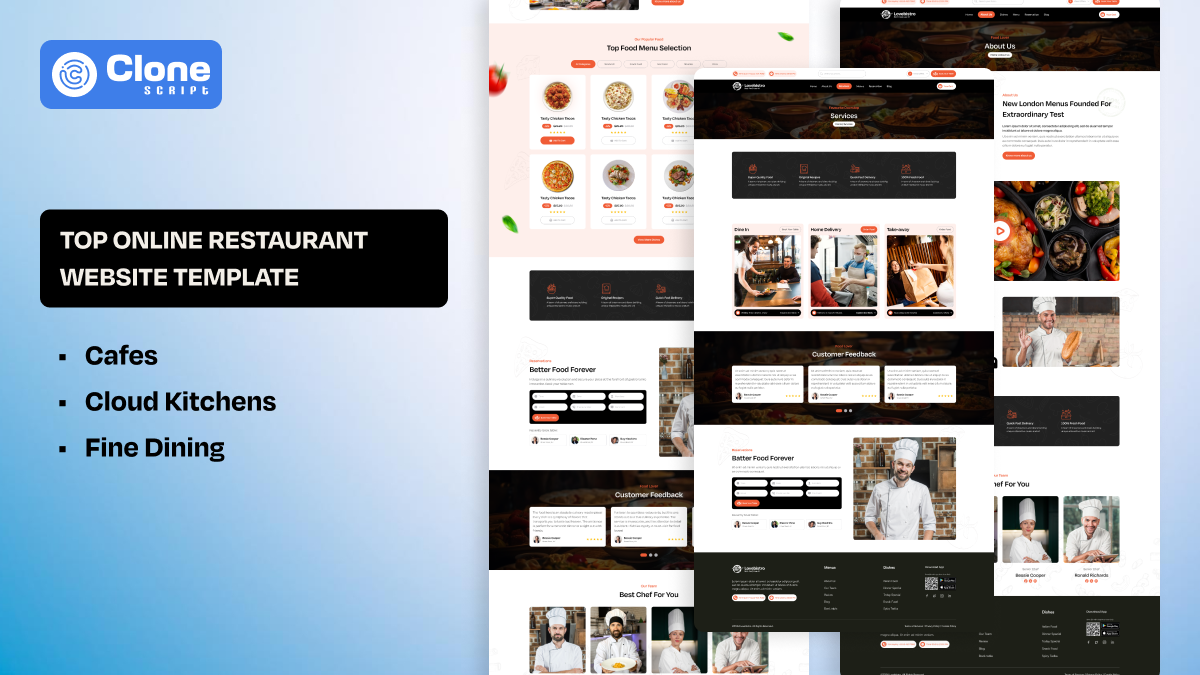
Top Restaurant Website Template for Cafes, Cloud Kitchens, and Fine Dining Front-end Website
In 2026, a branded restaurant website is a business asset. Why? Because it helps customers to feel a virtual experience of menus, online reservation, and convenience before they visit a location or place an order. The cost of a custom website development remains $5000 to $50,000.
So, what’s the solution that remains smart, scalable, secure, and cost-effective?
The restaurant website templates have come out as a practical solution without long development cycles. These templates are optimized for brand positioning while supporting SEO, online ordering, and local discovery.
This article will help you to understand the importance of templates, their features, customization possibilities, and the approach for development.
What Website Needs by Restaurant Types?
Every different restaurant formats serve different customer behaviors. A single website layout rarely fits all unless it is designed with flexibility in mind. Here are some types of restaurant websites that need to be known.
-
Cafes and Quick-Service Restaurants
Cafes' revenue relies on repeat visits, visual appeal, and local foot traffic. Their websites must support fast browsing and immediate access to essential information.
These websites’ key needs include:
-
A clear display of menu items and pricing will increase accessibility.
-
The proper location details, clear opening hours, and map integration increase repeat visits.
-
The mobile-first design is required for customers searching on the go.
-
Strong branding through colors, typography, and imagery improves the engagement rate.
-
Quick CTAs such as “View Menu” or “Visit Us Today” keep the bounce rate lower, and the conversion rate will improve.
For cafes website, simplicity and speed matter more than complex functionality. Note this aspect.
-
Cloud Kitchens & Delivery-Only Brands
Cloud kitchens operate without dine-in experiences, making the website a primary conversion channel. Every design element should guide users toward placing an order.
These websites have the following requirements:
-
A prominent “Order Online” CTAs through homepages, menu pages, and item page keep the users aligned with what to do.
-
Optimized landing page designs for delivery areas to attract more interested users to make an order for their location easily.
-
Integration readiness for ordering systems or APIs allow to work with the back-end systems properly.
-
Minimal distractions and focused user journeys improve conversions and make marketing campaigns optimized for ROI.
-
Fast load times for mobile networks are related to the back-end management and have to be used for it.
In essence, cloud kitchen websites prioritize conversion efficiency and SEO-driven visibility over visual storytelling.
-
Fine Dining & Premium Restaurants
Fine dining websites focus on experience, exclusivity, and storytelling. The goal is to build anticipation and justify premium pricing.
These websites have to be optimized for the following:
-
High-quality visuals and refined layouts allow users to visit more sections and take the preferred action.
-
Reservation-first UX design guides users on what to do and helps them to fulfill their requirements at ease.
-
Space for brand story, chef profiles, and ambiance keeps users' trust alive before they make a decision to visit the restaurant.
-
Elegant typography and restrained animations are required to manage the website at professional scale.
-
Trust signals such as awards, reviews, and press mentions are improving the brand message and giving users confidence to visit the restaurant.
For premium restaurants, design consistency and emotional appeal are as important as functionality.
Essential Features of a High-Performing Restaurant Website Template
Regardless of restaurant type, certain features define the effectiveness of a restaurant template.
-
Mobile-First and Fully Responsive Design
This is the first and most important feature of any online food restaurant website template. Usually, customers like to search for information about cafes or dining places on their mobile devices. The premium templates are optimized for a smooth user experience, so whether the customer visits the cafe website on a mobile device, tablet, or desktop, the same visibility increases trust.
So, the restaurants have a chance to increase the order value and bookings as the website’s user experience is optimized. In addition, search engines use mobile usability as a key factor for ranking websites. So,
-
Fast Loading Speed and Optimized Performance
Only a mobile-optimized template for an online restaurant is not enough. With it, the site has to be optimized for a loading speed and proven performance.
For example, a user visits the website and tries to open the menu page, but it takes 30 seconds to load properly. This results in frustration and zero order value.
Thus, high-performance website templates are preferable as they include well-written code, optimized image files, and lightweight website frameworks. so that pages load quickly.
This benefits page speed, increases the page's core web vitals (metrics that define web page success), decreases bounce rates, and enhances the browsing experience on websites that include plenty of menus and photos.
-
SEO-Friendly Structure and Clean HTML
When selecting a template to make your restaurant website front-end development task easier and agile, make sure to check the SEO-friendly structure and HTML layout:
-
A good heading structure
-
A navigational structure that is searchable
-
Use a clean HTML code structure
This combination allows search engine crawlers to scan the website and understand the menu pages, locations (city, state, etc.), and services offered by the restaurants.
-
Menu-Focused Layout and Easy Content Management
Historically, menus are the most essential part of a restaurant's website. A well-developed template will display menus in a clear manner with legible fonts and categorized items to ensure visual symmetry.
Since easy content management allows restaurants to make updates (e.g., price or dish changes) without needing any technical knowledge, content remains up-to-date and accurately reflects the menu.
-
Clear CTAs for Orders and Reservations
Premium cafe and fine dining website templates feature CTAs (e.g., "Order Online", "Reserve a Table", or "View Menu") prominently throughout the site.
At the same time, proper placement of CTAs allows users to move throughout the site to take action, improving conversions and supporting the differing nature of the various restaurant types within the site (i.e, café, cloud kitchen, fine dining).
-
Customization Flexibility for Different Restaurant Types
A scalable restaurant website template should be developed for cafés, cloud kitchens, or fine dining. Flexible sections and reusable UI components combined with customizable styles allow a restaurant to align its design to create a cohesive brand. With it, maintaining performance, SEO structure, and usability regardless of the type of restaurant is easy.
-
Integration-Ready for Third-Party Tools
Typical modern restaurant websites will require multiple integrations (e.g., reservation systems, payment processors, delivery options, and analytical systems). A scalable restaurant website template is designed for compatibility with third-party APIs and tools. Therefore, a restaurant can extend the functionality of its website as the business continues to evolve.
These features can be found in free website templates, but their restricted mode makes the development efforts complex. At the same time, using premium design and front-end coded templates for a restaurant website saves you 60-65% of a ground work. It’s a good deal after all for your web development agency.
Restaurant Website Templates Design & UX Best Practices to Follow
Effective restaurant website design is driven by user intent. These UX practices make it preferable in terms of usability and accessibility.
-
Homepage clarity: Through this bisitors should immediately understand what the restaurant offers and what action to take next. The hero section of the website plays a key role here with the H1 title, H3 branded description, and CTA.
-
Visual hierarchy: The restaurant menus, CTAs, and key information must stand out without overwhelming the layout. It is required for a user experience.
-
Consistent branding: The branded fonts, colors, and imagery should reflect the restaurant’s identity across all pages.
-
Accessibility considerations: Readable fonts, sufficient contrast, and intuitive navigation improve usability for all users.
-
Minimal friction: Every additional click reduces conversions. Design should shorten the path to action. Check if adding a new feature makes users feel interested or bored.
Website templates that follow these UI design principles perform better across different restaurant formats.
Looking for a premium front-end optimized website template to use for restaurant website development? We have it.
LoveBistro: Recommended Bootstrap Template for Cafes, Cloud Kitchens, and Fine Dining
For businesses seeking a flexible and performance-focused solution, the LoveBistro: Cafe and Restaurant Bootstrap and Tailwind CSS Website Template offers a strong foundation.
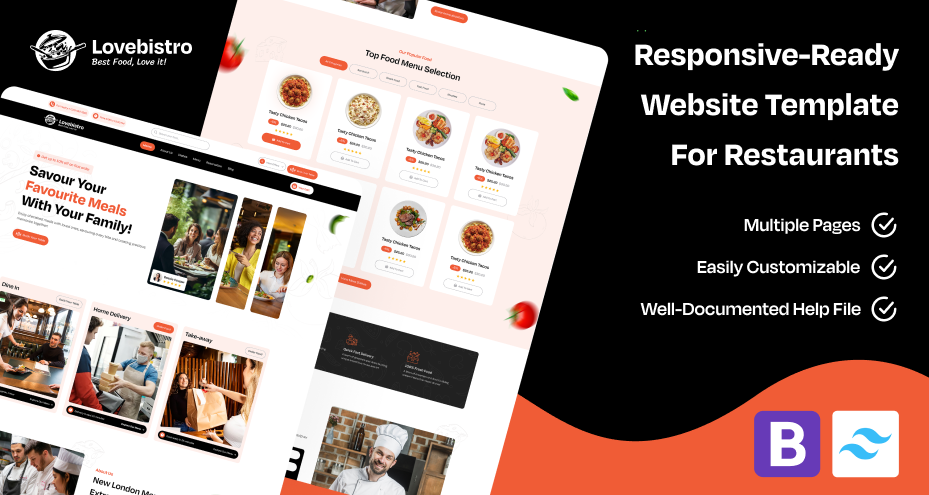
This template is built using front-end UI frameworks, combining structural reliability with modern utility-based styling. The result is a clean, adaptable layout suitable for cafes, cloud kitchens, and fine dining restaurants.
Why this template works across restaurant types:
-
Responsive, mobile-first design optimized for speed.
-
Categorized areas for menu, gallery, testimonials, and CTAs.
-
Premium graphic layout that can fit both casual and high-end brands.
-
Developer-friendly code for quick modifications.
-
Best option for restaurants with one location or multi-location franchises
This template is especially great for agency, startup, and restaurant owners who desire a professional web presence without starting from scratch.
How to Customize One Template for Different Restaurant Models
A good quality template will enable you to build websites for numerous different types of restaurants; therefore, you will want to use customized solutions to achieve the exact branding and messaging required for each type of restaurant.
-
For cafes:
When working with a cafe restaurant template, you should:
-
Promote the menu preview and store address. Describe the cafe's type of cuisine and how to get there.
-
Use comfortable formatting and easy-to-see typography. Many cafes use bold, bright colors like red or yellow to create a more fun, casual feel. Typography must be readable and also fit the branding message.
-
Place an emphasis on daily specials or special deals. Cafe restaurant websites prefer to have more visitors when they highlight their daily specials or deals at the top level of the navigation menu. This can greatly improve conversion rates.
-
For cloud kitchens:
The cloud kitchens site needs to have customized templates applied:
-
CTAs should be the first content shown on the site as they encourage customers to connect with the provider.
-
Ensure no unnecessary visual elements on each page that are not also on the homepage (i.e., testimonial; Instagram feed) that will impede the customer experience.
-
Ensure that all content on the site is optimised with keywords related to delivery. This is another aspect of SEO, but it is important to ensure you leave the sales website with a good level of optimised content.
-
For fine dining:
The website will differ from cafes and cloud kitchens, and therefore, there is plenty of room to create the following through customization:
-
Increase the size of the story section, i.e., best restaurant for birthday celebrations or corporate event celebrations, to encourage as many people as possible to visit the restaurant.
-
Use a higher quality palette and typeface, as it can be directly impacted by conversion and bounce rate on the site. Do not use colours too warm for easy reading, but make them easy to scan. Choose the type of typeface for the appropriate brand.
-
The primary focus for your CTAs should be on reservations and indirectly offer visitors a secondary option (purchasing food). The online restaurant industry should include the ability of users to book tables or halls for events; therefore, table reservations should have priority as a primary CTA.
The addition of purchasing options can serve as a secondary CTA.
By modifying how layout blocks, CTAs, and content hierarchy are utilized, we can implement one template for multiple use cases to meet different business objectives.
What to Do After Purchasing a Restaurant Website Template to Make It Live
By purchasing a restaurant template, you are purchasing only the structure of your website. Each front-end, back-end, database, and deployment phase needs to be addressed to create a fully functional website. Each phase will help ensure the website functions effectively and performs efficiently in preparation for real users.
-
Front-End Setup
Most of the work on a website template has already been completed in front-end development for the restaurant, but you will need to customize the front-end as part of the restaurant website design process.
As you build the front-end website, go through the website template and replace all of the placeholder text and images with your actual menu items and food pictures, as well as your restaurant's branding colors and fonts.
You also want to optimize your website images to keep your website loading fast without sacrificing quality. In addition, you want to ensure that the layout of the restaurant website will be usable on mobile devices since a large percentage of users searching for restaurants will be using their mobile phones to browse.
To help make it easy for restaurant customers to get the information they need, you will also want to have clearly defined call-to-action (CTA) buttons on your website so that customers can easily find how to order food online, make a table reservation, and contact the restaurant.
-
Back-End Integration
The next step in the restaurant website design process will be focusing on back-end development. After you have completed the customization of the front-end of your restaurant website template, you will connect your template to a content management system (CMS) or back-end framework that meets your needs.
In addition, you may have to add functional back-end logic to the contact form, table reservations, or order management. Also, you may need to add a payment gateway integration or a third-party food delivery service for customers to place online orders.
-
Database Configuration
Once you have optimized your restaurant's website front-end and have completed all the back-end development tasks, you need to create a database for your restaurant's website.
To create a website database, you will need to create the appropriate database tables for your restaurant's menu items, orders, table reservations, and user information. You want to use a robust database such as MySQL, PostgreSQL, or MongoDB with proper security and backup measures applied.
-
Deployment
This is the last phase of the website development for the cafe and dining industry. At this stage, you should have chosen a hosting provider, uploaded all of your project files, configured your domain and SSL certificate, and tested every user flow before going live. Development of a website should have an established launch procedure to ensure the long-term viability, performance, and scalability of the website.
However, the time for completion of the website development project may not be the same due to the addition of other functionality that the client may request.
What Mistakes to Avoid for Restaurant Templates Selection
Selecting the wrong restaurant website template can lead to long-term performance issues and usability problems. Listed here are some of the errors you should avoid making when selecting a front-end optimized template.
-
Selecting visually heavy templates that load slowly.
One of the most common mistakes made when selecting a restaurant website template is selecting a visually heavy template that is based on large images, animations, or excessive use of external scripts to create and display those templates.
Although visually-heavy templates look very impressive on the screen, they load slowly, resulting in a poor user experience. Solving the problem of slow-loading templates is done through optimization of the code, which can take up time and effort to do so.
-
Ignoring mobile-first behavior.
Another common mistake that people make is to disregard mobile-first usage behavior. Most of the people who visit a restaurant website are busy looking at the menu, location, and how to order. The templates that do not focus on the usability of the mobile version of the website will have high bounce rates and lost conversions.
-
Choosing templates without an SEO-friendly structure.
SEO friendliness is a common problem among many businesses. These templates will often not have clean HTML, a proper heading hierarchy, or a logical page layout to allow potential customers to be visible in the search engine results pages from the beginning. Poor brand and marketing return on investments (ROI) can also occur due to the impact of non-SEO-friendly templates.
-
Over-customizing without performance testing.
Restaurant brands often successful to stand out from their competitors by requesting that the development teams make excessive customizations of templates without conducting any performance tests. For instance, if a restaurant requests that a 2-minute-long video be placed before the hero section, the site’s load times will be dramatically impacted, and users will experience lag when they try to access the site.
-
Using generic layouts that fail to reflect brand identity.
Lastly, using generic layouts that do not reflect the brand identity will have a negative impact on customer trust and differentiation. A template should be a verbal representation of your restaurant’s personality rather than eliminating it. Utilize a paid website template that has an appropriate frontend framework.
By avoiding the above mistakes, developers will be able to save time during the development process and support the growth of a sustainable business.
Final Thoughts
The selection of a website template is critical to the success of a restaurant's website. Restaurants exist in varying types (e.g., Cafes, Cloud Kitchens, Fine Dining), and therefore provide different user experiences or "customer journeys", but they all share the same fundamental attributes - Speed, Clarity of Information, and Conversion-Oriented Design.
The template that is presented above, "LoveBistro: Cafe and Restaurant Bootstrap and Tailwind CSS," is the best choice for your restaurant website template. Purchase this template and complete your essential development phases to make your website live.