BTC - Bitcoin
 USDTERC20 - USDT ERC20
 ETH - Ethereum
 BNB - Binance
 BCH - Bitcoin Cash
 DOGE - Dogecoin
 TRX - TRON
 USDTTRC20 - USD TRC20
 LTC - LiteCoin

Taxi App Revenue Models: How Ride-Hailing Apps Actually Make Profit
A taxi app doesn’t become profitable the moment rides start happening.
In fact, most ride-hailing platforms generate steady bookings long before they generate consistent profit. That gap exists because revenue in this model is layered. The costs, especially driver incentives and rider acquisition, scale aggressively in the early stages.
For a business owner, understanding the taxi app revenue model isn’t about listing income sources. It’s about knowing what you actually keep after payouts, discounts, and operational pressure. A $10 ride in markets like the United States does not translate into $2 profit, and in many cases, it barely breaks even.
This blog explains how ride-hailing apps truly make money, where margins are created or lost, and what changes when you move from growth mode to profitability. If you’re planning to build or invest in a taxi app, this clarity is non-negotiable.
How Taxi Apps Really Make Money (Prime Revenue Streams)
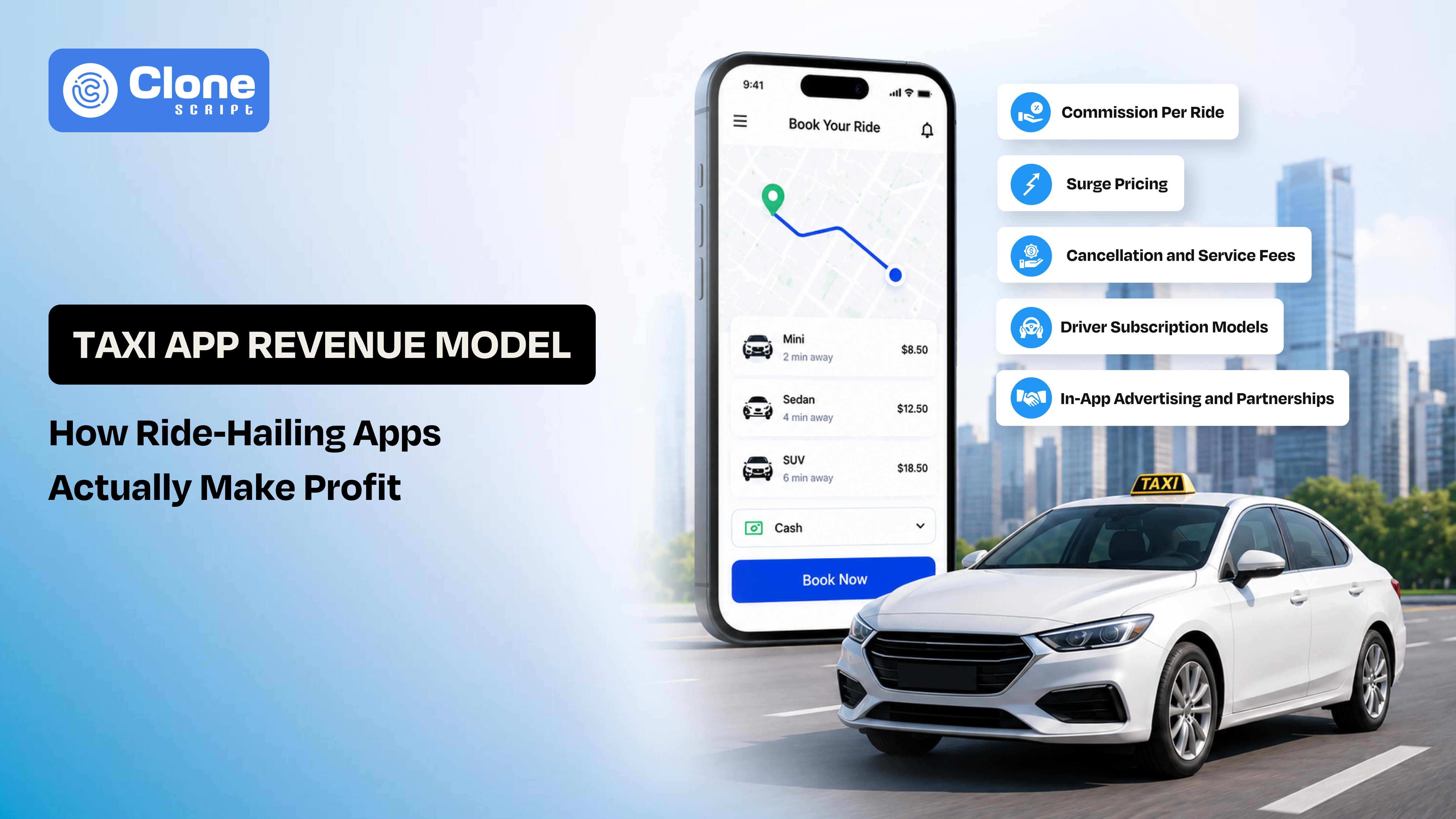
At a surface level, most ride-hailing platforms appear to rely on a single income source: commission per ride. In reality, the taxi app revenue model is operated with multiple streams working together to stabilize revenue and offset high operational costs. Understanding these layers is important because no single stream is sufficient to sustain profitability on its own.
-
Commission Per Ride (Primary Revenue Driver)
This is the first model of the ride-hailing business to make money. The platform takes a percentage from every completed trip.
-
The typical commission range is 15%–30%.
-
The revenue varies based on market competition, driver availability, and city-level pricing strategy.
For example, in the United States, the ride fare is $20, and the platform takes a commission of around $5 at 25%.
While this looks straightforward, the actual retained amount is often lower after incentives and discounts. That’s why commission alone doesn’t define profitability.
-
Surge Pricing (Dynamic Revenue Expansion)
Surge pricing increases fares during periods of high demand and limited driver supply. It’s not just a pricing tactic. It’s a revenue multiplier when used correctly.
There are trigger conditions to know:
-
Peak commute hours
-
Weather disruptions
-
Events or holidays
What it does:
-
Increases total fare value
-
Expands the platform commission proportionally
-
Encourages more drivers to come online
However, excessive dependency on surge pricing can lead to price sensitivity and user churn, especially in competitive markets.
-
Cancellation and Service Fees
These are smaller charges, but they create a consistent secondary revenue layer for the taxi app. Here are the ways that make this happen:
-
Rider cancellation fees
-
Driver cancellation penalties
-
Booking or convenience fees
Individually, these fees seem minor. At scale, they contribute significantly to predictable, low-risk revenue because they don’t depend on ride completion margins.
-
Driver Subscription Models (Shift from Commission)
This is an emerging model that replaces per-ride commission with fixed driver payments. Here is how it works
-
Weekly or monthly subscription fees
-
Flat fee per ride after a threshold
Why platforms adopt this:
-
Ensures predictable income
-
Attracts high-frequency drivers
-
Reduces dependency on ride-based commission
The driver subscription revenue model works best in high-density markets, where ride volume is stable and predictable.
-
In-App Advertising and Partnerships
Once the platform reaches scale, it unlocks additional monetization channels that operate independently of rides:
-
Local business promotions inside the app
-
Sponsored placements
-
Partnerships with travel, food, or hospitality services
These channels typically offer higher margins because they don’t involve driver payouts. However, they only become viable after achieving a large and active user base.
A profitable taxi app doesn’t rely on one revenue stream. It balances multiple layers while controlling costs.
The Real Economics Behind Ride-Hailing Apps
Understanding revenue streams is only half the equation. The real decision-making insight comes from how much of that revenue is retained after payouts and operational pressure. This is where most taxi app business models either stabilize or collapse.
-
Revenue vs Profit: The Critical Difference
At scale, ride-hailing platforms process thousands of trips daily. That creates the illusion of strong earnings. However, high ride volume does not guarantee profitability.
The revenue = Total earnings from rides, fees, and other streams.
The profit = What remains after:
-
Driver payouts
-
Incentives
-
Discounts
-
Operational costs
Here is the example.
-
Total ride fare: $20
-
Platform share: $5
-
Incentives/discounts: $3–$6
-
Net outcome: Often close to break-even or negative
This is why many platforms prioritize market capture first, profit later.
-
Unit Economics Per Ride
To evaluate viability, you need to break performance down to a per-ride level. This reveals whether your model is sustainable.
Typical structure is follow:
-
Gross Fare: $20
-
Driver Earnings: $14–$16
-
Platform Revenue: $4–$6
-
Incentives & Discounts: $3–$5
Net Margin per ride: Frequently minimal in early stages
This explains why scaling without optimizing unit economics can increase losses instead of profits.
-
Take Rate Strategy (What You Actually Keep)
The “take rate” is a more accurate metric than commission.
-
Take Rate = Platform Earnings ÷ Total Fare
But the effective take rate is often higher than the base commission because it includes:
-
Booking fees
-
Service charges
-
Surge multipliers
Here is the example.
The base commission remains 20%, and the effective take rate: 25%–35%+.
This is where platforms improve margins without visibly increasing commission rates.
-
Demand–Supply Balance (Marketplace Reality)
A taxi app is not just a product. It’s a two-sided marketplace. Revenue depends on how well you balance riders and drivers.
Here are the core challenges you may face during the setup:
-
Too many riders means long wait times and drop-offs.
-
Too many drivers can turn into low earnings and driver churn.
This imbalance creates what’s known as the liquidity problem.
Why This Matters for Revenue
-
Low driver availability can result in fewer completed rides
-
High driver churn will increase incentive costs
-
Poor rider experience can reduce repeat usage
Even with a strong pricing model, revenue collapses if the marketplace balance fails.
Network Effects and Density
Taxi app profitability improves when your platform reaches high geographic density.
-
More drivers can make faster pickups
-
Faster pickups mean more riders
-
More riders can generate higher ride frequency
This creates a self-reinforcing growth loop, reducing these KPIs:
-
Customer acquisition cost
-
Incentive dependency
A taxi app becomes profitable when each ride starts generating a predictable margin.
Taxi Booking Business Hidden Costs That Kill Profitability
Revenue streams may look stable on paper, but profitability is often undermined by cost layers that scale faster than income. These costs are not always visible in high-level models in the taxi business, yet they determine whether your taxi app survives beyond the growth phase.
-
Driver Incentives (Largest Cost Driver)
To build an initial supply, platforms aggressively incentivize drivers. Without this, you won’t achieve marketplace liquidity. Here is what to consider:
-
Sign-up bonuses for new drivers
-
Guaranteed earnings per day and week
-
Peak-hour and surge participation incentives
The reality is:
-
Incentives can consume 30%–50% of platform revenue in early stages
-
Removing them too quickly leads to driver drop-off
This creates a dependency cycle: You need incentives to grow, but they delay profitability.
-
Customer Acquisition Cost (CAC)
Rider growth doesn’t happen organically in competitive markets. It’s driven by discount-heavy acquisition strategies. Apply the following:
-
First-ride discounts
-
Referral programs
-
Promo codes and seasonal campaigns
For example, the cost to acquire one rider is $5–$20. The average rides before churn are often low in the early stages.
If retention is weak, you’re paying repeatedly for the same user behavior, which erodes margins.
-
Discounts and Price Subsidization
To compete with established players, new platforms subsidize rides through these strategies:
-
Lower-than-market pricing
-
Cashback offers
-
Flat fare promotions
This impact increases ride volume but reduces the per-ride margin significantly.
In many cases, platforms are effectively sharing their commission with users just to stay competitive.
-
Technology and Infrastructure Costs
Even though a ride-booking app is asset-light, the back-end infrastructure is not cheap.
-
App development and continuous updates
-
Server and cloud infrastructure
-
Real-time GPS tracking and mapping services
-
Payment gateway fees
These taxi app development costs scale with usage, meaning growth increases operational expense, not just revenue.
-
Customer Support and Operations
As ride volume grows, so does operational complexity. Optimize the app for the following
-
24/7 customer support teams
-
Dispute resolution (fare issues, cancellations)
-
Driver onboarding and verification
Poor support leads to churn, but strong support increases the cost to manage.
-
Fraud, Abuse, and Leakage
At scale, platforms face such issues and have to handle them proactively and professionally:
-
Fake ride completions
-
Promo abuse
-
Driver-rider collusion
Without strong controls, this creates revenue leakage that’s hard to detect but expensive over time.
-
Regulatory and Compliance Costs
Each market introduces its own legal requirements. Operating the taxi app in the U.S. is stricter compared to India, with little liberalization. But the necessary steps and regulations have to be followed:
-
Driver licensing and background checks
-
Insurance policies
-
Local transport regulations
These are non-negotiable costs and can significantly impact expansion plans.
A taxi app fails because its costs scale faster than its ability to control them.
Which Revenue Model Should You Choose?
There’s no single “best” taxi app revenue model. What works depends on how quickly you need traction, how much capital you can deploy, and how competitive your target market is.
The mistake most business owners make is adopting a standard commission model without aligning it to their stage of growth and local market dynamics.
-
Early Stage: Focus on Market Entry
At launch, your biggest challenge is getting enough drivers and riders on the platform at the same time. Without that balance, revenue models won’t matter.
What to implement:
-
Lower commission (10%–15%) to attract drivers
-
Controlled incentives instead of large-scale payouts
-
Introductory rider discounts with clear limits
Why this approach works:
-
Reduces friction for onboarding
-
Helps establish initial marketplace activity
-
Keeps early burn manageable
Watch out for:
-
Over-subsidizing rides without a retention strategy
-
Expanding beyond a focused area too soon
-
Growth Stage: Improve Margins Gradually
Once rides become consistent, the objective shifts to retaining users while improving unit economics.
What to implement:
-
Moderate commission (15%–25%)
-
Introduce optional subscription plans for drivers
-
Start reducing discounts in phases
Why this works:
-
Maintains supply-demand balance
-
Adds predictable revenue streams
-
Moves the business closer to break-even
Operational focus:
-
Use ride data to optimize pricing
-
Identify high-demand zones and double down
-
Competitive Markets: Differentiate or Lose Margin
If you’re entering a saturated market, pricing alone won’t sustain you. Competing directly with established players leads to unsustainable discounting.
What to implement:
-
Better driver earnings structure instead of just lower commission
-
Niche positioning:
-
Airport rides
-
Corporate transport
-
Safety-focused services
-
-
Localized pricing rather than uniform fares
Why this works:
-
Avoids direct price wars
-
Builds a targeted user base
-
Improves retention through specialization
-
Profit-Focused Strategy: Control Costs Early
If your priority is profitability rather than aggressive scaling, your model should minimize variability in revenue.
What to implement:
-
Subscription-based driver model
-
Limited geographic expansion
-
Minimal reliance on discounts and cashbacks
Why this works:
-
Creates predictable income streams
-
Reduces dependency on incentives
-
Strengthens per-ride margins
Trade-off:
-
Slower growth compared to heavily funded competitors
5. Multi-Region Expansion: Adapt Locally
Scaling across regions introduces new variables that directly impact your ride-hailing business model.
Key adjustments to focus:
-
Modify commission rates by region
-
Align pricing with local purchasing power
-
Adapt to payment behavior (cash vs digital)
Why this matters:
-
A model that works in one city may fail in another
-
Local optimization improves both adoption and profitability
Your revenue model should evolve with your business. Locking into a fixed strategy too early limits both growth and profitability.
Final Verdict: Should You Build a Taxi App?
The viability of this business depends on how well you manage acquisition, retention, and marketplace balance from day one.
Before investing, evaluate these fundamentals:
-
Do you have the budget to acquire and retain both drivers and riders? Without consistent incentives and onboarding strategies, early traction will stall.
-
Can you solve local demand–supply gaps? Marketplace imbalance leads to poor experience on both sides, directly impacting revenue.
-
Do you have a clear differentiation strategy? Competing on pricing alone is not sustainable in a saturated ride-hailing market.
If the Answer Is Yes
You’re positioned to build a scalable, multi-layered revenue business where income comes from commissions, subscriptions, and high-margin add-ons. With the right execution, profitability becomes achievable as your unit economics stabilize.
If the Answer Is No
You’re likely to build a platform that:
-
Generates ride activity
-
Requires continuous subsidies
-
Struggles to retain drivers and riders
In that case, the business operates, but doesn’t produce sustainable profit.
A taxi app succeeds when its economics are engineered.
If your strategy accounts for cost control, market density, and evolving revenue models, the opportunity is substantial. If not, growth will come at the expense of profitability.
Conclusion: Think Beyond “Commission”
The biggest mistake business owners make: They copy Uber’s model without understanding its economics.
To succeed, you need a localized revenue strategy, a clear path to profitability, and control over cost structure for a taxi app.