BTC - Bitcoin
 USDTERC20 - USDT ERC20
 ETH - Ethereum
 BNB - Binance
 BCH - Bitcoin Cash
 DOGE - Dogecoin
 TRX - TRON
 USDTTRC20 - USD TRC20
 LTC - LiteCoin

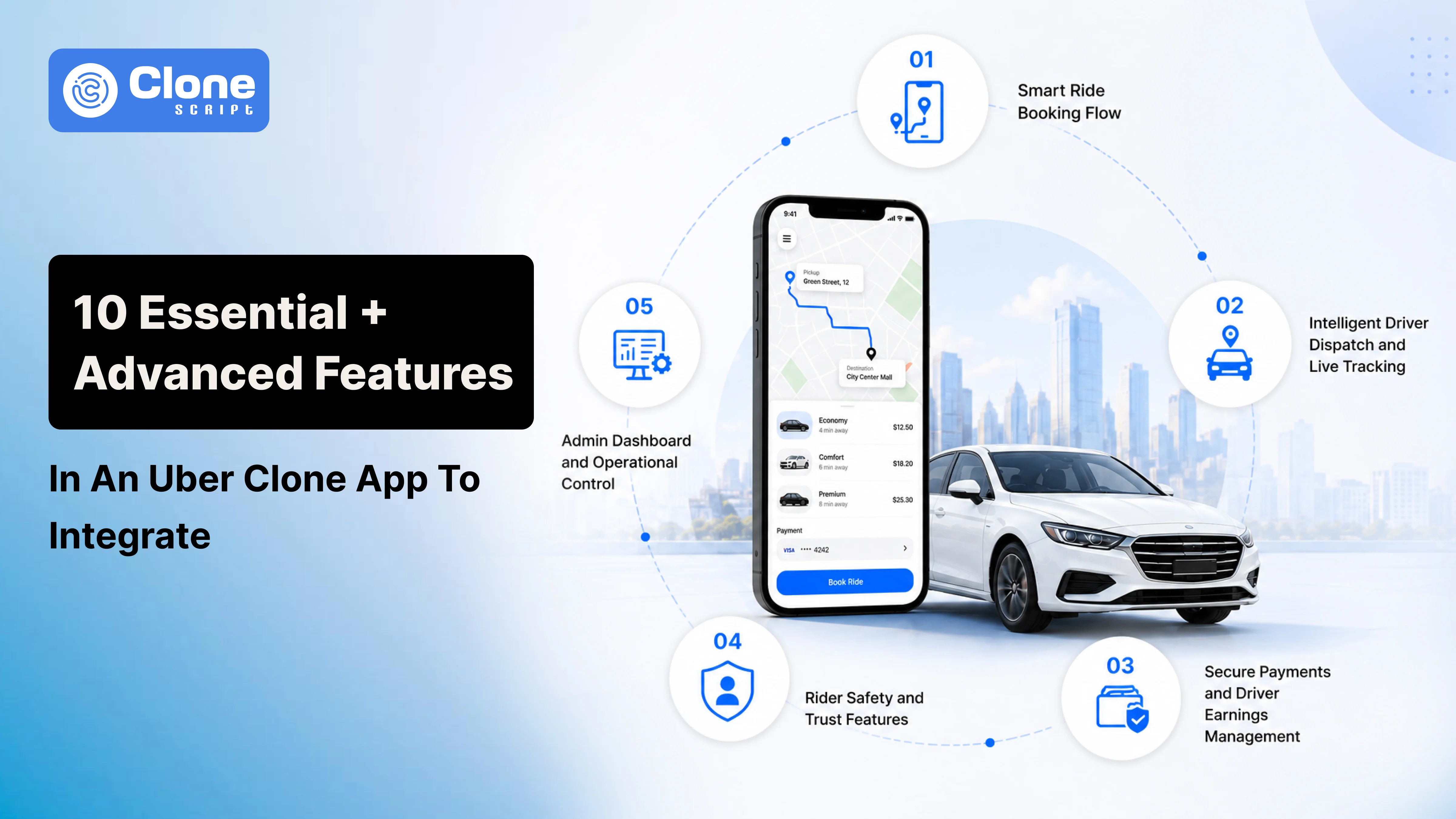
10 Essential and Advanced Features in Uber Clone App: Integrate Now
Uber clone app development can be an actually useful product when the features are prioritized: 1. Essential and 2. Advanced.
Now, hundreds of ride-hailing scripts, open-source projects, and UI kits can help a taxi app run within weeks. After that, startups also struggle; riders do not like the app because it has too many steps to confirm the booking, and drivers stop accepting rides due to poor earnings.
That means copying Uber’s functionality is worthless.
You have to prioritize features that improve user experience, reduce operational complexity, and increase driver retention. Also, create a foundation for future services like bike taxis, courier delivery, rental, and corporate transportation.
Planning an MVP app, white-label mobility solution for clients, or using the Uber clone scripts or UI kits to make the process faster? Know the features that deserve first and others to be waited on.
Why Feature Prioritization Matters in an Uber Clone App?
Accomplishing business objectives like establishing a reputable mobility business, driving revenue, and user retention can be done only when features are added to the Uber clone app to minimize frustration.
A smarter approach is to divide development into two phases:
-
Essential features that make your platform functional, reliable, and launch-ready.
-
Advanced features that improve scalability, automation, and competitive differentiation.
This approach shortens your MVP timeline and gives your engineering team a clear roadmap for future releases.
Essential Features Every Uber Clone Needs
These features directly influence whether users complete a booking.
1. Smart Ride Booking Flow
The ride booking flow is an important part of an Uber clone app. When a user can’t find how to request a ride, they abandon the app before exploring other features. The booking process should be intuitive, fast, and require as few interactions as possible.
A well-designed booking flow should include:
-
Accurate pickup and destination selection using GPS and map search.
-
Multiple ride categories (Economy, Premium, SUV, Bike, etc.).
-
Real-time fare estimates before confirming the booking.
-
Saved locations like Home, Work, and Favorite Places.
-
Ride scheduling for future bookings.
-
Coupon and promo code support to encourage repeat usage.
-
Flexible payment options before or after ride confirmation.
The booking workflow directly impacts your conversion rate. Every extra step, confusing interface, or loading delay increases the likelihood that users will abandon their booking and switch to a competitor. A streamlined experience not only improves customer satisfaction but also increases completed rides and overall revenue.
Developer Considerations
While booking a ride appears simple from the user's perspective, it's one of the most complex workflows behind the scenes. The system must coordinate:
-
User authentication
-
Geolocation and map services
-
Route calculation
-
Fare estimation
-
Driver availability
-
Ride confirmation
-
Payment preferences
Each action depends on another, making this one of the most interconnected modules in the application.
2. Intelligent Driver Dispatch and Live Tracking
In mobility businesses, overall experience depends on how quickly and accurately the driver dispatch system works. Because riders always expect their request to be accepted within seconds, and drivers need a fair app that assigns trips based on proximity and availability.
A modern Uber clone should intelligently match ride requests with the most suitable driver instead of simply selecting the nearest one.
Key capabilities include:
-
Real-time driver matching based on location and availability.
-
Automatic ride reassignment if a driver declines or misses the request.
-
Live GPS tracking for riders, drivers, and administrators.
-
Dynamic ETA updates based on traffic and route changes.
-
Route optimization to reduce pickup and travel time.
-
Driver online/offline status management for accurate availability.
Developer Considerations
Implementing real-time dispatch involves much more than integrating a map SDK. The application must continuously synchronize driver locations, ride requests, and trip statuses. It must maintain low latency and high reliability.
Developers should also account for:
-
Real-time communication using WebSockets, Firebase, or Socket.IO.
-
Background GPS tracking without excessive battery consumption.
-
Accurate location updates despite poor network conditions.
-
Automatic failover when drivers reject or miss ride requests.
-
Traffic-aware route recalculations for more accurate ETAs.
Building a scalable dispatch engine requires careful backend architecture to ensure consistent performance as the number of active drivers and ride requests grows.
3. Secure Payments and Driver Earnings Management
A payment gateway doesn’t make a ride-hailing platform useful until it helps to manage the financial ecosystem. This can include customer payments, driver earnings, commissions, refunds, taxes, and payouts. It should support every transaction to be secure and transparent.
To provide a smooth payment experience, your Uber clone should support:
-
Multiple payment methods such as credit/debit cards, digital wallets, UPI, and cash (where applicable).
-
Promo codes and discount coupons to drive customer acquisition and retention.
-
Corporate or business accounts with centralized billing.
-
Digital invoices and trip receipts for every completed ride.
-
Secure payment processing with PCI-compliant payment gateways.
However, the real complexity begins after the ride is completed.
The platform must accurately calculate driver commissions, bonuses, surge pricing incentives, taxes, refunds, cancellation charges, and payout schedules.
Drivers should have access to a dedicated earnings dashboard where they can review completed trips, incentives, wallet balances, withdrawal history, and payment status without contacting support.
Developer Considerations
Payment infrastructure is one of the most complex modules in a ride-hailing application because it combines security, financial reporting, and business logic.
Developers should plan for:
-
Wallet and credit management.
-
Commission and revenue calculations.
-
Refund and cancellation workflows.
-
Tax calculation and invoice generation.
-
Scheduled driver payouts and transaction history.
As the platform scales, these financial workflows become increasingly difficult to maintain without a modular architecture.
4. Rider Safety and Trust Features
In the ride-hailing industry, trust is just as important as convenience. Riders are stepping into a vehicle driven by someone they've never met, at night or in unfamiliar locations. Without robust safety measures, even the most feature-rich Uber clone will struggle to retain users.
A well-designed Uber clone app should include multiple layers of safety and trust, including:
-
Verified driver profiles with identity and document verification.
-
Live trip sharing with trusted contacts.
-
Emergency SOS assistance for quick access to emergency services.
-
Masked phone numbers to protect rider and driver privacy.
-
Two-way ratings and reviews to maintain service quality.
-
Trip history and digital ride receipts for future reference.
-
In-app reporting for safety incidents, disputes, or lost items.
Developer Considerations
Building trust requires more than adding an SOS button or rating screen. Developers should design workflows that support secure onboarding, privacy protection, and efficient incident management.
Key implementation areas include:
-
Driver KYC and document verification workflows.
-
Secure storage of identity and vehicle documents.
-
Role-based access for reviewing safety reports.
-
Real-time trip sharing and emergency alerts.
-
Automated notifications for document expiry and account verification.
-
Moderation tools for handling ratings, complaints, and disputes.
Automating these processes not only improves operational efficiency but also reduces the administrative workload as your platform scales.
5. Admin Dashboard and Operational Control
An Uber clone doesn't run itself. Behind every successful ride-hailing platform is an admin dashboard that manages daily operations, monitors business performance, and keeps the entire ecosystem running smoothly.
Booking on the mobile app by riders and drivers is completed successfully; administrators depend on a centralized dashboard to oversee every aspect of the platform. This includes onboarding drivers to resolving disputes and analyzing business performance.
A comprehensive admin dashboard should provide:
-
Driver and rider management for approvals, account verification, and user status.
-
Live trip monitoring with real-time ride tracking and status updates.
-
Pricing and commission management for configuring fares, surge pricing, and platform commissions.
-
Promo code and campaign management to support customer acquisition and retention.
-
Payment and payout monitoring for refunds, settlements, and transaction history.
-
Support and dispute resolution with access to trip records and customer reports.
-
Business analytics covering revenue, completed rides, cancellations, driver performance, and peak operating hours.
Developer Considerations
Unlike rider or driver applications, admin dashboards evolve continuously as business requirements change. New reports, pricing models, operational tools, and compliance requirements are introduced over time. Here, flexibility a critical architectural consideration.
When building an admin system, developers should prioritize:
-
Modular dashboard architecture for future expansion.
-
Role-based access control for administrators and support teams.
-
Real-time operational dashboards and reporting.
-
Automated driver verification and document management.
-
Configurable pricing, commission, and promotional rules.
-
Integration with payment, notification, and customer support systems.
Designing the admin panel as a collection of reusable modules makes it easier to introduce new operational features.
Advanced Features That Differentiate a Modern Uber Clone
The following advanced features are designed to improve business efficiency, enhance customer experience, and prepare your Uber clone for long-term growth.
6. Dynamic Pricing Engine
Static pricing works for small operations, but it quickly becomes inefficient as ride demand fluctuates throughout the day. A dynamic pricing engine automatically adjusts fares based on real-time market conditions. That means riders can still book trips and drivers remain motivated to stay online during peak demand.
Instead of relying on a single pricing model, a modern Uber clone should support:
-
Surge pricing during peak hours or high-demand periods.
-
Distance and time-based fare calculations.
-
Location-specific pricing for airports, business districts, or special zones.
-
Weather-based fare adjustments during heavy rain or extreme conditions.
-
Event-based pricing for concerts, festivals, or sporting events.
-
Configurable pricing rules that administrators can update without modifying the application.
Developer Considerations
Building a pricing engine involves much more than multiplying the base fare by a surge factor. The system must process multiple pricing variables simultaneously to keep fare calculations transparent for both riders and drivers.
Key implementation considerations include:
-
Rule-based pricing configuration.
-
Peak-hour scheduling.
-
Geofencing for location-specific pricing.
-
Real-time demand analysis.
-
Driver incentive calculations.
-
Fare estimate synchronization across rider, driver, and admin applications.
A modular pricing engine also allows businesses to introduce promotional campaigns, subscription discounts, or loyalty rewards without redesigning the fare calculation logic.
7. Multi-Service Platform Architecture
Many startups begin with a single goal, and it's launching a taxi booking app. But as the business grows, customer expectations evolve, and new revenue opportunities emerge. Expanding into services like bike taxis, courier delivery, car rentals, or airport transfers becomes the next logical step.
A scalable Uber clone should support:
-
Taxi booking for daily commuting.
-
Bike taxi services for short-distance and budget-friendly rides.
-
Courier and package delivery with real-time tracking.
-
Car rental and hourly bookings for business or leisure travel.
-
Airport transfers with scheduled pickups and fixed pricing.
-
Luxury ride categories with premium vehicle options.
Rather than building separate applications for each service, they all share the same back-end, authentication system, payment infrastructure, and administrative dashboard. This reduces development costs and creates a consistent user experience across the platform.
Developer Considerations
Supporting multiple services requires a modular architecture rather than hard-coded business logic.
Developers should design reusable components that can adapt to different ride types without duplicating code. Key architectural considerations include:
-
Shared authentication and user management.
-
Configurable service categories and pricing rules.
-
Reusable booking and checkout workflows.
-
Common payment and wallet infrastructure.
-
Centralized trip management across all services.
-
Modular APIs for adding new mobility services in the future.
By separating business logic from service-specific configurations, development teams can introduce new offerings with minimal code changes and significantly lower maintenance costs.
8. White-Label Customization and Branding
Launching an Uber clone is about building your own. Whether you're targeting a local taxi company, a corporate mobility service, or a regional ride-hailing startup, your application should reflect your brand identity rather than looking like a generic clone.
A white-label architecture makes this possible by allowing businesses to customize the application's appearance, branding, and regional settings without modifying the core functionality.
A customizable Uber clone should support:
-
Custom logos, app icons, and splash screens.
-
Brand colors, typography, and UI themes.
-
Light and dark mode support.
-
Multi-language and localization.
-
Multiple currencies and regional pricing formats.
-
Country-specific date, time, and address formats.
-
Configurable ride categories and business rules.
These customization options make it easier to launch the same application across different cities, countries, or client projects while maintaining a unique brand identity.
Developer Considerations
Designing a truly white-label application requires more than exposing a few color settings. The user interface should be built around reusable design components and centralized configuration files so branding changes can be applied across the entire application with minimal effort.
Developers should prioritize:
-
Theme-based design systems.
-
Reusable UI components.
-
Centralized branding configuration.
-
Localization and internationalization (i18n).
-
Responsive layouts for multiple devices.
-
Easy integration of new assets without modifying application logic.
This separation between design and functionality makes future maintenance significantly easier and reduces the risk of introducing bugs during branding updates.
9. Analytics and Business Intelligence
Every ride booked through your platform generates valuable data. The real advantage is turning it into actionable insights that improve operations, increase revenue, and enhance customer satisfaction.
An Uber clone should include a comprehensive analytics dashboard that helps administrators monitor business performance in real time and identify opportunities for growth.
Key analytics features include:
-
Revenue and earnings reports across different time periods.
-
Ride demand analysis to identify peak booking hours and high-demand locations.
-
Driver performance metrics such as acceptance rate, cancellations, completed trips, and earnings.
-
Customer behavior insights including repeat bookings and ride frequency.
-
Cancellation and refund reports to identify operational bottlenecks.
-
Regional performance dashboards for comparing different cities or service areas.
Instead of relying on assumptions, businesses can make informed decisions using real operational data.
Developer Considerations
An effective analytics system requires more than displaying charts and graphs. It should collect data from multiple services, process it efficiently, and present meaningful insights through intuitive dashboards.
Developers should design analytics modules that support:
-
Real-time operational dashboards.
-
Historical trend analysis.
-
Custom report generation.
-
Role-based access to business metrics.
-
Exportable reports (CSV, Excel, PDF).
-
Integration with third-party analytics and BI platforms.
As the platform grows, analytics should remain scalable so businesses can monitor thousands of daily rides without impacting application performance.
10. AI-Powered Automation and Predictive Operations
As ride-booking platforms grow, thousands of daily trips happen, and manually handling becomes increasingly difficult. Tasks such as dispatching drivers, adjusting pricing, responding to customer queries, and detecting fraudulent activities require constant monitoring. This is where AI-powered automation helps businesses operate more efficiently and deliver a better user experience.
Rather than replacing human decision-making, AI analyzes large volumes of operational data to identify patterns, predict demand, and automate repetitive tasks. The result is faster response times, improved resource utilization, and lower operational costs.
Modern ride-hailing platforms can leverage AI for:
-
Intelligent driver dispatch based on demand, proximity, and historical performance.
-
Demand forecasting to predict ride requests during peak hours, holidays, or local events.
-
Dynamic surge pricing using real-time supply and demand analysis.
-
Route optimization to reduce travel time and fuel consumption.
-
Fraud detection for suspicious bookings, fake accounts, and payment anomalies.
-
AI-powered customer support through chatbots and automated ticket routing.
-
Personalized promotions based on user behavior and ride history.
Developer Considerations
AI should be introduced incrementally rather than attempting to automate every process at once. A modular architecture allows businesses to integrate AI capabilities as operational data grows and business requirements evolve.
Developers should consider:
-
Collecting high-quality operational data for training AI models.
-
Separating AI services from core business logic using APIs or microservices.
-
Monitoring model performance to prevent inaccurate recommendations.
-
Providing administrators with configurable rules to override automated decisions.
-
Ensuring compliance with regional privacy and data protection regulations.
This approach keeps the platform flexible, making it easier to adopt new AI capabilities without disrupting existing workflows.
Build from Scratch or Start with an Uber Clone Script?
One of the biggest decisions when developing a ride-hailing platform is whether to build everything from scratch or accelerate development with a production-ready Uber Clone Script and UI Kit.
The following comparison highlights the differences between both approaches.
| Criteria | Build from Scratch | Uber Clone Script + UI Kit |
|---|---|---|
| Development Timeline | 6- 12 months | 4-8 Weeks |
| UI/UX Design | Designed from scratch | Production-ready, customizable UI |
| Core Features | Built individually | Pre-built and modular |
| Development Cost | Higher | Lower |
| Time to Market | Slower | Faster MVP launch |
| Customization | Complete flexibility | High flexibility with less effort |
| Maintenance | Depends on architecture | Easier with modular codebase |
For many businesses, the goal is to launch faster and invest engineering effort where it creates real competitive value. Features like AI-powered dispatch, loyalty programs, regional compliance, or custom business workflows often deliver a stronger return than rebuilding common booking screens or payment modules from scratch.
Accelerate Development with Production-Ready UI Kits and Clone Scripts
Building a ride-hailing platform involves much more than creating mobile screens. Rider applications, driver apps, admin dashboards, authentication flows, payment modules, notifications, and reporting tools all need to work together seamlessly.
Our Uber Clone UI Kits and Uber Clone Scripts provide a production-ready foundation that helps development teams reduce repetitive work while maintaining complete control over customization.
-
Uber Clone UI Kits
This is perfect for developers and design teams who want to accelerate front-end development with professionally designed interfaces.
Highlights include:
-
Complete Rider, Driver, and Admin UI.
-
Clean and reusable component library.
-
Responsive layouts with modern design patterns.
-
Light and dark theme support.
-
Easy branding and white-label customization.
-
Organized design system for faster development.
-
Uber Clone Scripts
This option is ideal for businesses that want a faster path to market without sacrificing flexibility and customization. Uber clone app Flutter templates can manage the coding for every kind of platform.
Included capabilities:
-
Modular project architecture.
-
Ride booking and driver management workflows.
-
Payment and wallet integration.
-
Admin dashboard with operational controls.
-
Real-time tracking infrastructure.
-
Multi-service-ready architecture for future expansion.
Save months on rebuilding standard ride-hailing functionality. Your development team can focus on creating unique features that differentiate your business.
Conclusion
Launching an Uber clone app is beyond matching riders with nearby drivers. Success depends on delivering a reliable booking experience, building trust through secure payments and safety features, optimizing operations with powerful admin tools, and preparing your platform for long-term growth with automation, analytics, and scalable architecture.
Starting with production-ready Uber Clone UI Kits and Uber Clone Scripts allows your team to launch faster, customize with confidence, and dedicate more time to building features that create real business value instead of recreating functionality that's already been solved.