BTC - Bitcoin
 USDTERC20 - USDT ERC20
 ETH - Ethereum
 BNB - Binance
 BCH - Bitcoin Cash
 DOGE - Dogecoin
 TRX - TRON
 USDTTRC20 - USD TRC20
 LTC - LiteCoin

What is the Double Diamond Design Process: Everything You Need to Know
Every web team has experienced it. A redesign launches with excitement, only to see engagement metrics barely move. Meetings begin again. Design Hypotheses multiply. Stakeholders question the direction. Suddenly, what felt like progress turns into uncertainty.
This pattern is not uncommon, and it rarely happens because teams don’t have creativity or technical skills. It happens because teams move too quickly into solution mode without fully understanding the problem.
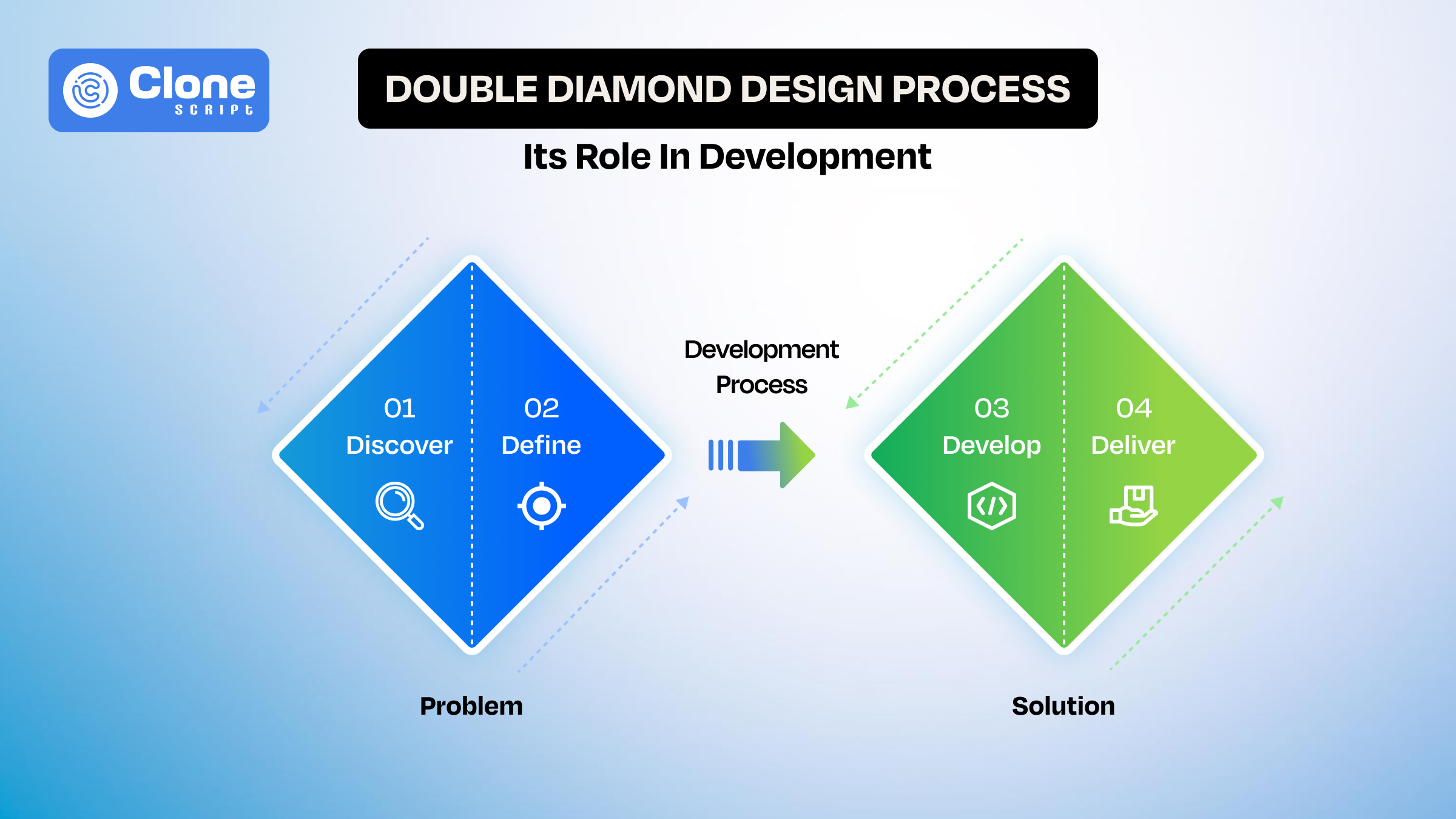
The Double Diamond design process was created to prevent this. It offers a structured way for UX designers, product managers, and web strategists to explore challenges deeply before building solutions. By dividing innovation into phases of exploration and focus, the framework reduces guesswork and improves decision quality.
In digital environments, clarity is not a luxury. It is a competitive advantage.
Origin and Evolution of the Double Diamond Framework
The Double Diamond framework was popularized by the British Design Council in 2005 as a visual representation of how effective design thinking unfolds in practice. Rather than presenting design as a linear checklist, the model acknowledges that innovation involves cycles of expansion and refinement.
Historically, the framework was influenced by divergence-convergence theories in systems thinking, which emphasized the importance of exploring problems widely before narrowing solutions. Over the past two decades, the Double Diamond has evolved from an academic concept into a practical methodology adopted by global organizations.
Today, it is widely used in:
-
SaaS product design
-
E-commerce experience optimization
-
Government digital services
-
Fintech interface innovation
Its enduring relevance lies in its flexibility. Teams can compress or expand phases based on project complexity while still maintaining the underlying logic of structured exploration.
The Four Phases of the Double Diamond Process Explained
At the heart of the Double Diamond design process are four distinct yet interconnected phases that guide teams from ambiguity to validated outcomes.

-
Discover Phase: Building Understanding Before Building Interfaces
The Discover phase represents the first expansion of thinking. Instead of immediately sketching layouts or debating color schemes, teams step into research mode.
This is where assumptions begin to collapse.
User interviews reveal motivations that analytics alone cannot show. After it, session recordings expose friction points invisible in stakeholder discussions. Finally, market analysis uncovers competitor strengths that were previously underestimated.
Web design teams uncover issues such as:
-
Cognitive overload caused by dense information architecture.
-
The unclear messaging hierarchy that weakens value perception.
-
Trust barriers related to security signals or social proof.
-
Inconsistent interaction patterns across devices.
The key objective here is not validation. It is a discovery.
See the statistics.
-
Companies that prioritize customer experience generate 5.7× more revenue growth than competitors (Forrester research).
-
Poor UX causes 88% of users to avoid returning to a website after a bad experience.
These numbers highlight why discovery is not optional. It is strategic groundwork.
A common misconception is that discovery slows projects down. In reality, insufficient discovery leads to longer redesign cycles later, increasing both cost and organizational issues.
High-maturity UX teams treat this phase as a strategic investment rather than optional research.
-
Define Phase: Transforming Insights into Strategic Focus
After expanding their understanding, teams must converge toward clarity. The Define phase turns raw insights into actionable direction.
This is where design becomes analytical.
First of all, the patterns are synthesized with a behavioral signal priority. Then, what are the possible business constraints that could affect the user's needs? At the final stage, teams formulate clear problem statements that guide subsequent design decisions.
For example, a declining conversion rate might initially appear as a visual issue. However, structured analysis may reveal deeper causes:
-
There is a misaligned landing page intent.
-
The performance latency affects perceived reliability.
-
Unclear next-step guidance within user flows causes confusion.
-
Decision anxiety is caused by excessive options.
When the problem is framed accurately, solution exploration becomes more efficient.
Define is also the phase where successful teams establish design success metrics such as task completion rate, engagement depth, or time-to-value. Without these benchmarks, later validation becomes subjective.
Clarity here reduces debate later.
-
Develop Phase: Expanding Solution Possibilities Intelligently
Once the web UI product design team aligns on the problem, the second diamond begins. Creativity returns, but now it operates within strategic boundaries.
The Develop phase encourages structured ideation.
Here, web designers experiment with alternative interaction models. On the other side, product managers test feature prioritization scenarios. Developers provide early feedback to avoid late-stage surprises.
This collaborative exploration generates multiple solution directions rather than a single dominant concept.
For web design teams, common exploration areas include:
-
Progressive disclosure patterns to reduce cognitive load.
-
Modular design layout systems that improve scalability.
-
Contextual onboarding flows that enhance retention.
-
Micro-interaction refinements that increase perceived responsiveness.
Research from Forrester indicates that companies investing in structured UX experimentation can achieve return on investment ratios as high as 100:1 in certain digital transformation initiatives.
The goal of this phase is not perfection. It is optionality.
Optionality allows teams to compare solutions based on evidence rather than intuition.
-
Deliver Phase: Converging Toward Validated Outcomes
The Deliver phase represents focused execution. Prototypes evolve into production experiences, and design hypotheses face real-world scrutiny.
The workflow starts with a central role: usability testing. Even a minor interface adjustment can produce measurable behavioral shifts. A simplified checkout step, for example, can reduce abandonment rates significantly.
Web teams track performance indicators such as:
-
Conversion rate uplift
-
Bounce rate reduction
-
Scroll depth improvement
-
Feature adoption metrics
Importantly, delivery does not end the innovation cycle. Insights gained post-launch frequently trigger discovery initiatives.
This continuous loop is what differentiates mature product organizations from teams that treat design as a one-time project.
In dynamic markets, validated learning is more valuable than static perfection.
Divergent vs Convergent Thinking in UX Design
Good UX work is about creativity or speed with timing. Design teams need moments where they step back and explore, and moments where they move forward with clear decisions. This balance is what divergent and convergent thinking bring into the design process.

-
Divergent thinking
It happens when the team opens the problem widely. Designers look at user journeys, talk to customers, sketch different layouts, and question what already exists. At this stage, the focus is on learning and discovering new possibilities rather than choosing one direction. It often feels messy, but this is where meaningful insights come from.
-
Convergent thinking
It starts once there is enough understanding. The team begins to compare options, remove weak ideas, test what works, and decide what should actually be built. This creates clarity and helps the project gain real momentum.
Knowing each design’s consequences is helpful.
If a team keeps exploring without deciding, progress slows. If they decide too quickly, they may fix the wrong issue. Strong UX teams move between both modes naturally, exploring to understand, then focusing to deliver better digital experiences.
Why is the Double Diamond Process useful?
Because it brings structure to how web and UX teams handle the uncertainty of simple to complex products. Instead of going straight into design solutions, teams first spend time understanding user problems and then move toward validated outcomes. This approach reduces guesswork and leads to more confident product decisions.
-
It reduces redesign effort.
When teams invest in research early, they are less likely to rebuild features later. Studies show that fixing usability issues after website development can cost significantly more than addressing them during the design stage.
-
It improves user satisfaction.
A well-structured UX process helps teams create experiences that feel intuitive. Research indicates that nearly 88% of users are less likely to return after a poor website experience, highlighting the importance of thoughtful design decisions.
-
It supports better collaboration.
Clear phases help designers, developers, and product managers stay aligned on priorities and progress. The project completion can be done on time and delivered to the client.
-
It encourages smarter innovation.
Web development teams can explore multiple ideas before choosing one, which increases the chances of finding high-impact solutions. This can reduce the re-work for solving the issues.
-
It strengthens business outcomes.
Companies that prioritize design maturity often outperform competitors in revenue growth and customer loyalty. After all, they’re solving the problems of users and presenting them in a promising way.
Real-World Applications in Product & UX Design
The Double Diamond design process becomes truly valuable when teams apply it to real business and user experience challenges. Instead of depending on assumptions, product and UX teams use this framework to understand problems clearly, test ideas, and deliver improvements that create measurable impact.

-
Website redesign with performance focus.
Teams begin by analyzing user behavior data such as drop-off pages, scroll depth, and search patterns. Based on insights, they simplify navigation, restructure content flow, and improve page clarity. This leads to website redesigns that improve engagement, not just visual appearance.
-
SaaS onboarding and feature adoption.
Software product teams identify where new users struggle to understand value. By testing guided onboarding flows, contextual tooltips, and step-based progress indicators, they help users complete key actions faster and increase activation rates.
-
E-commerce checkout optimization.
UX designers experiment with fewer form fields, clearer pricing breakdowns, and stronger trust signals like secure payment badges or reviews. These e-commerce UX refinements reduce hesitation and support higher conversion completion.
-
New feature validation before development.
Instead of building immediately, teams wireframe and prototype multiple interaction approaches and gather feedback. This reduces development waste and ensures features solve real needs.
-
Accessibility and service experience improvement.
Organizations map full user journeys across devices to create inclusive, consistent digital experiences that build trust and long-term retention.
The Hidden Cost of Skipping the First Diamond
When not paying attention to the first diamond design process, these consequences can be found.
-
Rushing to Solutions Feels Fast. But Creates Bigger Problems.
Many web and product teams are tempted to move quickly into UI design or development without spending enough time on discovery and problem definition. At first, this creates the impression of speed and productivity. Screens get designed, features get planned, and stakeholders feel progress is being made.
However, when the first diamond (Discover and Define) is skipped, teams end up solving the wrong problem. For example, they may redesign a homepage layout when the real issue is unclear messaging or weak user trust. This leads to repeated revisions and wasted effort.
-
Increased Rework and Design Debt.
Without proper research, teams build features based on assumptions. Later, when user feedback or analytics reveal issues, redesign becomes necessary. This increases development cost, delays timelines, and adds technical and design debt.
-
Misaligned Business Outcomes.
Features that are not grounded in real user needs rarely improve engagement or conversion. Over time, this affects product growth and stakeholder confidence.
-
The Real Advantage of the First Diamond.
Investing time in understanding users early helps teams make smarter decisions, reduce risk, and build solutions that deliver long-term value.
Double Diamond Challenges and Limitations
These challenges have to be solved with the double diamond design process.
-
Time Pressure in Fast-Moving Projects.
One of the common challenges of the Double Diamond process is the time required for proper discovery and definition. In web or product environments, stakeholders may expect quick visual outputs or rapid feature releases. Spending time on research can feel slow, even though it prevents larger delays later. Teams need to balance depth of exploration with realistic delivery timelines.
-
Managing Too Many Ideas.
During the divergent phases, teams generate a large number of concepts and improvement opportunities. Without clear prioritization, this can create confusion about what to build first. Strong facilitation and decision frameworks are necessary to keep the process focused and actionable.
-
Stakeholder Alignment Can Be Difficult.
Not all stakeholders are familiar with structured design processes. Some may push for immediate solutions based on assumptions or past experiences. Explaining the value of research-driven decisions requires communication effort from UX leaders.
-
Risk of Treating the Framework as Rigid.
If followed too strictly, the Double Diamond can feel like a checklist rather than a thinking approach. Modern teams must adapt it flexibly, combining it with agile practices to maintain momentum while still making informed design decisions.
Double Diamond vs Design Thinking vs Agile
This is the comparison to know between double diamond, design thinking, and agile way.
| Aspect | Double Diamond | Design Thinking | Agile |
|---|---|---|---|
| Primary Focus | Structured problem exploration and solution validation | Human-centered innovation mindset | Fast and iterative product delivery |
| Core Goal | Ensure teams solve the right problem before building | Build empathy and generate creative ideas | Deliver working features quickly and continuously |
| Process Nature | Diverge → Converge → Diverge → Converge | Empathize → Define → Ideate → Prototype → Test | Plan → Build → Test → Release → Repeat |
| Best Use Case | Complex UX challenges, redesigns, and product strategy decisions | Early-stage innovation and concept generation | Development execution and feature iteration |
| Team Involvement | Cross-functional collaboration with strong research input | Collaborative workshops and creative exploration | Developers, product managers, and QA working in sprints |
| Strength | Reduces design risk and improves decision clarity | Encourages creativity and deep user understanding | Increases speed, adaptability, and delivery consistency |
| Limitation | Can feel time-intensive if not adapted | May lack execution structure without other frameworks | Risk of building fast without fully validating problems |
| How They Work Together | Guides what to solve and validate | Inspires how to think creatively | Enables how to build and ship efficiently |
This can be helpful to understand what works for your website and app design work.
How to Implement the Double Diamond in Modern Teams
Implementing the Double Diamond design process in modern web and product teams is less about following a strict diagram and more about building the right working rhythm. Teams need to create space for understanding problems, exploring solutions, and learning from real outcomes.

-
Start with Structured Discovery.
Before planning features or redesigns, teams should run focused discovery activities such as reviewing analytics, conducting quick user interviews, or mapping existing journeys.
For example, a website’s conversion rate drops. Instead of redesigning the landing page immediately, the team studies user behavior and realizes visitors are confused about pricing tiers. This insight shifts the focus from visual redesign to clarity in content and structure.
-
Define Clear Direction and Metrics.
After gathering insights, teams must agree on what problem to solve and how success will be measured. Like, a UX team may define a goal like “increase sign-up completion rate by improving form usability.” This clarity helps designers prioritize the right improvements.
-
Explore and Validate Multiple Solutions.
Web design teams should prototype different approaches and test them before development. Testing simplified forms versus multi-step forms can reveal which experience reduces friction.
-
Integrate with Agile and Continuous Learning.
The framework fits naturally into sprint cycles where delivery is followed by a performance review. Post-launch insights then trigger discovery loops, helping teams manage products based on real user needs.
Conclusion
The Double Diamond design process helps web and UX teams move from uncertainty to clarity by structuring how problems are understood and solutions are developed. Instead of depending on assumptions, teams explore user needs, define meaningful challenges, and validate ideas before full implementation. This approach reduces redesign effort, improves collaboration, and supports better business outcomes. In modern digital environments where user expectations change quickly, following a balanced cycle of discovery, ideation, and validation enables teams to build experiences that are both effective and sustainable.