BTC - Bitcoin
 USDTERC20 - USDT ERC20
 ETH - Ethereum
 BNB - Binance
 BCH - Bitcoin Cash
 DOGE - Dogecoin
 TRX - TRON
 USDTTRC20 - USD TRC20
 LTC - LiteCoin

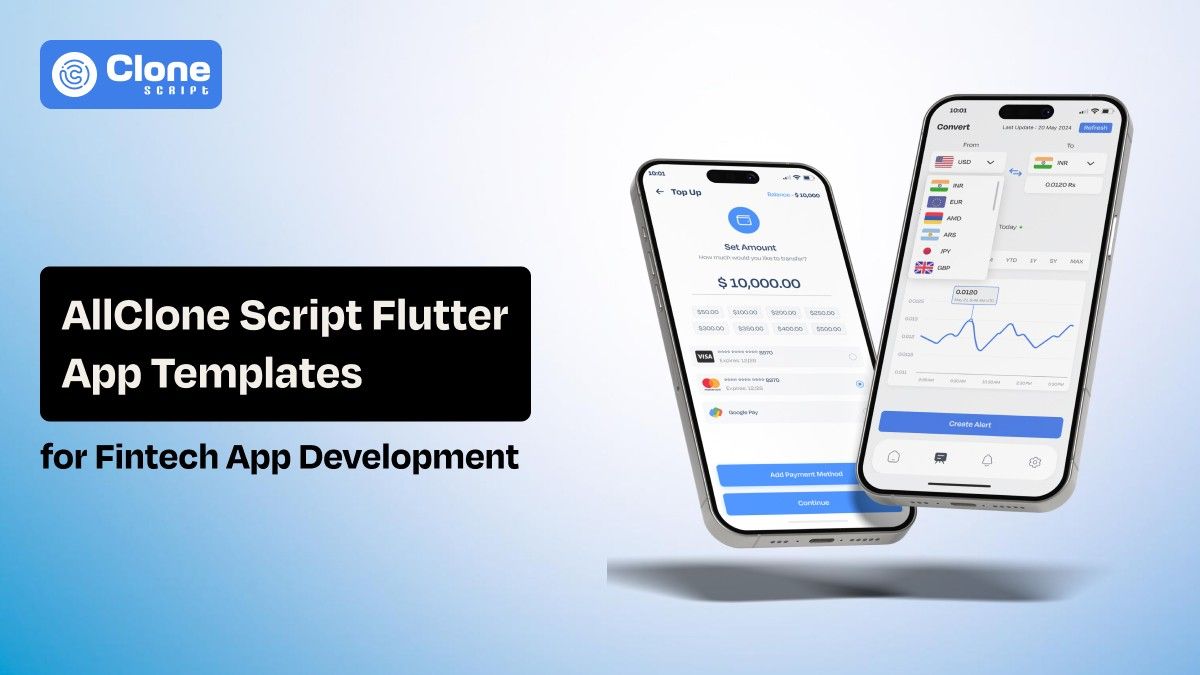
Why AllClone Script Flutter App Templates Are Useful for Fintech Development
Fintech products are making their lives easy, convenient, and safe. But behind it, the complex development cycle has been worked on that lets them manage their finances at a tap. Client approach with the least budget and top quality measurements, and at the same time, development teams are facing a time constraint issue.
This is where ready-made Flutter app templates, especially fintech-focused ones like those from AllClone Script, become more than just shortcuts. They act as structured foundations, saving time on repetitive engineering while allowing teams to focus on what actually differentiates a financial product.
This article breaks down how AllClone Script Flutter app templates help fintech development and where they fit best. We also explore why they are increasingly being used by startups and established teams alike.
Why Ready-Made Flutter Templates Matter in Modern Fintech
Using the Flutter templates, you don’t have to wait for months of design and coding to make your app live on the web and the Play Store. In recent years, fintech development has shifted significantly as new development tools are introduced, especially AI. In 2026, the following approach works.
-
Fintech Development Is No Longer Experimental
Experimenting with a fintech app is just like risking the reputation. Even a single mistake costs more than expected. Today’s app has to be optimized for:
-
Handle real money and sensitive user data
-
Operate with near-zero downtime.
-
Scale quickly once adoption begins.
This leaves little room for unstable MVPs or half-finished architectures. It means the product, from designing to deployment remain organized.
-
Speed Has Become a Competitive Advantage
To win a competitive share of fintech products, it’s important to enter the market quickly. Even with the MVP, you can launch the app and then expand beyond the basic features, while still maintain user’s trust.
As multiple companies are targeting the same financial use cases like eWallets, payments, remittance, and FX tools, the first stable product works. Here, Flutter templates reduce the time spent building foundational layers, and from there, dev teams have an advantage to validate it faster.
-
Flutter Fits Fintech Requirements Well
There’s a debate about why choose only Flutter for fintech applications. Is React not enough, or do Angular or Vue.js feel advanced? The thing here is not using the modern tech stack or going with traditional front-end frameworks. But it’s related to what is a smart approach to accomplish the client’s goals: speed with the market and cost-effectiveness.
Here are three primary reasons why Flutter outranks others:
-
A single codebase for iOS and Android helps you to deploy the same code for both platforms without writing separate code logic again. Even the web version can also work with the code if needed.
-
Consistent UI performance. Flutter bypasses native UI OEM widgets and renders its own user interface components directly to the screen.
-
Strong support for real-time updates and animations. Flutter’s code compiles with the machine code and controls the rendering process. As a result, it maintains 60+ FPS performance for visibility.
AllClone Script’s templates are built on these strengths and designed specifically for financial workflows.
What Makes AllClone Script Flutter App Templates Relevant for Fintech
There are three reasons: 1. Templates are designed by mapping financial user journeys, 2. Code structures are maintained well, and 3. To launch an MVP and production-grade app, it’s suitable.
Now, you may think that other fintech app template marketplaces are not enough to do the same? No, it’s not like that.
Look, not all templates are suitable for a specific use case, such as fintech products. Using generic UI kits on the surface appears fine, but it lacks the structure needed to establish financial logic.
AllClone Script templates stand out because they are use-case driven, not just design-driven.
-
Designed Around Financial User Journeys
We first analyze the current famous fintech apps and see what problems they are solving and what’s the gap they still miss. Then, identifying the gaps, we designed the templates.
-
Account creation and onboarding: We make it very simple, secure, and convenient from a design and code point of view.
-
Balance visibility: From color palettes to layouts and visual assets to customizability, everything is optimized for maintaining visibility.
-
Transaction flows: These templates contain a ready-made UI design along with code for transactions like pending, confirmed, scheduled, etc.
-
History tracking: We also included the layout for payment history tracking that allow user how much they spent in a week, month, or year on average.
This ground work save the time of your development team from rethinking common fintech patterns and invests more resources in complex functionality.
-
Structured Codebases That Developers Can Extend
Fintect app developers clean code structure matters more than a good UI design look. AllClone Script templates are built accordingly:
-
The code is optimized with a modular design, which means it can be reused throughout the project.
-
Customizable options allow adding new functionality in the app and prove the UVP that the fintech product is looking for.
-
Extendable with APIs, services, and compliance layers makes templates truly valuable for a development team as well client’s too.
Thinking that the Flutter app templates are just demos or prototypes has to be changed into a modern team’s important tool for product development.
-
Practical for Both MVPs and Production Builds
Usually, templates are not the first choice of fintech product owners because they feel they’re generic and don’t have any value. While development teams use it for MVP testing before a full-fledged launch.
The question is: do these templates support long-term products or stuck in between?
Surely when they paired with a proper back-end architecture, they prove be the next famous app in the fintech market.
Let’s take a look at these templates’ what they do best, how developers can leverage them, and why it’s preferable.
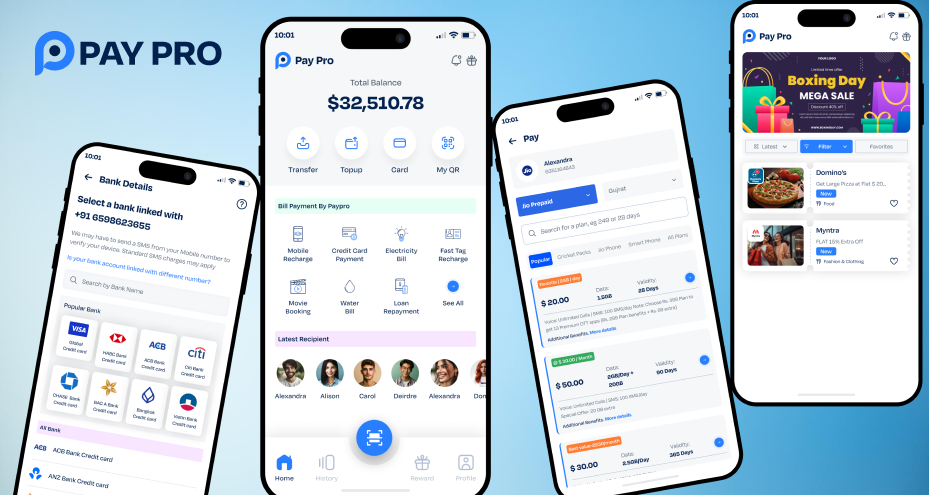
Pay Pro eWallet & Mobile Banking Flutter App: A Strong Base for Payment Products.
This Flutter template is particularly useful for teams building transaction-focused fintech solutions for payments and money transfer. Optimized for simplicity and security in mind, this template is a truly perfect choice to develop apps like Google Pay, Paytm, MobiKwik, PhonePe, and PayPal.
Where Pay Pro Fits Best?
This template is well-suited for the following use cases:
-
To develop a digital wallet application with the necessary features.
-
Having a mobile banking interface, the security is identified with the look.
-
Peer-to-peer payment systems can let users pay bills and recharge directly from their bank accounts to the respective businesses.
-
Internal finance tools for enterprises keep the data safe, useful, and organized to make decisions easily.
It already reflects user expectations around clarity and trust, two non-negotiables in financial apps.
Key Strengths from a Development Perspective
Pay Pro Flutter templates help app developers by offering the following:
-
It provides ready-made wallet and account screens that can be customized for a brand identity.
-
The logical transaction flows are structured in a way that users want. So, there is no requirement to rethink what works and what doesn’t.
-
Reducing UI inconsistency across payment journeys. The icons, sections, layouts, and functionality are tested well for that feels secure and optimized for enhanced protocols.
Instead of designing every screen manually, developers can focus on these aspects:
-
API integrations for a proven functionality.
-
Security layers to add more advanced protocols to protect user privacy.
-
Business rules are applied according to the client’s goals behind designing the fintech app.
User Experience Benefits of Using This Flutter Template
For end users, the Pay Pro app template supports:
-
Clear balance visibility with a easy to access flow.
-
Simple navigation between financial actions like paying the bills, scheduling the subscription, and money transfer at any time.
-
Familiar banking-style layouts like balance check through PIN, bank account money transfer, receiving money, and making payments to merchants are secure.
These patterns reduce cognitive load, which is critical when users are dealing with money. They do not want a single tiny compromise here.
Recommended For:
Startups launching wallet products, payment aggregators, neobank MVPs, or fintech agencies delivering client projects.
Currency Converter Flutter App: Essential for Global and FX-Focused Fintech Products
In fintech apps, only payment-related products are not famous, but nowadays, foreign exchange and currency conversion are becoming a profitable venture for businesses. That’s why this Flutter template has been designed with the essential functionality.
Currency conversion may look simple on the surface, but it plays a key role in global transactions, pricing, and transparency.

Why Currency Conversion Still Matters in 2026?
Despite advances in payments, users still need the following easily:
-
Clear exchange rates with dashboards
-
Accurate conversions
-
Simple tools to understand cross-border costs
This is especially true for these entities and businesses:
-
Remittance platforms
-
Travel fintech apps
-
Cross-border eCommerce tools
How does the Currency Converter Template help in development?
The AllClone Script Currency Converter Flutter App provides a clean foundation for:
-
Displaying multiple currencies, including FIAT, along with the crypto and commodities like Gold and Silver.
-
Handling conversion logic at the UI level prevents later fixes and refactoring that takes time and resources.
-
Presenting financial data clearly through charts, graphs, and reducing your work to do it again.
It eliminates the need to design these flows from scratch, which often leads to usability issues.
Ideal Use Cases:
FX-focused fintech startups, Payment apps with international users, and tools that need embedded currency conversion.
Reducing Development Time Without Sacrificing Code Quality
One common concern with templates is quality. In fintech, poor code structure can become expensive very quickly. You can’t take it for granted.
The advantage of using AllClone Script templates is not just speed; it’s controlled acceleration.
-
Time Is Actually Saved.
Templates reduce effort in areas like UI layout and navigation, standard fintech screen flows, and repetitive front-end logic. This frees time for back-end architecture, security audits, and performance optimization with proper code quality.
-
Avoiding Technical Debt Early.
Because these templates are structured for financial use cases, they help teams avoid consequences. It includes overly complex UI rewrites, inconsistent design patterns, and rework caused by poor early decisions. This is especially valuable for startups that plan to scale.
Customization and Scalability for Long-Term Fintech Growth
A fintech app is rarely static. Features evolve, regulations change, and user behavior shifts. Any starting point must allow growth.
-
Easy Integration with Financial APIs
AllClone Script Flutter templates can be extended to support payment gateway integration, banking APIs, and KYC and identity verification services. The templates do not prevent architectural decisions. They support them.
-
Compliance-Ready by Design
While compliance logic lives mostly on the back-end development, the front-end structure still matters. These templates make it easier to add consent screens, display compliance notices, and support audit-related UI flows. This is often overlooked during early development.
-
Modular Expansion
As the product grows, teams can add new financial modules, introduce premium features, and support additional user roles. The templates act as a base, not a limitation.
Who Should Use AllClone Script Flutter Templates for Fintech
These templates are not only for one type of team. They serve multiple audiences.
-
Development Agencies
Fintech app development agencies approached by the client to deliver the project faster. They can use these templates for multiple clients as well and maintain consistency. Also, the repetitive UI work has been reduced further.
-
Fintech Startups
Before startups introduce the new functionality in the app, launching with MVP is an approachable way. Templates allow them to do it and validate ideas with real users. It reduces initial development cost.
-
Enterprises and Financial Institutions
Large finance corporations need assurance for implementing internal tools, so with the template’s prototype, they can visualize it. In addition, it becomes easier to modernize legacy workflows and test new digital finance initiatives.
-
Product Managers and CTOs
Fintech product managers prefer to accelerate roadmap execution, and CTOs are looking to lower technical risk before investing in custom development. The Flutter template provides them a space to focus resources on differentiation and make sure the ROI is achievable.
App Templates Work as Strategic Tools, Not Just Shortcuts
One misconception about app templates is that they are shortcuts taken when quality does not matter. In fintech, the opposite is often true.
Templates like those from AllClone Script act as strategic accelerators. They help teams:
-
Avoid common UI and UX mistakes that cost in losing the market share and confidence of the users.
-
Start with patterns that users already trust and are familiar with the apps. So, the usability is optimized before it creates risks for both the development team and the client.
-
Allocate more time to security and reliability. This is important for developers to follow the local as well as international regulations to prevent user privacy from being compromised.
Using the templates in development correctly increases product quality rather than reducing it.
Aligning Templates with Fintech User Expectations in 2026
Fintech app features help users to achieve what they want. In 2026, users expect instant feedback on the actions they take, such as sending money or making a payment. They also want to access financial data with a tap that means the app has to be optimized accordingly. The predictable flow for usage is also required in the template to prevent the development team from managing it by shifting focus from the core issues.
AllClone Script templates already reflect these expectations through:
-
Structured navigation
-
Clear transaction displays
-
Familiar financial layouts
This alignment shortens the gap between development and real-world usability.
Final Thoughts: Building Smarter Fintech Apps with the Right Foundation
Fintech development is about proving that it works reliably, securely, and at scale.
AllClone Script Flutter app templates help teams start from a place of structure rather than uncertainty. Whether you are building a wallet, a payment app, or a currency-focused fintech tool, these templates reduce friction in the development process while keeping quality intact.
Consider that they do not replace engineering expertise. But they respect it.
If your goal is to launch faster, reduce risk, and build fintech apps users can trust, start with a foundation designed for financial products.
Build your fintech app smarter with AllClone Script Flutter templates.
FAQs
-
What kind of back-end programming languages work with these templates?
Flutter app templates are front-end focused and can work with any modern back-end that exposes APIs. Commonly used back-end technologies include Node.js, Java (Spring Boot), PHP (Laravel), Python (Django/FastAPI), and .NET. As long as the back-end supports REST or GraphQL APIs, it can integrate smoothly with Flutter templates.
-
Do I need to integrate payment gateways like PayPal or Stripe in template?
Yes. Most Flutter fintech templates provide UI flows and placeholders, but actual payment gateway integration must be configured separately. You’ll need to integrate gateways such as Stripe, PayPal, Razorpay, Adyen, or regional PSPs based on your target market and compliance requirements.
-
Is any license agreement associated with using the Flutter templates?
Yes. Flutter templates are typically sold under a commercial license that allows you to use, modify, and deploy the app for your business or clients. However, redistribution or resale of the source code itself is usually restricted. Always review the specific license terms provided at purchase.
-
How much cost can be saved by opting for Flutter app templates?
Using Flutter app templates can reduce development costs by 40%–70% compared to building a fintech app from scratch. Savings come from prebuilt UI, core workflows, and cross-platform code reuse, which significantly cuts design, development, and testing time.
-
Is any support available for a fintech app development if I bought templates from AllClone Script?
Yes. Typically, support includes installation guidance, documentation, bug fixes, and basic technical assistance. Advanced customization, third-party integrations, or compliance-related work may require additional development support or paid services, depending on project complexity.
-
The client approached me to have an app like PhonePe. Are these templates useful in development?
Yes, but with realistic expectations. Flutter templates are useful for building a PhonePe-like MVP or foundational architecture, including wallets, transactions, and dashboards. However, core systems such as UPI processing, banking partnerships, compliance layers, and security infrastructure must be custom-built.
-
What kind of third-party integration is required to have a functional fintech app?
A production-ready fintech app typically requires these integrations:
-
Payment gateways (Stripe, PayPal, UPI providers)
-
KYC/AML services (Sumsub, Onfido, Veriff)
-
SMS & email services (Twilio, Firebase, SendGrid)
-
Push notifications (Firebase Cloud Messaging)
-
Analytics & monitoring (Firebase, Mixpanel)
-
Fraud detection & security tools
Templates reduce UI effort but do not eliminate the need for these solutions.
-
I want to launch the fintech app for the North American and EU regions. Are these Flutter templates optimized for?
Yes, from a technical and UI perspective. Flutter supports multi-currency, localization, accessibility standards, and scalable architecture suitable for North America and the EU. However, regulatory compliance (GDPR, PSD2, PCI-DSS) and region-specific payment providers must be implemented separately before launch.