BTC - Bitcoin
 USDTERC20 - USDT ERC20
 ETH - Ethereum
 BNB - Binance
 BCH - Bitcoin Cash
 DOGE - Dogecoin
 TRX - TRON
 USDTTRC20 - USD TRC20
 LTC - LiteCoin


Best Auction Website Templates: Developer Guide for Bidding Platforms
Managing real-time complexity layered on top of standard marketplace logic is the common problem when developers are involved in auction website development. First of all, they’re not making an e-commerce system, but a bidding platform. Here, a synchronized auction, precise timing, and immediate UI updates matter.
Then, one thing stops them: starting from scratch means solving WebSocket handling, bid validation, concurrency control, and front-end state sync before even reaching core business logic.
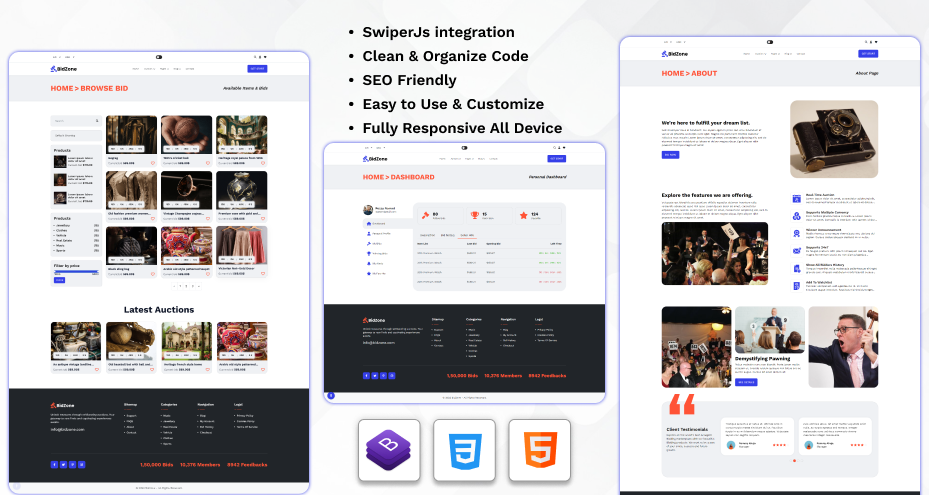
It took around 3-4 months to be completed. This is where a well-structured auction website template becomes more than a design shortcut. It provides a pre-aligned UI architecture, interaction patterns for bidding flows, and a foundation that can be wired directly into back-end services. Instead of spending cycles on layout decisions and component structuring, developers can focus on bid processing logic, performance tuning, and system reliability.
In this guide, the focus is on understanding how to evaluate, extend, and productionize them to build scalable auction platforms efficiently.
Auction Website Template Architecture: What Developers Should Evaluate Before Integration
Here are some kind of aspects to understand before downloading the auction website template and starting the work with it.

-
Component Structure & UI Modularity
The first question is “what’s included in the template.” With it, the consideration of how the structure supports integration, scalability, and real-time behavior is important. Most templates look complete at the UI level, but their internal architecture determines how efficiently they can evolve into a production-ready auction platform.
A well-structured template is separated into modular layers:
-
Auction listings
-
Bid interaction components
-
User dashboards
This becomes important once real-time data flows in. If components are tightly coupled, even small updates, like reflecting a new bid, can require unnecessary rework. A modular structure allows seamless API injection without breaking UI consistency.
-
State Handling & Data Flow Readiness
Usually, auction platforms rely heavily on dynamic states such as current bid values, countdown timers, and bidder activity. Templates that follow a predictable data flow through structured props, JSON bindings, or clear placeholders reduce back-end integration complexity.
Think that if poor state planning is executed, it often leads to UI desynchronization during live bidding. A template that already anticipates dynamic updates gives developers a strong head start.
-
Interaction Logic at Code Level
Beyond visuals, evaluate how interactive elements are structured internally. Bid buttons, timer resets, and alert states should be logically grouped and reusable.
This directly impacts the implementation of advanced features like:
-
Auto-bidding systems
-
Bid validation logic
-
Real-time notifications
If interaction logic is scattered in the auction template, extending functionality becomes inefficient.
-
File Structure & Code Maintainability
The file organization of the template influences development speed more than expected. Clean hierarchies, consistent naming conventions, and reusable UI blocks can help to enable faster onboarding and smoother server-side system integration.
The long-term design and technical debt arise when a poorly structured template is used in development for scalability.
-
Integration Flexibility (API-Ready Design)
Finally, assess whether the template is integration-friendly. Even static templates should be designed in a way that allows easy binding with APIs for front-end and back-end.
Look for the following:
-
Clear separation between UI and data layers
-
Placeholder content that maps easily to dynamic data
-
Reusable components that can be connected to endpoints
This ensures the transition from template to functional auction platform remains efficient and predictable.
How Real-Time Bidding Systems Work in Auction Websites
Here is the explanation for bidding on work on the auction website.

-
Bid Flow: From User Action to System Update
In an auction system, a single bid triggers a chain of operations that must execute within milliseconds. The flow typically starts when a user places a bid, which is sent to the server for validation. Once verified, the system updates the database and immediately broadcasts the new bid to all active users.
This isn’t just a request-response cycle. It’s a continuous synchronization process where every participant sees the same state in near real time.
-
WebSockets vs Polling: Choosing the Right Approach
Traditional HTTP polling introduces latency and unnecessary server load. For auction platforms, WebSockets (e.g., Socket.io) are the preferred approach because they maintain a persistent connection between client and server.
This allows:
-
Instant bid updates without page refresh
-
Reduced network overhead
-
Better handling of high-frequency bid events
Polling may work for low-scale systems, but it breaks under competitive, high-speed bidding scenarios.
-
Handling Concurrent Bids (Race Conditions)
One of the biggest technical challenges is managing simultaneous bids. When multiple users place bids at the same time, the system must ensure:
-
Only the highest valid bid is accepted
-
Lower or delayed bids are rejected gracefully
-
Bid order is preserved based on timestamp and server validation
This is typically handled using atomic operations or database-level locking, ensuring consistency even under heavy load.
-
Real-Time UI Synchronization
Once a bid is accepted, the website front-end must reflect changes instantly across all users. This includes:
-
Updating the current highest bid
-
Resetting or extending countdown timers
-
Highlighting the latest bidder
Any delay or inconsistency here directly impacts user trust. A well-integrated template should already support dynamic UI updates, making this synchronization easier to implement.
-
Latency & Edge Case Handling
Even with real-time systems, latency can’t be eliminated, only minimized. Developers need to handle:
-
Last-second bids (auction sniping scenarios)
-
Network delays between users
-
Temporary desynchronization
Advanced systems implement buffer windows or time extensions to ensure fairness during the final seconds of bidding.
Where Templates Fit in This System
A strong auction website template doesn’t implement real-time logic. But it prepares the UI for it. Elements like live bid sections, countdown timers, and activity feeds are already structured to accept dynamic data.
This reduces the effort required to connect WebSocket events and allows developers to focus on back-end event handling and data consistency, rather than rebuilding UI components from scratch.
Database Design for Auction Platforms (Bids, Users, Transactions)
When creating a bidding website or app, the database is important to prioritize.

-
Core Entities & Relationships
Auction systems are data-sensitive and order-dependent, which means your database design must prioritize consistency and traceability. At a minimum, the system revolves around four core entities:
-
Users relate to bidders, sellers, and admins
-
Auctions made to item details, start/end time, and status
-
Bids are designed to adjust the bid amount, user reference, and timestamp.
-
Transactions are created for final payment, the winner, and the settlement status.
The relationship between these tables must support high-frequency writes (bids) while maintaining accurate historical records.
-
Bid Table Design: Where Precision Matters
The bids table is the most critical component. It must handle:
-
Strict ordering (latest valid bid wins)
-
Timestamp accuracy (server-side, not client-side)
-
Bid validation flags (accepted, rejected, auto-bid)
A common mistake is relying only on timestamps. In high-concurrency scenarios, you need unique sequencing (e.g., auto-increment IDs or logical clocks) to resolve conflicts reliably.
-
Handling Active Auctions vs Historical Data
Separating active auction data from historical records improves performance. Active auctions require frequent reads and writes. The completed auctions are mostly read-only.
Follow this typical approach:
-
Store live auctions in a high-performance layer (e.g., Redis or optimized queries)
-
Archive completed auctions in long-term storage
This reduces query load and improves response time during peak bidding activity.
-
Data Consistency & Concurrency Control
Auction systems must prevent inconsistent states, especially during rapid bidding. This is handled through:
-
Atomic database operations (ensuring one valid update at a time)
-
Row-level locking or optimistic concurrency control
-
Validation at both the API and database levels
Without this, you risk duplicate winners or invalid bid acceptance.
-
Indexing & Query Optimization
Since bids are queried frequently, proper indexing is essential:
-
Index on auction_id + bid_amount (descending)
-
Index on timestamp for bid history
-
Optimize queries for the current highest bid retrieval
Poor indexing leads to delays that directly impact real-time updates.
-
Supporting Advanced Features Through Data Design
If you plan to implement advanced auction logic, your schema must support it from the start:
-
Auto-bidding (proxy bidding): store max bid limits per user
-
Reserve price: hidden threshold logic in the auctions table
-
Multi-vendor auctions: seller_id relationships
-
Audit logs: track every bid action for dispute resolution
Usually, the bidding website development cost covers the setup and configuration of the database. Before integrating with a live website, check if it's working or not.
How Templates Influence Database Planning
While an auction website template doesn’t define your database, it implicitly shapes your data model. UI elements like bid history, timers, and user dashboards indicate what data needs to be structured and delivered efficiently.
Auction website design is a key aspect of the front-end optimized template. It helps developers map front-end components into back-end schema and real-time data flow without rethinking the system architecture.
How to Convert an Auction Template into a Fully Functional Web App
Follow these steps to make a live auction website live using the UI design and source code template.

Step 1: Break the Template into Reusable Components
Most auction templates start as static HTML or loosely structured UI blocks. The first step is to decompose the interface into reusable components, auction cards, bid panels, timers, and user dashboards.
This allows you to:
-
Map each component to a specific data source
-
Reuse logic across multiple views
-
Maintain consistency during real-time updates
If skipped, integration becomes fragmented and harder to scale.
Step 2: Define API Contracts Before Integration
Before connecting the UI, establish clear API contracts. Every dynamic element in the template, like current bid, bid history, and user info, should correspond to a defined endpoint.
Typical endpoints include:
-
GET /auctions → list active auctions
-
GET /auction/{id} → auction details
-
POST /bid → place a bid
-
GET /bids/{auction_id} → bid history
This avoids mismatches between front-end expectations and back-end responses.
Step 3: Bind Dynamic Data to UI Layers
Once APIs are ready, replace static content with dynamic data bindings. This involves:
-
Injecting auction data into listing components
-
Updating bid values in real time
-
Rendering user-specific states (e.g., highest bidder, outbid alerts)
At this stage, the template transitions from a visual structure into a functional interface.
Step 4: Integrate Real-Time Communication
Auction platforms depend on continuous data flow, not periodic updates. Integrate WebSocket connections (e.g., Socket.io or Firebase) to:
-
Push new bids instantly to all users
-
Sync countdown timers
-
Trigger UI updates without reload
This layer connects your front-end directly to live auction events.
Step 5: Implement Authentication & User Context
Bidding is user-specific, so authentication must be integrated early. Add:
-
JWT or session-based authentication
-
Role handling (bidder, seller, admin)
-
User-specific UI states (active bids, watchlists)
Templates should be adapted to reflect user context dynamically, not just display generic views.
Step 6: Connect Payment & Transaction Flows
Once bidding logic is stable, integrate payment systems for auction completion:
-
Transaction verification
-
Order confirmation flows
Ensure the UI supports post-auction states like “won,” “lost,” or “pending payment.”
Step 7: Add Error Handling & Edge Case Logic
Static templates don’t account for failures. You need to implement:
-
Bid rejection messages (e.g., lower than the current bid)
-
Network failure handling
-
Timeout or expired auction states
This ensures the platform behaves reliably under real-world conditions.
Step 8: Optimize for Production Readiness
Before deployment, refine the system:
-
Remove unused UI components
-
Minify assets and optimize loading
-
Ensure responsiveness across devices
-
Test real-time flows under load
With these steps, it’s possible to create an eBay-like auction website with the required functionalities.
Where Templates Provide Real Value
An HTML, Bootstrap, and Tailwind CSS framework-ready auction template reduces effort in UI structuring and interaction design, but the real advantage appears during integration. It gives developers a pre-defined blueprint that aligns with auction workflows, allowing faster transition from concept to working product.
Instead of building interfaces from scratch, the focus shifts to system logic, performance, and scalability, where the real complexity lies.
Best Tech Stack for Auction Website Development
Check these stacks for technology used in the auction website.

-
Front-end Framework
Use React or Vue to handle real-time UI updates and dynamic state changes during bidding. These frameworks make it easier to manage components as bid panels, timers, and live activity feeds without UI lag.
-
Back-end System
Node.js is well-suited for event-driven bid processing and concurrent requests. Alternatives like Laravel or Django can also work, provided they integrate efficiently with real-time services.
-
Real-Time Layer
Implement WebSockets using Socket.io or Firebase to enable instant bid synchronization across all connected users, ensuring a seamless live auction experience.
-
Database & Caching
Use PostgreSQL for structured auction data and Redis for fast access to active bids and caching, improving performance under load.
-
Payment Integration
Integrate Stripe or Razorpay to manage secure transactions and post-auction settlements on the auction website.
A balanced stack ensures low latency, high concurrency handling, and reliable auction performance.
When to Move from Template to Custom System
Some criteria suggest only custom website development work rather than a designed template.
-
Feature Limitations
There’s no doubt that templates are effective for initial builds, but limitations appear when implementing auction website features, such as custom bidding rules, multi-vendor workflows, or advanced auction logic. If extending features requires workarounds, the architecture is becoming restrictive.
-
Performance Issues
As user activity grows, delays in real-time updates or API responses signal that the current structure isn’t handling concurrency efficiently. This is a clear indicator that scaling requires architectural changes. Templates don’t handle this until the back-end system supports it.
-
Maintainability Challenges
Continuous modifications to a template can introduce technical debt, making the codebase harder to maintain, debug, and extend over time. Here, custom development solves the challenges.
-
System Decoupling
Transitioning to a custom system often involves separating front-end and back-end layers. This is useful for greater flexibility and independent scaling.
-
Gradual Transition
Instead of a full rebuild, refactor high-impact components first while retaining stable modules. This is called agile development, as most of the development team prioritizes it.
The move to a custom system is driven by scalability, performance, and long-term maintainability.
Conclusion
Auction platforms require handling real-time data and concurrency, which can delay development when built from scratch. Templates provide a pre-structured UI and interaction flow, reducing repetitive work. Developers can focus on back-end logic, performance, and system stability instead of UI setup. A well-chosen template supports future growth and feature expansion without rework.
Auction website templates act as development accelerators, helping teams launch faster while maintaining flexibility and scalability.