BTC - Bitcoin
 USDTERC20 - USDT ERC20
 ETH - Ethereum
 BNB - Binance
 BCH - Bitcoin Cash
 DOGE - Dogecoin
 TRX - TRON
 USDTTRC20 - USD TRC20
 LTC - LiteCoin

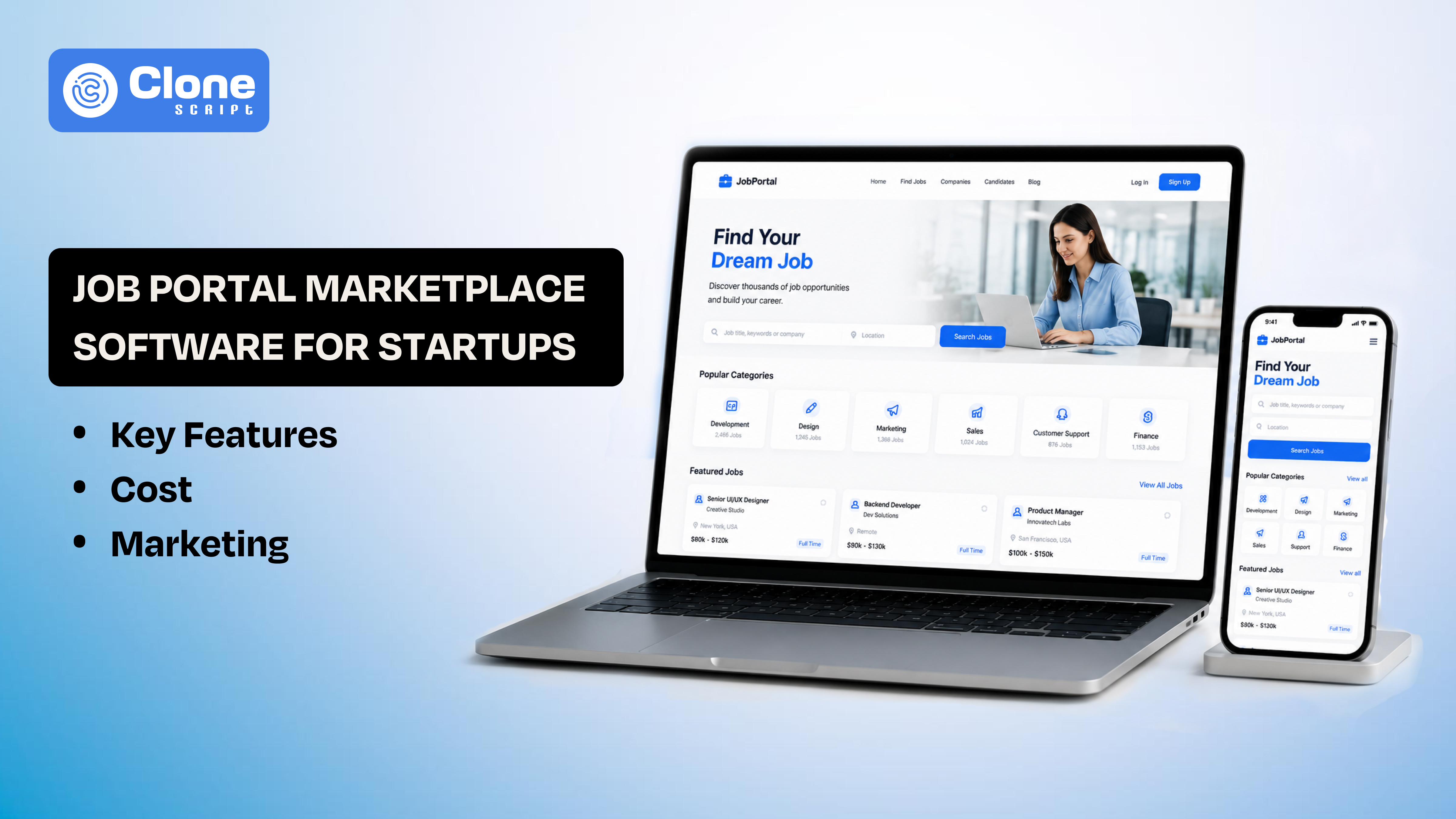
Job Portal Marketplace Software for Startups: Key Features, Cost, Marketing
Most startup founders approach job portal marketplaces the wrong way.
First, they assume success comes from building a platform filled with features, including job listings, filters, dashboards, and maybe a mobile app like Apna and Naukari. So they invest months (and tens of thousands of dollars) into software development only to launch into a silent market with no traction, no users, and no revenue.
So, does the idea make the problem? No. The recruitment marketplace business model is proven.
Platforms like global hiring ecosystems have demonstrated that connecting employers and candidates at scale can create high-margin, defensible SaaS businesses.
Then what is the challenge? Execution specifically, understanding that a job portal is not just a product. It’s a two-sided marketplace that depends on timing, liquidity, and user behavior.
Here’s the reality:
-
Without enough job listings, candidates won’t join
-
Without candidates, employers won’t pay
-
Without a clear niche, you compete with established players and lose
This creates what’s known as the marketplace cold-start problem, and it’s the single biggest reason job portal startups fail.
At the same time, the opportunity has never been stronger.
With the rise of remote work, skill-based hiring, and AI-driven recruitment, startups can now build highly focused, intelligent job platforms that outperform generic job boards.
This explains and breaks down exactly how to do that, starting with the foundation that determines everything else: your feature strategy.
Key Features of Job Portal Marketplace Software That Actually Drive Growth
When you see readily available job board software features, think it’s good to have. But in reality, it depends on what you’re trying to achieve.
In a recruitment marketplace, features are not just functionality. They directly impact:
-
User acquisition
-
Retention
-
Revenue generation
So instead of listing everything equally, let’s focus on the features that actually move the business forward. This is required to build a job portal startup to achieve growth.
-
Structured User Profiles: The Foundation of Matching
At first glance, user profiles seem basic. In reality, they are the data engine of your platform.
A typical mistake is allowing unstructured profiles like random resumes, incomplete data, and inconsistent formats. This leads to poor search results and weak recommendations.
High-performing platforms structure profiles around:
-
Skills and competencies
-
Experience levels
-
Industry tags
-
Salary expectations
-
Work preferences (remote, hybrid, onsite)
Why this matters:
Structured data enables the following:
-
Better search accuracy
-
Stronger AI matching
-
Higher-quality job recommendations
In practical terms, this directly increases application rates and user satisfaction.
-
Advanced Search: Your Primary Growth Lever
Search is not just a feature in a job board platform. It’s your largest traffic and engagement driver.
When users land on your platform, they are not browsing randomly. They have intent.
If your search experience is weak, they leave.
Modern job portal software must go beyond basic filters and support:
-
Multi-layered filtering (skills, salary, experience, location)
-
Semantic search (understanding intent, not just keywords)
-
Dynamic result ranking
Example:
A user searching for “remote back-end developer jobs with Node.js” should not see generic developer roles. They expect precise, relevant results immediately.
3. AI-Powered Matching: The Real Differentiator in 2026
This is where most startups either win or fall behind: Artificial Intelligence-based job matching.
Traditional job portals rely on manual filtering. Modern platforms use AI to:
-
Parse resumes automatically
-
Extract and standardize skills
-
Match candidates with relevant roles
-
Rank applicants for employers
Why this is critical:
Hiring speed has become a competitive factor across business sectors like e-commerce, retail, and even service segments like banking, automobiles, etc.
Platforms that reduce time-to-hire by even 20–30% create significant value for employers, and that’s what they are willing to pay for.
4. Employer Dashboard: Where Revenue Is Won or Lost
Employers are your paying customers. Their experience determines your revenue.
A strong dashboard should allow employers to:
-
Post and manage jobs easily
-
Track applications in real time
-
Filter and shortlist candidates
-
Access performance analytics
But here’s the key insight: Employers don’t just want applicants. They want qualified applicants.
That’s why integrating an Applicant Tracking System (ATS) directly impacts whether employers stay and continue paying.
5. Candidate Experience: The Retention Engine
Many platforms over-optimize for employers and ignore candidates. That’s a mistake.
Candidates drive hiring marketplace liquidity. Without them, the platform collapses.
Your goal should be to make applying for jobs fast, clear, and frictionless.
Essential features include:
-
One-click applications
-
Application tracking dashboards
-
Personalized job alerts
Simple rule: If applying feels like work, users will drop off.
6. Built-In Communication: Reducing Hiring Friction
Delays in job posting and applying will harm hiring momentum.
Job portals rely on external communication (email chains, manual follow-ups) create friction.
Instead, we recommend integrating:
-
In-app messaging
-
Interview scheduling tools
-
Automated notifications
This keeps users inside your ecosystem and improves conversion rates from application to hire.
From Features to Economics: What It Really Costs to Build a Job Portal Marketplace
Once your feature strategy is clear, the next step is to know the cost to build and sustain the platform. This depends on scope, architecture, and long-term goals. More importantly, your cost decisions will directly influence speed to market, scalability, and profitability.
-
MVP Job Portal Development Cost: Buying Speed and Validation
For most startups, the first goal is validation.
An MVP (Minimum Viable Product) software development should include only the features that allow:
-
Employers to post jobs
-
Candidates to create profiles and apply
-
Basic search and filtering
The typical investment for this kind of application will cost $15,000 – $40,000, and the timeline is 8–16 weeks.
At this stage, avoid the following:
-
Complex AI systems
-
Over-engineered dashboards
-
Advanced analytics
Why this approach works:
You are not building a full product. You are testing:
-
Is there demand in your niche?
-
Are users engaging?
-
Will employers pay?
Spending heavily before answering these questions is where most startups lose capital.
-
Scaling Cost: Turning a Product into a Business
Once validation is achieved, the focus shifts from “Does this work?” to “Can this job posting marketplace scale?”
This is where costs increase significantly.
There is an estimated investment of $50,000 – $150,000+.
This phase includes:
-
AI-powered matching systems
-
Scalable cloud infrastructure
-
Advanced employer dashboards
-
Security and compliance layers
What changes here:
You are building systems:
-
That handles thousands of users
-
That process large datasets
-
That delivers consistent performance
This is the difference between a tool and a platform.
-
Ongoing Costs: The Part Most Founders Underestimate
Building the platform is only the beginning. Operating it is where real costs emerge.
| Category | Monthly Estimate |
|---|---|
| Cloud Infrastructure | $200 – $2,000 |
| Maintenance & Updates | $1,000 – $5,000 |
| Marketing & Growth | $2,000 – $10,000 |
These job portal development costs scale with usage. For example:
-
More users → higher server load
-
More data → higher storage costs
-
More competition → higher acquisition spend
Key insight: A job portal is not a one-time investment. It is a continuously evolving system.
-
Hidden Costs That Break Budgets
Even well-planned startups face unexpected expenses. The most common ones include:
-
Third-party integrations (payment gateways, job feeds, analytics tools)
-
Data storage scaling as resumes and job listings grow
-
Security and compliance requirements
-
Performance optimization under high traffic
Practical rule: Add a 20–30% contingency buffer to your total budget.
How to Build a Job Portal Marketplace Without Wasting Time or Capital
Understanding cost is important, but execution determines success.
Most failed platforms don’t fail because of bad technology. They fail because of poor sequencing of decisions.
Here’s a structured approach that aligns with how successful hiring marketplaces are built.
Step 1: Start Narrow to Win Faster
Trying to serve everyone is the fastest way to fail. Instead, define a niche where:
-
Demand exists
-
Competition is fragmented
-
Users have a clear problem
Examples:
-
Remote tech hiring
-
Healthcare staffing
-
Blue-collar workforce platforms
Why this works:
Niche platforms reach liquidity faster, which is critical in recruitment marketplace businesses.
Step 2: Solve One Side of the Marketplace First
A common mistake is trying to acquire both employers and candidates simultaneously.
This splits focus and slows growth.
Instead, try the following:
-
Start with employers (revenue side)
-
Or start with candidates if you already have access to talent
Goal: Build a strong supply on one side before expanding into a scalable platform.
Step 3: Choose the Right Development Approach
Your build strategy for the job portal marketplace impacts both cost and speed.
There are three options to choose from.
-
Custom development
In this method, you have maximum flexibility to manage the entire job search marketplace. From front-end website development to back-end development and integration has been managed through a custom solution. But the cost rises higher, and it takes a long time to be completed.
-
Ready-made solutions as white-label clone scripts
With a clone script, you have a chance to launch the app or website for a marketplace quickly. You have to spend a lower upfront cost. By customizing the platform, you can list it as yours on the Play Store and the web. Most startups opt for this option when having a limited budget.
-
Hybrid approach
Before scaling a platform to an enterprise-grade one, it’s beneficial to start with a minimum risk, and here, a white-label solution becomes important. Once you have enough users and need advanced features to help employers hire skilled candidates, then you can move towards custom development.
Recommendation: Start lean. Upgrade as your business grows.
Step 4: Design for Scalability Early (But Not Excessively)
Many founders either ignore scalability completely or over-engineer from day one.
Both are costly for job portal development.
Instead, focus on cloud-based hosting, modular architecture, and API-ready systems become important to scale.
This ensures you can scale without rebuilding everything later.
Step 5: Launch Fast, Then Iterate Relentlessly
Speed is a competitive advantage in software application development.
Once your MVP is ready:
-
Launch to a small audience
-
Collect real user feedback
-
Track behavior and engagement
Then improve based on data, not assumptions.
Marketing a Job Portal Marketplace: Where Sustainable Growth Comes From
Building a strong platform is only half the equation. Without a consistent flow of employers and candidates, even the most feature-rich product will struggle to gain traction.
In the recruitment marketplace, distribution is the real growth driver. The platforms that succeed are not necessarily the ones with the most features, but the ones that reach the right audience, communicate clear value, and create repeat engagement.
Here’s how to approach growth in a structured and scalable way.
-
Niche Positioning: Start Focused to Scale Faster
Before investing in ads or partnerships, you need clarity on two fundamentals:
-
Who is your platform built for?
-
What specific problem are you solving better than existing options?
Broad positioning leads to weak messaging and high acquisition costs. In contrast, a focused approach allows you to build relevance quickly.
For example:
-
A platform dedicated to remote developers
-
A marketplace focused on healthcare staffing
This level of specificity improves:
-
Audience targeting
-
Conversion rates
-
Organic visibility over time
When users instantly recognize that your platform is built for them, acquisition becomes significantly easier.
-
SEO as a Long-Term Growth Channel
Search remains one of the most reliable and scalable acquisition channels, especially for platforms that rely on consistent inbound traffic. Website search engine optimization is important to get qualified leads from both job seekers and employers.
Instead of targeting broad terms, focus on:
-
Long-tail queries (specific job roles, skills, or industries)
-
Industry-focused searches (niche hiring needs)
-
Location-based intent (city, country, or remote roles)
Effective content strategies include:
-
Addressing common hiring challenges
-
Publishing salary benchmarks and industry reports
-
Creating practical career guidance content
This approach allows you to attract users with high intent, which typically results in better engagement and conversion.
-
Community-Led Growth: Building Trust Before Transactions
Communities are often overlooked, yet they are one of the most effective ways to build early traction.
Instead of relying entirely on paid channels, invest in spaces where your target audience already interacts:
-
Professional groups and forums
-
Private communities on Slack or Discord
-
Industry-specific discussion platforms
Why this works:
Communities create familiarity and trust before users ever interact with your product.
Over time, this leads to:
-
Higher-quality user acquisition
-
Stronger engagement
-
Reduced dependence on paid marketing
-
AI-Driven Acquisition: Personalization at Scale
As your platform grows, manual marketing efforts become inefficient. This is where automation and AI play a critical role.
Modern platforms use AI to:
-
Deliver personalized email campaigns based on user behavior
-
Segment users into meaningful groups
-
Recommend relevant opportunities dynamically
The impact is measurable:
-
Higher open and click-through rates
-
Improved conversion from visitor to user
-
Increased retention through relevant experiences
Personalization is no longer optional. It’s expected.
-
Founder-Led Growth: The Early Traction Advantage
In the early stages, growth is rarely automated. To build a job portal startup, it is driven by direct effort from the founding team.
This includes:
-
Reaching out to early employers and candidates
-
Building credibility through professional networks
-
Forming partnerships with companies in your niche
Why this approach works:
Early adopters are not acquired through ads. They come through trust, conversations, and relationships.
This hands-on approach also provides valuable insights into:
-
User needs
-
Market gaps
-
Product improvements
All Clone Script Helps You Launch a Recruitment Marketplace Faster
Building a job marketplace from scratch can cost $30,000+ and take months to launch, which is not ideal for startups testing a new idea. All Clone Script offers a practical alternative by providing a pre-built job portal solution that significantly reduces both cost and development time.
With this approach, you get essential features like job posting, candidate profiles, search filters, and admin controls ready to use. This allows you to launch your platform within weeks instead of months, helping you validate your business model faster.
As your platform grows, we also support custom development, enabling you to add advanced features, improve user experience, and scale based on your niche requirements.
This combination of low initial cost, fast deployment, and flexibility makes it easier for startups to enter the market without heavy upfront investment while still planning for long-term growth.
Contact us now.
Conclusion: Building More Than a Platform
A job portal marketplace is not just a product. It is a living system.
Its success depends on:
-
How well it matches users
-
How quickly it creates value
-
How efficiently it scales
Startups that succeed in this space do not just build software. They build:
-
Distribution channels
-
Data engines
-
Trust-based ecosystems
If you approach it with the right strategy, an online recruitment marketplace can become a highly scalable, defensible business.