BTC - Bitcoin
 USDTERC20 - USDT ERC20
 ETH - Ethereum
 BNB - Binance
 BCH - Bitcoin Cash
 DOGE - Dogecoin
 TRX - TRON
 USDTTRC20 - USD TRC20
 LTC - LiteCoin

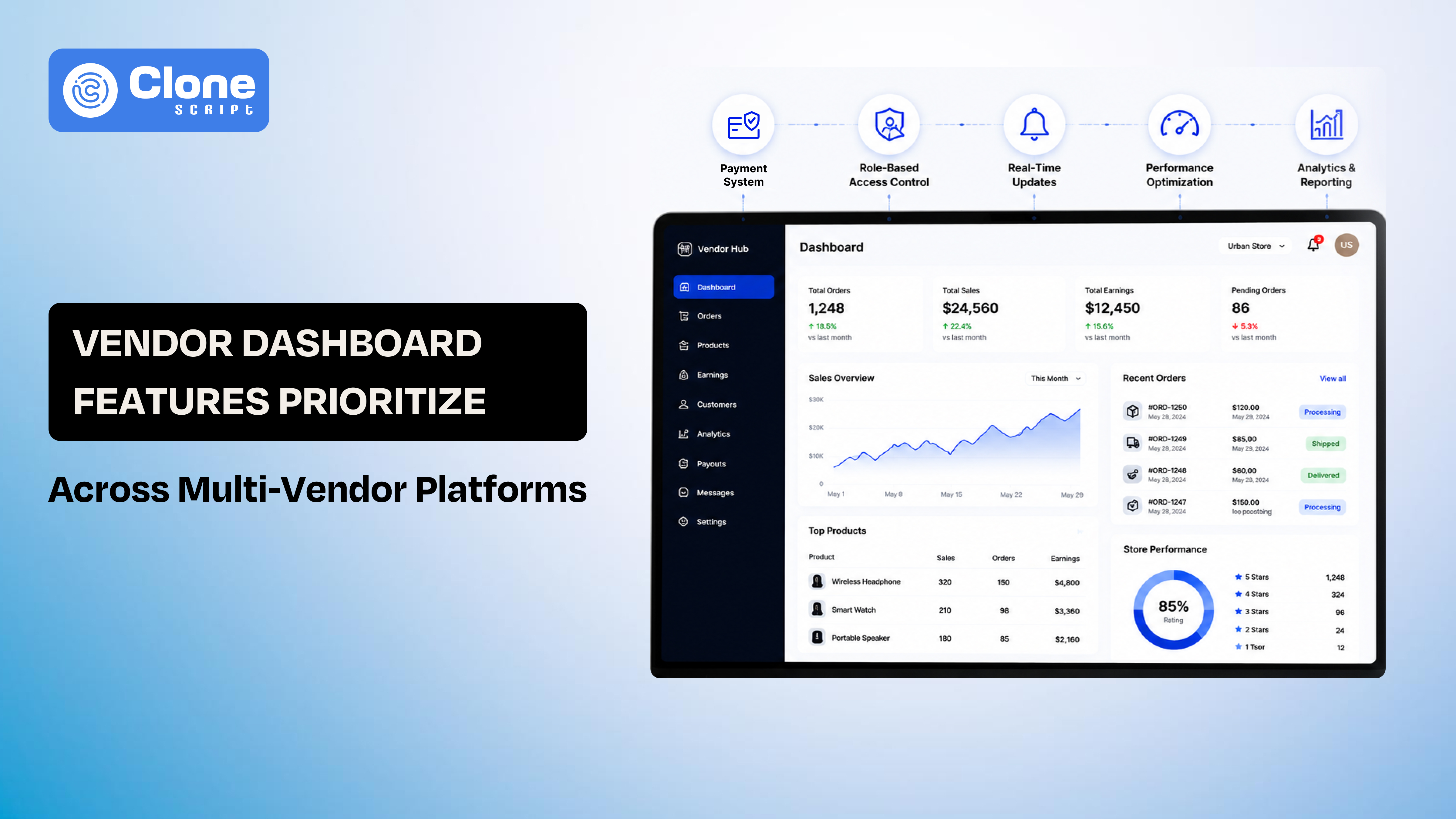
Vendor Dashboard Features Prioritize Across Multi-Vendor Platforms
In any multi-vendor platform, the vendor dashboard is the operational command layer that determines how efficiently supply-side participants interact with the system.
The fact is that most marketplaces focus heavily on customer experience. On the other side, vendor experience quietly dictates retention, fulfillment quality, and long-term scalability.
Do you know what happens when the vendor dashboard is compromised?
-
The workflow may be fragmented
-
The operations experience delays
-
The support dependency has to be increased
This all causes problems for suppliers to struggle to manage inventory, track orders, or reconcile payments, which directly impacts platform reliability. A well-structured, designed dashboard with UI and UX principles helps vendors to operate independently, reducing friction and enabling scale.
From a systems perspective, the vendor dashboard is a distributed interaction layer sitting on top of multiple back-end services such as catalog, order management, payments, analytics, and notification systems. Designing it requires careful thinking around performance, data consistency, and extensibility rather than just feature completeness.
Feature Prioritization Framework: MVP to Scale
There are three levels to consider when adding a feature to your multi-vendor marketplace dashboard:
-
MVP Stage (0–100 Vendors)
At the earliest stage, the goal is to establish a functional baseline without introducing unnecessary architectural complexity. This is called MVP development.
-
Product management: Vendors need the ability to create, edit, and organize listings while maintaining structured data consistency across catalog schemas.
-
Order handling: A simple order lifecycle ensures vendors can accept, process, and complete orders without operational confusion or dependency on manual support.
-
Earnings visibility: Basic revenue tracking builds trust by allowing vendors to monitor incoming payments and validate transaction accuracy over time.
At this stage, a modular monolith architecture is sufficient. The focus should remain on reliability rather than scalability.
-
Growth Stage (100–1,000 Vendors)
As vendor count increases, system behavior becomes less predictable. Concurrency, latency, and operational visibility start to matter.
-
Analytics dashboards: Vendors require deeper insights into sales trends, customer behavior, and product performance to make informed decisions consistently.
-
Notification systems: Real-time alerts for orders, payments, and stock changes ensure vendors respond quickly without relying on manual dashboard checks.
-
Role-based access: Vendor teams require controlled access levels so staff members can manage operations without exposing sensitive financial or administrative controls.
At this stage, introducing asynchronous processing and service separation begins to provide measurable benefits.
-
Scale Stage (1,000+ Vendors)
At scale, the dashboard must handle high throughput, distributed data systems, and real-time interactions.
-
Event-driven architecture: System events replace synchronous workflows, enabling faster processing and reducing issues caused by tightly coupled service dependencies.
-
Automation workflows: Repetitive vendor actions such as inventory updates or order confirmations are automated to improve efficiency and reduce manual intervention.
-
Observability tooling: Monitoring, logging, and tracing systems become essential for debugging issues and maintaining operational transparency across services.
At this level, architecture decisions directly influence platform stability and growth potential.
Core Vendor Dashboard Features with Technical Depth
See what key features are useful for the dashboard to integrate with:
-
Product and Inventory Management
Product systems must be designed for flexibility and performance, especially when dealing with large catalogs and frequent updates.
-
Catalog service separation: Decoupling catalog logic from order systems improves scalability and allows independent optimization of read and write operations.
-
Bulk operations: Vendors should be able to upload and update products in batches through asynchronous processing pipelines without blocking system performance.
-
Version control: Maintaining product history enables rollback capabilities, which are critical when incorrect data updates affect pricing, descriptions, or availability.
A well-designed inventory system also ensures synchronization between stock levels and order allocation, reducing overselling risks.
-
Order Management System (OMS)
Order management is the most critical operational component in a vendor dashboard.
-
Event-based lifecycle: Each order transition emits an event, ensuring downstream systems react independently without creating tight coupling across services.
-
Async processing: Inventory checks, payment confirmations, and notifications should be handled through queues to prevent delays in user-facing workflows.
-
Status tracking: Vendors need clear, real-time visibility into order states to manage fulfillment efficiently and avoid customer dissatisfaction.
This approach increases resilience and allows the system to handle spikes in order volume without degradation.
-
Payments and Payouts Engine
Financial operations require strict consistency and traceability.
-
Ledger-based accounting: Instead of updating balances directly, every transaction is recorded as an immutable ledger entry to maintain financial integrity.
-
Settlement workflows: Payments are processed in stages, ensuring accurate reconciliation between platform commissions, vendor earnings, and refunds.
-
Dispute handling: Systems must account for chargebacks, cancellations, and adjustments without corrupting financial records or introducing inconsistencies.
Building this correctly from the beginning prevents complex financial errors later.
Advanced Features Most Platforms Overlook
In the vendor dashboard of multi-vendor platforms, these features have to be present:
-
Event-Driven Real-Time Updates
Traditional polling mechanisms fail at scale and create unnecessary load on back-end systems.
-
Event streaming: Back-end systems publish events that propagate changes instantly across services, ensuring dashboards accurately reflect real-time operational data.
-
WebSocket updates: Front-end developed dashboards receive live updates without refresh cycles, significantly improving responsiveness and the vendor experience.
-
Decoupled communication: Services interact through events rather than direct calls, reducing dependencies and improving system fault tolerance during partial failures.
This architecture significantly improves responsiveness and scalability.
-
Multi-Tenant Data Isolation
Handling multiple vendors securely within a shared system requires careful data modeling.
-
Row-level isolation: Data is separated using tenant identifiers, ensuring each query applies strict filtering rules to prevent cross-vendor data exposure.
-
Schema-level isolation: Vendors operate within isolated database schemas, improving security but increasing complexity in migrations and maintenance workflows.
-
Database-per-tenant: Each vendor has a dedicated database, offering maximum isolation while introducing significant infrastructure and cost overhead.
Most platforms adopt row-level isolation with strict enforcement mechanisms for optimal balance.
-
Role-Based Access Control (RBAC)
Vendor dashboards often require more granular permissions than basic role definitions.
-
Multi-role systems: Vendors can assign roles such as manager, staff, or finance, each with controlled access to specific dashboard features and actions.
-
Policy-based control: Permissions are defined through rules rather than hardcoded logic, allowing dynamic updates without requiring code changes or deployments.
-
Security enforcement: Access validation must occur at both front-end and back-end layers to prevent unauthorized operations through API manipulation.
Poor RBAC design leads to security vulnerabilities and operational confusion.
-
Vendor Performance Scoring
Ranking vendors effectively improves marketplace quality and customer experience.
-
Operational metrics: Performance scores incorporate fulfillment speed, cancellation rates, and delivery accuracy to evaluate vendor reliability objectively.
-
Customer feedback: Ratings and reviews contribute to scoring, influencing vendor visibility and trust within the platform ecosystem.
-
Algorithmic weighting: Different metrics are weighted based on business priorities, allowing platforms to promote vendors who meet strategic goals.
This system directly impacts marketplace dynamics and growth.
-
Observability and Audit Logs
Debugging distributed systems without observability is nearly impossible.
-
Activity logs: Every vendor action is recorded, providing traceability for operational changes and accountability across teams and processes.
-
Distributed tracing: Requests are tracked across services, enabling software developers to identify latency issues and issues within complex workflows.
-
Performance metrics: System health indicators such as response time, error rates, and throughput help maintain stability and optimize performance continuously.
Observability reduces downtime and improves system reliability.
-
Fraud Detection Systems
Fraud prevention is essential for protecting both vendors and customers.
-
Behavior tracking: Systems monitor unusual patterns such as sudden price drops or abnormal order spikes that may indicate fraudulent activity.
-
Rule-based alerts: Predefined conditions trigger alerts, allowing administrators to review and take action before issues escalate further.
-
Adaptive models: Over time, machine learning models can improve detection accuracy by learning from historical fraud patterns and behavioral anomalies.
Early implementation reduces long-term risk significantly.
Architecture Considerations in Dashboard Design
Before making any of the dashboards for the multi-vendor platforms, these design aspects have to be followed.
-
Monolith vs Microservices
Choosing the right architecture depends on the growth stage and operational complexity.
-
Monolith advantages: Simpler deployment and faster development make it ideal for early-stage platforms with limited vendor and traffic volume.
-
Microservices benefits: Independent scaling and service isolation improve resilience and flexibility as the platform grows and diversifies functionality.
-
Hybrid approach: Gradually extracting services from a monolith allows teams to balance complexity with scalability during transition phases effectively.
Premature microservices adoption leads to unnecessary overhead.
-
Communication Patterns
Efficient communication between services is critical.
-
Polling limitations: Continuous API requests increase system load and introduce latency, making them unsuitable for real-time dashboard updates.
-
Webhooks efficiency: Event-driven notifications allow systems to react instantly, reducing unnecessary requests and improving responsiveness significantly.
-
Streaming systems: Message brokers enable high-throughput communication, supporting real-time data synchronization across distributed services efficiently.
Combining webhooks with streaming systems provides optimal performance.
-
Caching Strategies
Caching improves performance and reduces database load.
-
In-memory caching: Frequently accessed data is stored in fast-access memory systems to reduce repeated database queries and improve response times.
-
Edge caching: Static assets and dashboard resources are served through content delivery networks, improving load speed for global users.
-
Cache invalidation: Proper strategies ensure data consistency by updating or clearing cached entries when underlying data changes occur.
Effective caching is essential for scalability.
-
Data Consistency Models
Different components require different consistency guarantees.
-
Strong consistency: Critical operations such as payments and inventory updates require immediate accuracy to prevent financial errors or overselling issues.
-
Eventual consistency: Analytics and reporting systems can tolerate slight delays, allowing systems to scale without sacrificing performance efficiency.
-
Conflict resolution: Distributed systems must handle data conflicts accordingly, ensuring system integrity without manual intervention during inconsistencies.
Balancing consistency and performance is a key design challenge.
Extensibility and Developer Experience in Vendor Dashboard Development
These kinds of aspects have to be known in vendor dashboard creation:
-
Plugin Architecture
Extensibility allows vendors to customize their workflows.
-
Custom modules: Vendors can integrate tools such as CRM or ERP systems directly into the dashboard, improving operational efficiency significantly.
-
Feature extensions: Plugins enable additional functionality without modifying core platform code to reduce development overhead and maintenance complexity.
-
Marketplace ecosystem: Third-party developers can build integrations, expanding platform capabilities, and creating new revenue opportunities for operators.
This approach increases platform adaptability.
-
API-First Design
Modern dashboards should be built on APIs.
-
Decoupled front-end: The dashboard interface communicates with back-end services through APIs, allowing independent evolution of front-end and back-end systems.
-
Multi-platform support: APIs enable mobile apps, third-party tools, and integrations to access platform functionality without duplicating logic.
-
Version control: API versioning ensures backward compatibility, preventing disruptions when introducing new features or modifying existing endpoints.
API-first design in front-end and back-end improves flexibility and scalability.
-
Webhooks for Integration
Webhooks enable seamless external communication.
-
Event notifications: Vendors receive real-time updates about orders, payments, and inventory changes, reducing reliance on manual dashboard monitoring.
-
System integration: External systems can react automatically to events, improving operational efficiency and reducing manual intervention requirements.
-
Scalable workflows: Event-driven integrations allow platforms to scale without increasing complexity in synchronous communication patterns.
Webhooks are essential for modern ecosystems.
Scaling Vendor Dashboards to Thousands of Users
Scaling requires deliberate architectural planning.
-
Horizontal scaling: Stateless services allow systems to distribute load across multiple instances, improving reliability and handling increased traffic efficiently.
-
Queue systems: Background processing ensures heavy operations do not block user interactions, maintaining smooth dashboard performance during peak loads.
-
Read optimization: Separating read and write databases improves query performance, especially for analytics-heavy dashboard components.
Additionally, rate limiting prevents abuse and ensures fair resource usage across vendors.
Common Pitfalls to Avoid in Dashboard Design
These mistakes don’t have to exist during the dashboard development.
-
Synchronous processing overload: Performing heavy operations in real time increases latency and degrades user experience significantly during high traffic conditions.
-
Weak permission systems: Inadequate access control exposes sensitive data and creates security risks that are difficult to resolve later.
-
Lack of observability: Without logging and monitoring, identifying system issues becomes time-consuming and negatively impacts platform reliability.
-
Overcomplicated UI: Excessive features without a clear structure reduce usability and slow down vendor workflows unnecessarily.
Avoiding these pitfalls improves long-term sustainability.
Conclusion
Vendor dashboards are not simple feature collections. They are complex, distributed control systems that define how efficiently a marketplace operates. Every architectural decision, from data modeling to communication patterns, directly impacts vendor experience and platform scalability.
The most successful platforms prioritize:
-
Clear separation of services
-
Event-driven workflows
-
Strong observability
-
Extensible design
By focusing on these principles early, software developers and product teams can build vendor dashboards that not only support current operations but also scale seamlessly as the marketplace grows.
FAQ
-
What architecture is best for vendor dashboards?
A modular monolith works initially, but event-driven microservices become necessary as vendor count, traffic, and system complexity increase significantly.
-
How can real-time updates be implemented efficiently?
Using event streaming combined with WebSockets ensures dashboards receive updates instantly without excessive polling or unnecessary back-end load.
-
What is the best approach to vendor data isolation?
Row-level isolation with strict query enforcement provides a scalable balance between security, performance, and operational complexity for most platforms.
-
How should vendor dashboard APIs be structured?
An API-first design with versioned endpoints, webhooks, and proper authentication ensures flexibility, scalability, and long-term maintainability across integrations.
-
What are the common performance bottlenecks in the vendor dashboard?
Synchronous operations, inefficient database queries, and a lack of caching mechanisms significantly impact performance as vendor activity and system load increase.
-
How do you scale to thousands of vendors?
Use horizontal scaling, background job queues, optimized databases, and caching layers to maintain performance and reliability under high concurrency conditions.