BTC - Bitcoin
 USDTERC20 - USDT ERC20
 ETH - Ethereum
 BNB - Binance
 BCH - Bitcoin Cash
 DOGE - Dogecoin
 TRX - TRON
 USDTTRC20 - USD TRC20
 LTC - LiteCoin

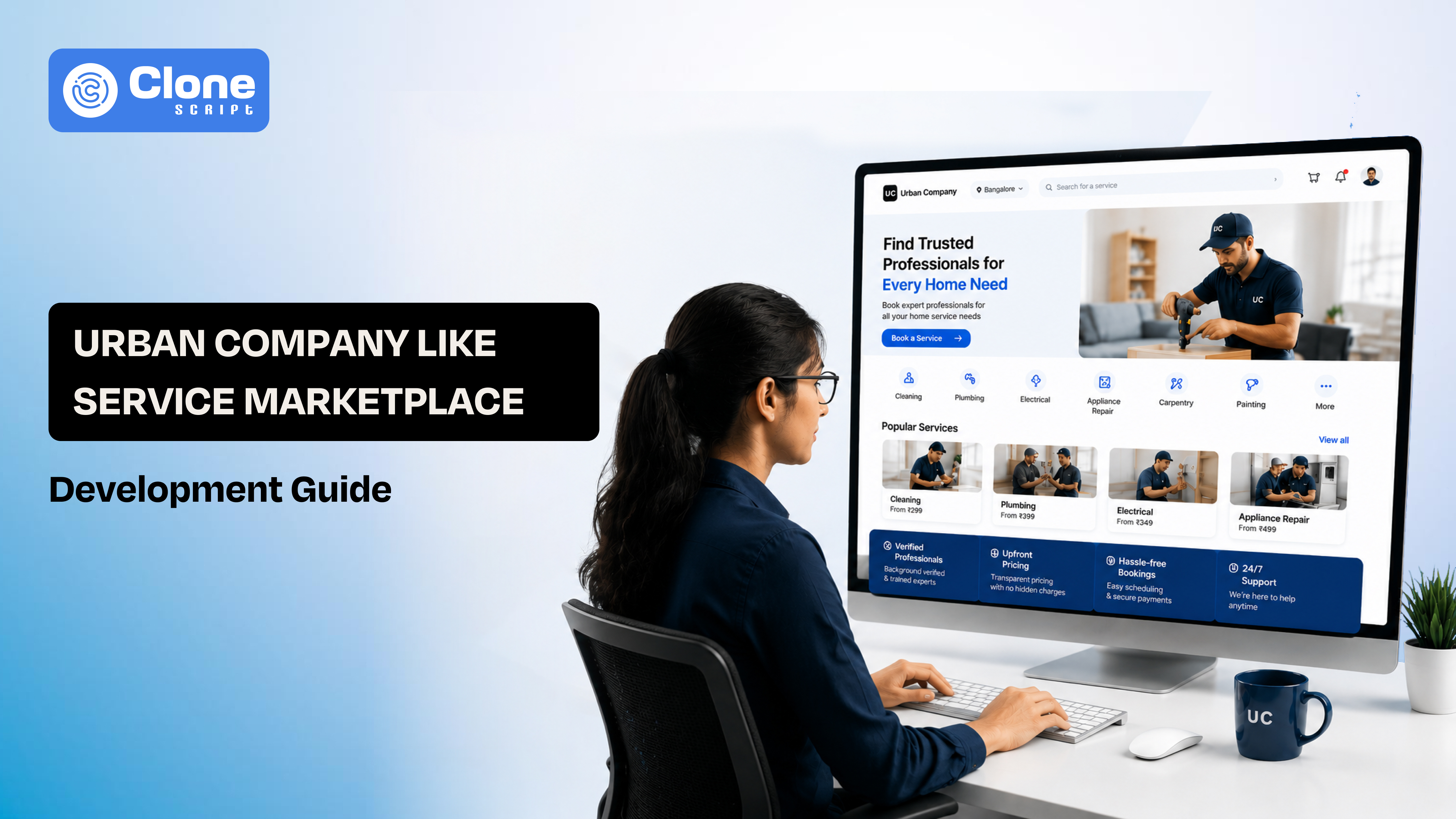
Urban Company Service Marketplace Platform Development: Cost, Features & MVP
How do you actually build a service marketplace platform that gains traction instead of becoming another failed app?
Many founders start with the unique website idea of creating an Urban Company-like solution, but quickly run into practical questions.
-
How do you start a service marketplace business without burning capital?
-
What does a realistic cost breakdown look like?
-
And more importantly, how do you validate demand before investing in full-scale development?
The challenge is not just building features anymore to stand out. It is proving that your marketplace can function in real conditions. That is important. From defining the right lean MVP for a service marketplace startup to planning a workable go-to-market strategy, every early decision directly impacts growth.
This guide walks through that journey, helping you move from concept to a scalable platform with clarity and control.
Urban Company Business Model Breakdown
When you see the Urban Company website or app, everything looks to be simple. Just connect users with service providers and take a commission. The problems have started from here.
Urban Company succeeds because it avoids the “open marketplace” trap. Instead of allowing unrestricted listings, it builds a curated network of service professionals.
-
The Controlled Supply Model (Quality Over Quantity)
One of the biggest differentiators is how supply is managed.
Rather than onboarding providers at scale without checks, the platform introduces structured onboarding, verification, and sometimes training. This reduces service variability, which is a common failure point in early-stage marketplaces.
This approach leads to:
-
More predictable service outcomes
-
Higher customer satisfaction
-
Stronger brand trust from the beginning
For founders, this highlights an important shift in thinking: more providers do not always mean better growth. The right providers do.
-
Revenue Model: Beyond Just Commission
Many founders assume that commission is the only viable revenue stream. While it remains the primary driver, relying solely on it limits scalability and profitability.
Urban Company expands revenue through multiple layers:
-
Commission per completed booking (core revenue)
-
Subscription or membership access for service professionals
-
Priority listing or lead visibility for providers
-
Dynamic pricing during high-demand periods
This diversified approach creates a more stable revenue system, especially during fluctuations in demand.
-
Retention Mechanics: The Real Growth Engine
The real strength of the model is in retention, not acquisition.
Customers return because they experience:
-
Consistent service quality
-
Transparent pricing
-
Reliable booking experience
Service providers stay because they gain:
-
Predictable income opportunities
-
Continuous demand flow
-
Performance-based growth
This creates a dual retention loop, where both sides reinforce each other. Without this loop, marketplaces struggle to sustain engagement even after initial growth.
Key Takeaway for Founders
Understanding this business marketplace model early changes how you approach development and growth.
Founders who treat it as a simple aggregator face churn and operational breakdowns. Those who design it as a managed ecosystem are the ones who scale.
MVP-First Approach: Where Most Founders Go Wrong
If a service marketplace is a managed ecosystem, not just a booking tool, then how should founders actually start building it?
This is where most get it wrong. Instead of validating the core model, they rush into full-scale website development, adding multiple service categories and complex features from day one. The result is higher costs, delayed launches, and no real proof of demand.
A more effective approach is to build a focused MVP for a service marketplace startup. Start with one service, one location, and one clear user problem. At this stage, the goal is not scale. It is validation.
A practical MVP should include:
-
A simple booking and scheduling flow
-
Basic provider onboarding
-
Payment integration
-
Admin control for managing operations
This approach allows you to test real user behavior, refine your model, and move forward with confidence instead of assumptions.
Scalable Service Marketplace Defined with These Features
If the business model explains how a marketplace works and the MVP defines how you start, then the next question is obvious: what features actually make the platform usable and scalable?
Most founders assume that more features create better products. In reality, feature relevance and execution quality matter far more than volume.
At the customer level, the platform must remove friction from discovery to booking.
Research shows that over 70% of users drop off if the booking process feels complex or unclear. This makes simplicity in flow a direct growth lever, not just a UX choice.
Key customer-facing capabilities should focus on:
-
Fast service discovery with clear categories
-
Transparent pricing before checkout
-
Real-time or near-instant booking confirmation
-
Ratings and reviews to build trust
For service providers, the platform must function as a reliable income system. Without this, supply churn becomes inevitable.
Critical provider-side functionality includes:
-
Structured onboarding and verification
-
Job notifications with clear details
-
Earnings visibility and payout tracking
-
Availability and schedule control
On the back-end development side, the admin panel becomes the operational core. This is where scalability is either enabled or restricted. Founders need visibility into bookings, provider performance, and customer issues in real time to maintain control as volume increases.
A well-designed service marketplace platform does not overwhelm users with features. Instead, it focuses on speed, clarity, and reliability across every interaction, ensuring that both customers and providers continue to engage consistently.
How to Build a Service Marketplace Platform: A Practical Execution Roadmap
What does the actual journey look like: from idea to a marketplace that consistently generates bookings?
Most founders follow an unstructured process, either overbuilding too early or scaling without validation. A service marketplace requires a phased execution strategy, where each stage builds on real market feedback.
Phase 1: Demand Validation Before Development
Before investing in service marketplace app development for iOS and Android, validate whether users are willing to pay for the service. This can be done through a simple landing page, paid social media ads, or even manual booking coordination.
Data matters here.
In early-stage validation campaigns, a conversion rate between 8–12% typically signals strong demand, while anything significantly lower suggests the need to refine positioning or service offering.
The objective is clear: confirm demand before building infrastructure.
Phase 2: MVP Development Focused on Core Flow
Once validation is established, move into development. But keep it tightly scoped. The MVP should focus only on enabling users to discover, book, and complete a service.
Avoid adding multiple categories or advanced automation at this stage. The goal is to launch quickly and observe real behavior, not to perfect the product.
Phase 3: Controlled Launch in a Single Market
Instead of scaling immediately, launch in one city or region. This allows you to maintain operational control. At the same time, understanding how users and providers interact in real conditions.
Early marketplaces operate with limited supply. Maintaining a provider-to-demand ratio that ensures quick booking fulfillment is important to avoid user drop-offs and prevent uninstalling the app for the service marketplace.
Phase 4: Iteration Based on Real Usage Data
Once live, your platform will expose gaps that no planning can predict. These may include onboarding friction, pricing mismatches, or service inconsistencies.
At this stage, decisions should be driven by:
-
Booking completion rates
-
Repeat usage patterns
-
Provider performance metrics
Iteration is not optional. It is the process that transforms a basic platform into a usable product.
Phase 5: Scaling with Proven Metrics
Scaling should only begin when the marketplace shows consistent usage patterns. Expanding too early often leads to operational breakdowns and poor user experience.
A strong signal for scaling is when:
-
Users return for repeat bookings
-
Providers remain active and engaged
-
Unit economics begin to stabilize
At this point, expansion into new services or locations becomes a calculated move rather than a risky assumption.
Tech Stack Strategy: What to Build Now vs What to Scale Later
What technology decisions actually matter when building a service marketplace, and which ones are premature?
The goal is not to pick the “best” technology, but to choose a stack that aligns with your stage of growth and expected usage.
Stage 1: MVP Stack (Speed Over Complexity)
At the MVP stage, your priority is fast execution and flexibility. A lean stack allows you to launch quickly and iterate based on user feedback.
A practical setup includes:
-
Front-end frameworks like React or Flutter for rapid UI development
-
Back-end systems such as Node.js or Laravel for flexibility
-
Cloud hosting (AWS or DigitalOcean) for scalable infrastructure
At this stage, even platforms with 10,000+ users can operate efficiently without complex architecture. Overengineering here only increases cost and delays validation.
Stage 2: Growth Stack (Stability and Performance)
As usage grows, system performance becomes important. Slow booking flows or delayed confirmations directly impact conversions and retention.
This is where you start optimizing:
-
Database performance and query efficiency
-
Caching mechanisms to reduce load time
-
Queue systems for handling background tasks like notifications
The focus shifts from building features to ensuring reliability under increasing demand.
Stage 3: Scalable Architecture (When the Marketplace Matures)
Once the platform reaches consistent traction, typically with thousands of transactions per week, scalability becomes a structural requirement.
At this stage, you may transition to:
-
Microservices architecture for independent scaling
-
Real-time systems for booking and tracking
-
Load balancing and container orchestration
However, these changes should be driven by actual demand. Many startups fail by investing in complex systems before achieving product-market fit.
Key Takeaway
Technology should follow business growth. A well-chosen stack allows you to:
-
Launch faster
-
Iterate based on real usage
-
Scale without unnecessary rebuilds
Founders who align technology with the stage avoid wasted resources and build platforms that evolve with their marketplace, not ahead of it.
Cost Breakdown: What It Really Takes to Build and Run a Service Marketplace like Urban Company
How much does it actually cost to build a service marketplace like Urban Company, and why do so many founders underestimate it?
Most cost discussions focus only on development. While that is the most visible expense, it is rarely the most significant in the long run. The real cost depends on acquiring users, managing operations, and maintaining service quality.
-
Development Cost: MVP vs Scalable Platform
At the initial stage, costs depend on how you approach development. A lean MVP built using a structured framework or pre-built architecture can significantly reduce investment, typically ranging between $5,000 to $20,000.
In contrast, a fully custom-built Urban Company service marketplace with advanced features can push costs beyond $50,000 to $120,000.
The difference is not just in features. It is in time to market. Faster launches allow earlier validation, which reduces overall risk.
-
Operational Costs: The Hidden Expense Layer
Once the platform goes live, operational costs begin to scale quickly. These include customer support, provider onboarding, dispute resolution, and service quality management.
For many early-stage marketplaces, operational expenses can account for 40–60% of total spending in the first year. This is because marketplaces are not purely digital. They require active coordination between users and providers.
-
Customer Acquisition Costs (CAC)
Growth is not free. Acquiring customers through paid channels, referrals, or promotions adds a significant cost layer.
In competitive urban markets, customer acquisition costs can range from $10 to $50 per user, depending on the service category and region. If retention is low, this quickly becomes unsustainable.
-
Payment and Infrastructure Costs
Every transaction comes with a cost. Payment gateways typically charge between 2% to 5% per transaction, which directly impacts margins. Additionally, hosting, server scaling, and third-party integrations add to ongoing expenses.
The real question is not “how much does it cost to build,” but “how much does it cost to sustain and grow.”
You have a plan only for development, but you may run out of resources when achieving scalability. On the other side, focusing on operations, acquisition, and infrastructure early, they are properly positioned to build a sustainable service marketplace business.
Monetization Strategy: How Service Marketplaces Actually Make Money
Once costs are clear, the next logical question is: how does a service marketplace generate sustainable revenue without slowing down growth?
We charge commission on every booking. This is a common option.
While it works, relying on a single revenue stream limits flexibility and creates pressure on both customers and service providers. The most effective marketplaces layer monetization gradually, aligning revenue with user behavior.
-
Core Revenue: Commission per Transaction
The primary income source remains commission on each completed booking. Depending on the category, platforms typically charge between 10% to 30% per transaction.
This model works because it scales with usage. However, higher commissions too early can discourage providers, especially when the platform is still building demand.
-
Predictable Revenue: Subscription Models
To stabilize income, many platforms introduce subscription plans for service providers. These plans often include benefits like:
-
Access to more leads
-
Reduced commission rates
-
Priority visibility
This creates a recurring revenue stream while offering value to high-performing providers.
-
Demand-Based Pricing: Maximizing Peak Revenue
Dynamic pricing plays a key role in optimizing revenue during high-demand periods. By adjusting prices based on availability and demand, platforms can increase margins without affecting base pricing.
This is especially effective in categories with urgent or time-sensitive services.
-
Additional Revenue Layers
As the platform matures, additional monetization channels can be introduced, such as:
-
Featured listings for higher visibility
-
Cancellation or rescheduling fees
-
Service bundles or subscription packages for customers
Revenue in a service marketplace is not built in a single step. It evolves with the platform.
Early monetization slows down the growth. Prioritizing usage first and introducing revenue layers gradually are more likely to build a scalable and sustainable marketplace.
How All Clone Script Helps Startup Entrepreneurs Launch Faster
If building a service marketplace requires careful validation, controlled execution, and cost efficiency, then the next logical question is: how do you actually achieve all of this without slowing down your launch?
This is where solutions like All Clone Script become strategically useful for startup entrepreneurs.
-
Faster Time-to-Market Without Compromising Core Functionality
One of the biggest advantages is speed. Instead of starting from scratch, founders can use a pre-built framework that already includes essential marketplace workflows, such as booking management, provider onboarding, and payment integration.
This reduces app development timelines from months to weeks, allowing startups to enter the market while the opportunity window is still open.
-
Cost Efficiency at the MVP Stage
Early-stage startups often operate with limited budgets. Building a platform from the ground up can quickly consume resources before validation even happens.
Using a structured clone-script-based solution allows founders to:
-
Avoid heavy upfront development costs
-
Allocate more budget toward marketing and operations
-
Test their business model with lower financial risk
This aligns directly with an MVP-first strategy.
-
Built for Real Marketplace Use Cases
Unlike generic software templates, platforms like All Clone Script help to design specifically for marketplace logic. This includes handling:
-
Multi-user roles (customers, providers, admin)
-
Booking and scheduling flows
-
Commission and pricing structures
This reduces the need for rebuilding core systems later, which is a common issue in poorly planned MVPs.
-
Flexibility to Customize and Scale
A common concern with pre-built solutions is limitation. However, the right architecture allows customization based on business needs.
Founders can start with a standard structure and gradually:
-
Add new service categories
-
Modify workflows
-
Integrate advanced features as the platform grows
This ensures the product evolves alongside the business rather than restricting it.
-
Reduced Technical Complexity for Founders
Not every founder comes from a technical background. Managing a full development cycle from architecture decisions to deployment can slow down execution.
With a solution like All Clone Script, much of the technical complexity is abstracted, allowing founders to focus on:
-
Market validation
-
User acquisition
-
Operational efficiency
For startup entrepreneurs, the goal is not to build the most complex platform. It is to launch, validate, and scale efficiently.
All Clone Script supports this by reducing development time, controlling costs, and providing a ready foundation tailored for service marketplaces. This allows founders to focus on what truly drives success: building demand, managing supply, and creating a reliable user experience.
Contact us today and get a quote for launching a service platform.
FAQs
-
How to get your first customers and service providers for a service marketplace platform?
Start by onboarding providers through direct outreach and incentives, then acquire customers using hyperlocal ads, SEO, and referral programs focused on high-intent users.
-
What are the biggest challenges in building a service marketplace platform?
The biggest challenges include balancing supply and demand, maintaining service quality, managing operations, controlling customer acquisition costs, and ensuring consistent user retention across both sides.
-
What mistakes should you avoid before launching a marketplace like Urban Company?
First, avoid overbuilding features and skipping market validation. Then, terminate onboarding low-quality providers, expanding too early, and ignoring retention, as these directly impact scalability and long-term growth.
-
What future trends should you consider when developing a service marketplace platform?
When developing a service marketplace platform, consider trends like AI-based service matching, automation in scheduling, vertical-specific marketplaces, subscription-based services, and provider enablement tools to improve scalability and retention.
-
Is $50,000 enough to build a service marketplace platform like Urban Company with a website and app?
Yes. It’s enough to build a functional MVP service marketplace platform with a website and app, but scaling to a full-featured system requires additional investment in operations, marketing, and advanced development.