BTC - Bitcoin
 USDTERC20 - USDT ERC20
 ETH - Ethereum
 BNB - Binance
 BCH - Bitcoin Cash
 DOGE - Dogecoin
 TRX - TRON
 USDTTRC20 - USD TRC20
 LTC - LiteCoin

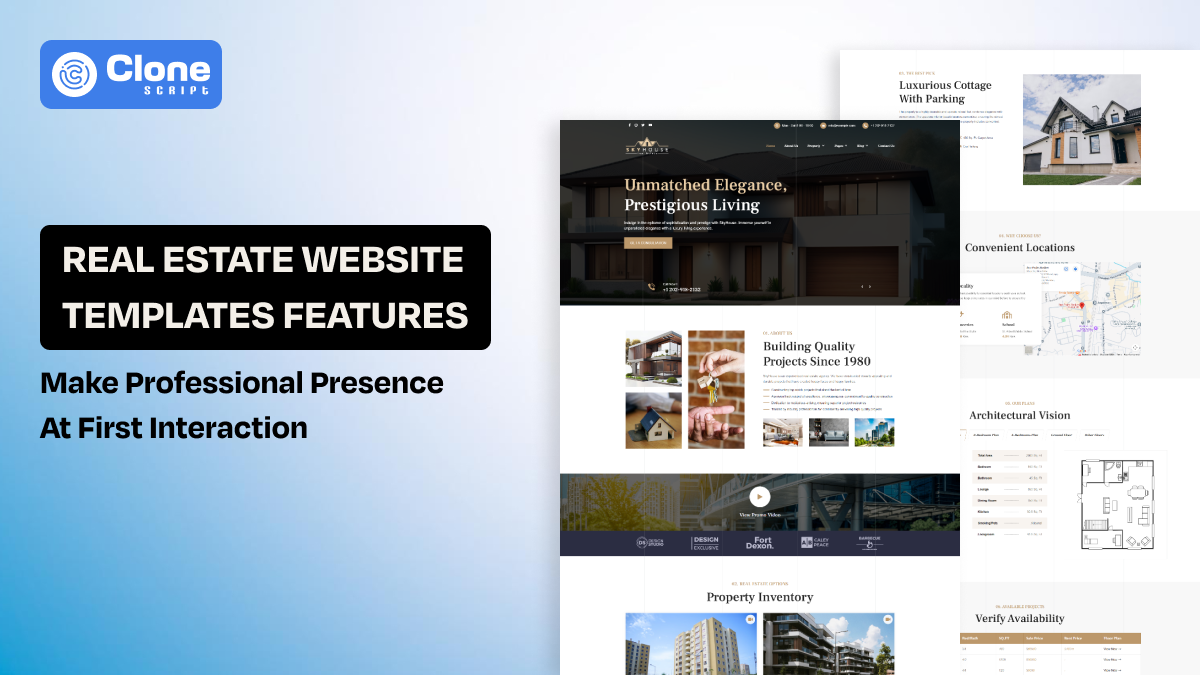
Real Estate Website Templates Features Handle Development Neatly
A real estate website development using the front-end template is reducing the months of designing and coding. But do you ever think: how it performs in a real-world use when thousands of visitors explore the site and list their properties for sale.
Look, a template that feels ok to be used for the custom website development with personalization, but not having relevant features to manage the listing data, user flows, and content scaling becomes a headache. Real estate business can't afford this anymore, in any situation.
A genuinely professional template handles complexity well. From property discovery to listing presentation, every section needs to support clarity, performance, and consistency without requiring heavy rework.
This blog explains the features that elevate real estate website templates from visually acceptable to functionally reliable. It helps you build platforms that feel refined, scalable, and purpose-driven from day one.
Why Most Real Estate Website Templates Fail in Real-World Use
These cases identify that a property management website template is becoming an NPA in the development lifecycle.
-
It looks structured in the demo, but breaks with real data.
You visited a template marketplace and were amazed by the design and ready-to-use front-end HTML code. At the second moment, think that downloading this template will be helpful. But after that, it looks totally different. This is a common problem.
The demo content appears genuine, the layouts are balanced, the sections are well-managed, and navigation appears smooth. The reality is: demo data is controlled and minimal.
The moment real property listings are added with varying formats, images, pricing structures, and location details, the same layout starts losing consistency. What looked structured initially begins to feel uneven and difficult to manage.
-
Scaling listings exposes structural gaps.
Thinking that a template handles 10 listings efficiently, can it manage 500 or more? Not necessarily. As listings grow, cracks begin to appear in how data is organized and displayed.
For example, when a user filters the property under $50k, the site lags. The categories section becomes harder to maintain, and the listing pages lose uniformity. Instead of supporting scale, the template starts requiring manual fixes, which slows down the entire workflow.
-
User behavior disrupts linear design.
Real users don’t navigate in a straight line. They jump between listings, compare properties, apply filters, and revisit pages multiple times.
If the template is not designed for this kind of dynamic interaction, the experience starts to feel disjointed. Because the key information becomes harder to access, navigation no longer supports quick decision-making, resulting in the conversion never happening.
-
The content expansion becomes tough to handle.
As the property listing platform grows, new requirements emerge. For example, additional property types, custom fields, location-based segmentation, or featured listings.
Many templates are not built to accommodate this level of expansion. Because they’re made only for fulfilling a certain number of users, not exceeding those limits.
Implementing new data points often means restructuring layouts, which increases development time and complexity instead of reducing it.
To solve these issues, you have to prioritize the features usually available in premium real estate website templates.
Features That Make a Real Estate Website Template Feel Truly Professional
The website template features indicate professionalism in every interaction.

-
Conversion-Focused Property Listing Layouts
A reliable real estate website template ensures listing layouts are built for decision-making, not just display. Users should be able to evaluate a property within seconds without scanning unnecessary sections.
What makes this effective:
-
Key details like price, location, and highlights are placed upfront.
-
Media and specifications structured for quick comparison.
-
Clear CTAs (inquiry, schedule visit) within reach.
-
Advanced Search & Filtering UX
Search defines how users interact with listings at scale. A template should support filtering that feels fast, accurate, and intuitive under real conditions.
What matters most:
-
Multi-criteria filtering (price, type, location)
-
Instant result updates without reload
-
Logical grouping of filters for usability
When filtering is smooth, users don’t feel restricted. They feel in control. This directly impacts how easily they can discover relevant properties without friction. In other words, it has to be optimized as a custom website UI design and UX.
-
Trust Signals (Agent Profiles, Reviews, Certifications)
A front-end template for property listing should surface credibility without forcing users to look for it. Agent details, reviews, and certifications need to be part of the browsing flow.
What makes this effective:
-
Agent profiles linked directly to listings.
-
Reviews are placed near decision points.
-
Certifications visible but not distracting.
These elements reduce uncertainty. Instead of questioning reliability, users experience trust naturally while exploring properties.
-
Visual Hierarchy for Property Media
Property media plays a major role in evaluation, but without structure, it quickly becomes overwhelming. A properly designed template organizes media to guide attention, not scatter it.
What defines a strong hierarchy:
-
Primary images are highlighted clearly.
-
Galleries structured for easy navigation.
-
Supporting visuals placed without clutter.
When the media follows a clear order, users can focus on what matters first. This improves engagement and makes property comparison more efficient.
-
Mobile-First Responsiveness (Not Just “Responsive”)
Responsive design is expected, but mobile-first thinking is what makes a template reliable. Most users explore listings on mobile, and the experience must be built for that behavior.
What makes the difference:
-
Touch-friendly navigation and filters.
-
Optimized layouts for smaller screens.
-
Prioritized content for quick scanning.
A responsive template that adapts visually is not enough. It needs to function smoothly on mobile, where most interactions actually happen.
-
Performance & Loading Speed Considerations
Website speed performance directly affects how users interact with a property platform. Slow loading, especially with heavy images and filters, quickly reduces engagement.
What keeps performance stable:
-
Optimized media without losing quality.
-
Efficient handling of dynamic content.
-
Minimal delay in search and navigation.
A real estate website template with the following practices ensures that speed remains consistent, even as listings and traffic increase.
-
CMS Structure for Dynamic Listings
Managing property data manually is not scalable. A strong template supports integration with a CMS that handles listings as structured content.
What makes this effective:
-
Custom fields for property attributes
-
Easy updates without layout disruption
-
Scalable categories and taxonomy
When the CMS structure aligns with the template, adding or managing listings becomes straightforward. This removes dependency on constant development changes and keeps operations efficient.
Real Estate Website Template Examples That Get It Right
Get your property management website live using these templates.
-
SkyHouse Property Website HTML Template
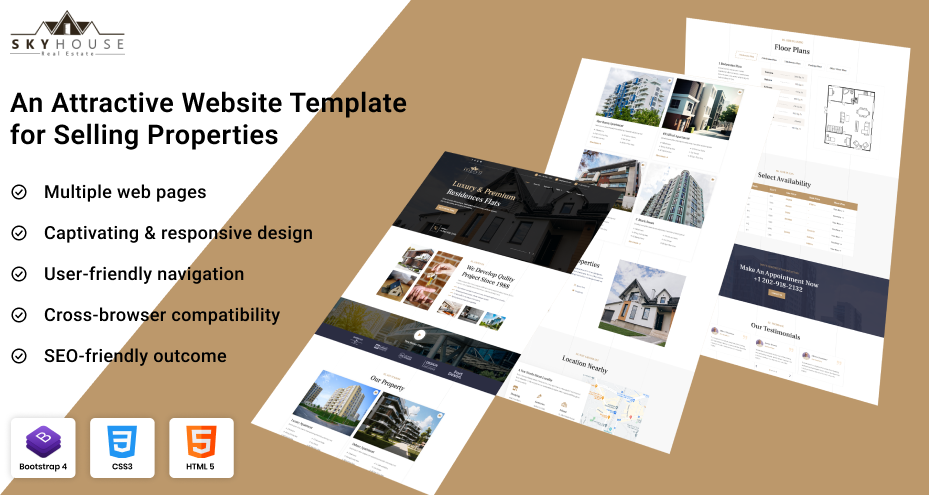
This website template is made with the latest front-end stack, including HTML5, Bootstrap 4, and CSS3. It is designed to manage property listings with a structured and scalable approach. It simplifies how data flows across listing pages, category views, and filters, making it easier to maintain consistency as inventory grows. The HTML layout supports real usage without requiring frequent structural changes.
What makes it easy
-
Managing large volumes of property listings.
-
Maintaining consistent listing and category layouts.
-
Implementing structured filtering and navigation.
-
Scaling property data without redesign.
-
Keeping user flow aligned across pages.
-
Carving Web UI Figma Design
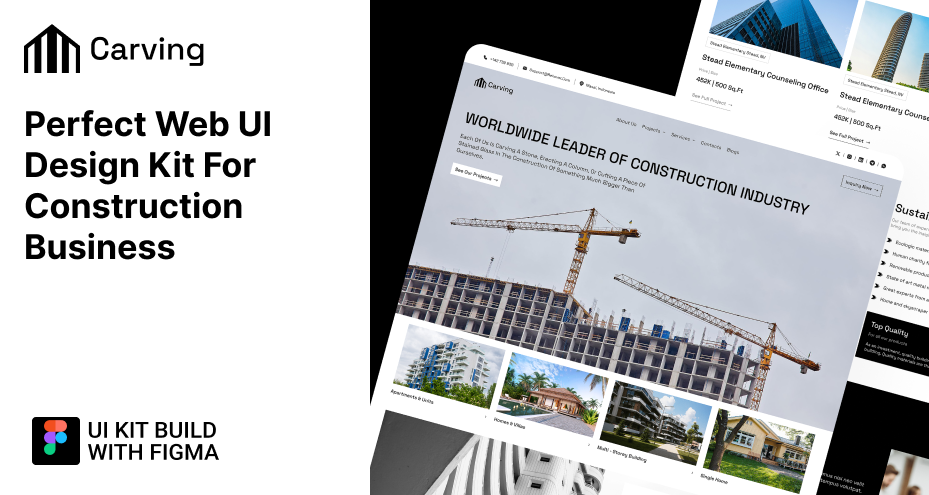
The Carving is a real estate website design made in Figma that focuses on clean presentation and strong content hierarchy. It ensures that property information is easy to scan, compare, and evaluate. The layout reduces clutter and keeps attention on key details, helping maintain clarity across different sections of the website.
What makes it easy
-
Structuring property information clearly.
-
Improving listing page readability
-
Maintaining visual consistency across pages.
-
Reducing layout complexity during expansion.
-
Supporting quick property comparison.
Customizing the template and integrating with the technology stack keeps the professional website ready.
What Technology Stack to Integrate with a Template
Choosing a real estate website template is only one part of the build. The real performance comes from how well the template integrates with the right technology stack. Without that alignment, even a well-structured template starts to create limitations in data handling, scalability, and user interaction.
-
Front-End That Supports Dynamic Data
A template should not remain static once integrated. It needs to connect seamlessly with dynamic data sources in front-end website development.
Using client-side development frameworks like React or Vue helps in:
-
Rendering property listings dynamically.
-
Managing state for filters and search.
-
Updating UI without full page reloads.
This ensures the interface stays responsive even when user interactions increase.
-
CMS for Structured Property Management
Managing listings manually inside code is not practical. A CMS layer is essential to handle property data efficiently.
Platforms like WordPress, Strapi, or Contentful make it easier to:
-
Add and update listings.
-
Manage property categories and locations.
-
Handle custom fields like pricing, amenities, and status.
A structured CMS ensures the template can scale without constant developer involvement. To manage a one-page theme for a property listing website, you can refer to these platforms.
-
Back-end for Data Processing and Logic
As the platform grows, back-end development support becomes critical. It handles:
-
Property search queries
-
Filtering logic
-
User interactions (inquiries, saved listings)
Back-end technologies like Node.js or Laravel help process large datasets and maintain performance when traffic increases.
-
Database Designed for Listing Scalability
Real estate platforms deal with structured and relational data. A reliable database ensures smooth performance as listings grow. Common choices include:
-
MongoDB for flexible data structures.
-
PostgreSQL for relational data and complex queries.
The right database setup prevents slow queries and keeps filtering efficient.
-
Search and Filtering Optimization
Basic filtering is not enough when listings scale. Advanced search solutions improve speed and accuracy. Integrating tools like Algolia or Elasticsearch allows:
-
Fast filtering across large datasets
-
Real-time search suggestions
-
Better user experience during property discovery
-
Media Handling and Performance Optimization
Property websites rely heavily on images and media. Without optimization, performance drops quickly. Using services like:
-
Cloudinary for image optimization
-
AWS S3 for scalable storage
This helps maintain speed while handling high-quality visuals.
-
Hosting and Deployment for Stability
A growing platform needs reliable hosting to maintain uptime and performance. The options are:
-
Vercel or Netlify for front-end deployment
-
AWS or DigitalOcean for backend infrastructure
It ensures the template performs consistently under real traffic conditions.
Bringing Everything Together
Using a template for real estate website development performs at its best when supported by the right stack. The goal is not to over-engineer, but to ensure that every layer, front-end, CMS, back-end, and database works together without friction.
This is what turns a template into a working platform that can handle real data, real users, and real growth without constant rework.
Conclusion
A real estate website template defines how the platform performs as it grows. When the structure supports property data, user behavior, and content expansion, it reduces friction across every stage of usage. Templates that handle search, listing flow, and scalability without constant adjustments create long-term efficiency. Combined with the right technology stack, they move beyond static design and become reliable systems.
The focus should always stay on how the template works under real conditions, not just how it looks during setup. That’s what ensures consistent performance as complexity increases.