BTC - Bitcoin
 USDTERC20 - USDT ERC20
 ETH - Ethereum
 BNB - Binance
 BCH - Bitcoin Cash
 DOGE - Dogecoin
 TRX - TRON
 USDTTRC20 - USD TRC20
 LTC - LiteCoin

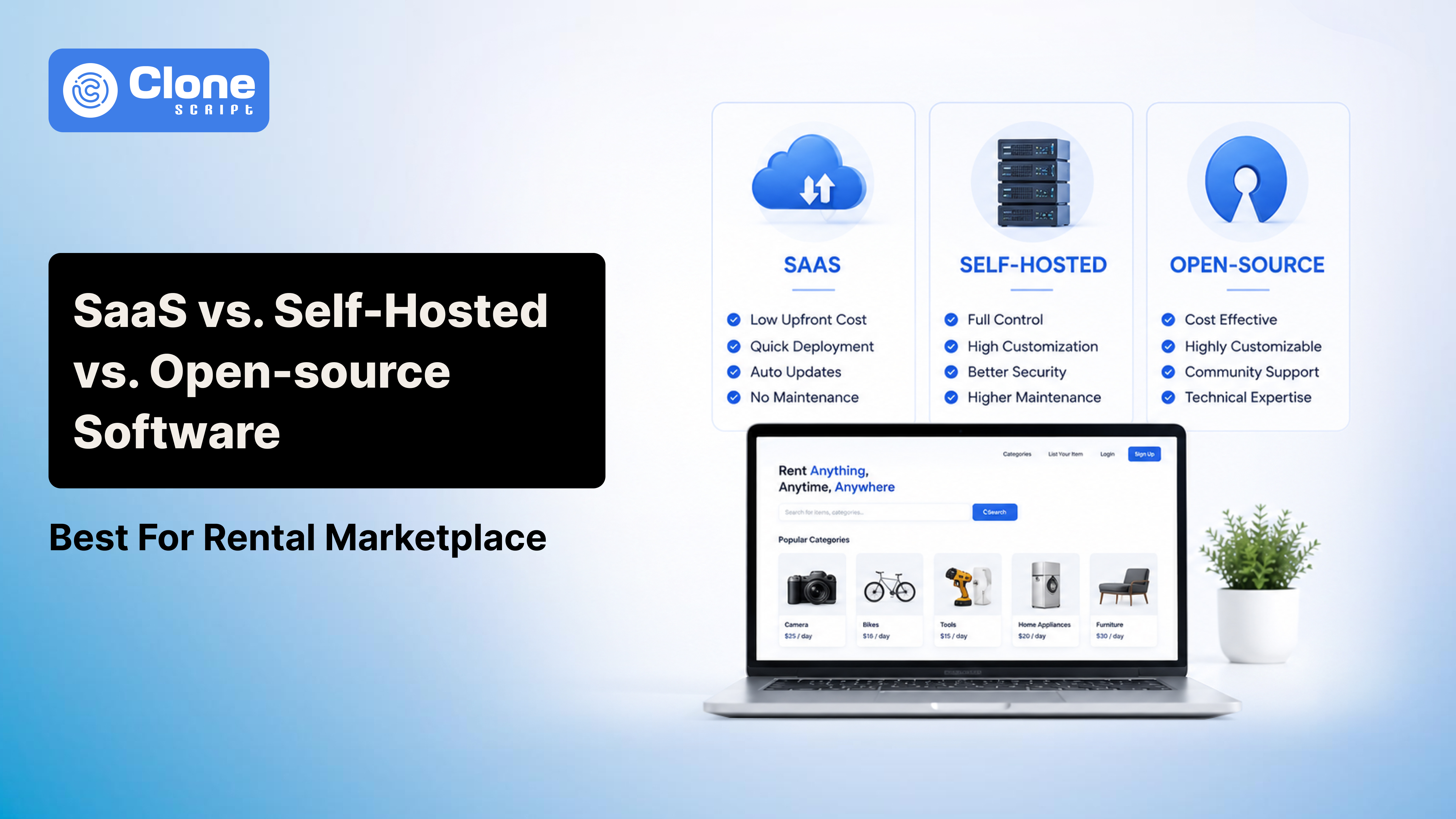
Compared SaaS vs Self-Hosted vs Open-Source Rental Marketplace Software
Launching a rental marketplace for startups and mid-sized businesses that are now building platforms for car rentals, vacation properties, heavy equipment, fashion items, furniture, and even niche industrial assets.
The growth of the rental economy has changed how customers access products. Instead of ownership, users increasingly prefer flexibility and on-demand access.
But while many entrepreneurs focus on branding and marketing first, the real foundation of a successful rental marketplace is software infrastructure.
Rental businesses operate differently. A normal online store processes a simple transaction: the customer buys a product and receives delivery. Rental marketplaces manage booking durations, inventory availability, vendor coordination, return schedules, deposits, maintenance tracking, and recurring usage patterns.
That complexity makes software selection a strategic business decision.
Most founders compare three models:
-
SaaS rental marketplace software
-
Self-hosted marketplace software
-
Open-source marketplace platforms
Each model affects:
-
Long-term operational cost
-
Marketplace scalability
-
Vendor management
-
Platform customization
-
Data ownership
-
Future expansion capability
The challenge is choosing a platform structure that supports long-term business goals instead of solving only short-term launch requirements.
This guide compares SaaS, self-hosted, and open-source rental marketplace software from a business growth perspective using real operational considerations rather than surface-level feature comparisons.
Why Rental Marketplaces Need Specialized Software
According to Statista, digital platform businesses continue to grow globally as consumers adopt flexible access-based commerce models. Rental marketplaces are becoming part of that shift, especially in urban mobility, property rentals, equipment sharing, and B2B logistics.
Many entrepreneurs underestimate the technical complexity behind rental operations.
A rental marketplace must continuously manage inventory movement, booking logic, vendor coordination, and customer scheduling without operational conflicts.
For example, a vacation rental platform handles:
-
Date-based reservations
-
Seasonal pricing
-
Vendor calendars
-
Refund policies
-
Availability synchronization
An equipment rental marketplace may additionally require:
-
Damage tracking
-
Security deposits
-
Hourly pricing
-
Delivery logistics
-
Maintenance workflows
This is where generic e-commerce systems begin to fail.
Research from McKinsey & Company shows that operational automation significantly reduces support costs and improves customer retention in digital commerce businesses.
But what about rental marketplaces? Automation becomes even more important because manual inventory coordination creates booking conflicts and customer dissatisfaction.
Founders usually discover these problems after launch.
At first, a simple platform appears sufficient. But as vendors increase and bookings grow, businesses require more advanced operational control.
The software must support:
-
Real-time inventory availability
-
Automated notifications
-
Flexible pricing models
-
Multi-vendor management
-
Search optimization
-
Mobile responsiveness
-
Geographic expansion
This is why software architecture matters from the beginning.
The wrong infrastructure often forces businesses into expensive platform migrations later. Many startups that initially choose low-cost SaaS systems eventually rebuild their marketplace entirely because the original platform cannot support scaling requirements.
Choosing correctly early reduces long-term operational disruption.
SaaS Rental Marketplace Software: Fast Launch with Platform Dependency
According to Gartner, subscription-based software reduces initial deployment costs and accelerates digital business launches for small and medium-sized companies.
SaaS marketplace software is designed for speed. Businesses subscribe to a hosted platform and launch using prebuilt infrastructure.
For startups validating a rental marketplace idea, this approach looks attractive because technical barriers remain low.
Most SaaS platforms already include:
-
Hosting
-
Booking modules
-
Vendor dashboards
-
Payment gateways
-
Mobile-ready themes
-
Security updates
-
Admin panels
A founder can launch within weeks instead of spending months on website development.
This model explains why SaaS adoption continues growing among startups.
However, rental marketplaces usually become more operationally demanding over time.
That is where SaaS limitations begin appearing.
Common SaaS Challenges for Rental Businesses
-
Limited workflow customization
Most SaaS platforms support standard marketplace logic. But rental businesses frequently need:
-
Hour-based billing
-
Dynamic deposits
-
Maintenance scheduling
-
Multi-location inventory rules
-
Advanced booking conditions
Customizing these workflows may not always be possible.
-
Rising transaction costs
Many SaaS providers charge:
-
Monthly subscription fees
-
Vendor transaction commissions
-
Premium integration charges
-
API usage fees
As booking volume grows, software expenses increase alongside revenue.
-
Restricted infrastructure control
Businesses usually cannot access:
-
Server-level optimization
-
Database structures
-
Complete back-end customization
-
Full SEO architecture
This becomes problematic for marketplaces scaling aggressively through organic traffic and operational automation.
Best Use Cases for SaaS
SaaS rental marketplace software works best for:
-
MVP launches
-
Early-stage startups
-
Small local rental businesses
-
Founders without technical teams
It is ideal for validating demand quickly. But businesses planning large-scale rental ecosystems outgrow SaaS restrictions within a few years.
Self-Hosted Marketplace Software: Balanced Control and Scalability
Self-hosted rental marketplace software gives businesses ownership over deployment while still providing a structured marketplace framework.
Instead of depending fully on a third-party SaaS provider, companies host the software on their own infrastructure or cloud environment.
This model has become increasingly popular among scaling marketplace businesses because it balances operational flexibility with controlled management.
Unlike SaaS systems, self-hosted platforms allow businesses to customize operations without losing infrastructure ownership.
That flexibility becomes important when rental workflows become more advanced.
Advantages of Self-Hosted Rental Marketplace Software
-
Better operational control
Businesses can customize:
-
Booking workflows
-
Vendor commission models
-
Search functionality
-
Availability logic
-
Geographic pricing
-
User roles
For example, a vehicle rental marketplace operating in multiple cities may need region-specific pricing and tax structures. Self-hosted systems support these adjustments more effectively.
-
Stronger SEO flexibility
Organic traffic is a major growth channel for rental marketplaces.
Self-hosted systems allow better control over:
-
URL structures
-
Schema markup
-
Core Web Vitals
-
Page speed optimization
-
Server-side rendering
-
Internal linking
These factors directly affect Google's visibility.
-
Lower dependency risk
Businesses retain greater ownership over:
-
Platform data
-
Infrastructure decisions
-
Third-party integrations
This reduces long-term platform dependency compared to SaaS ecosystems.
According to Flexera, businesses increasingly prioritize infrastructure flexibility to avoid vendor lock-in and improve scalability planning.
Challenges of Self-Hosting Software
Self-hosted systems still require:
-
Hosting management
-
Security monitoring
-
Performance optimization
-
Technical maintenance
However, many providers now offer managed deployment support, making self-hosted solutions more accessible for non-technical founders.
For growing rental marketplaces, this model often delivers the strongest balance between scalability and operational control.
Open-Source Marketplace Software: Full Flexibility with Higher Technical Demands
According to the Linux Foundation, open-source technologies now support most modern digital infrastructures because of their adaptability and innovation potential.
Open-source marketplace software provides direct access to the platform source code. Businesses can modify almost every component based on operational requirements.
For technically mature companies, this creates significant flexibility.
Unlike SaaS platforms, open-source systems do not impose strict platform limitations. Businesses can develop unique marketplace experiences tailored to specialized rental operations.
Why Businesses Choose Open-Source Platforms
-
Unlimited customization
Companies can build the following:
-
Proprietary booking systems
-
Advanced analytics
-
Specialized vendor dashboards
-
Industry-specific workflows
This is particularly useful for highly specialized rental sectors.
-
Greater infrastructure ownership
Businesses fully control:
-
Hosting environments
-
Database architecture
-
Security configurations
-
System integrations
This flexibility is attractive for enterprises building long-term proprietary ecosystems.
-
Reduced licensing dependency
Most open-source platforms eliminate recurring licensing fees. Businesses invest directly in development instead of subscription pricing.
The Hidden Complexity of Open-Source Systems
Open-source software is rarely inexpensive long-term.
The highest costs usually come from:
-
Development hiring
-
Security patching
-
Infrastructure scaling
-
Technical debt management
-
Plugin conflicts
-
Ongoing maintenance
Rental marketplaces add additional complexity because real-time booking systems require stable synchronization.
A poorly optimized platform may create:
-
Double bookings
-
Payment inconsistencies
-
Calendar conflicts
-
Inventory errors
Security also becomes a major responsibility. The Open Worldwide Application Security Project frequently highlights that outdated open-source environments become vulnerable when businesses fail to maintain updates consistently.
Best Use Cases for Open-Source
Open-source marketplace software works best for:
-
Enterprises with internal developers
-
Businesses needing proprietary workflows
-
Large-scale B2B rental operations
-
Companies building highly customized platforms
For non-technical entrepreneurs, operational complexity often becomes difficult to manage without long-term engineering investment.
Saas, Self-Hosted and Open Source Software Cost Comparison: What Founders Usually Ignore
Most entrepreneurs compare rental marketplace software using launch pricing alone. That approach creates misleading financial expectations because the actual cost of running a marketplace grows with vendors, transactions, integrations, and operational complexity.
The real comparison should include:
-
Infrastructure scaling
-
Transaction-based platform fees
-
Technical maintenance
-
Developer dependency
-
Migration costs
-
SEO rebuilding
-
Vendor management expansion
-
Custom feature implementation
A platform that appears cheaper during launch can become significantly more expensive after growth.
-
SaaS Cost Structure
SaaS marketplace software usually looks affordable in the beginning because hosting, maintenance, and deployment are bundled into monthly subscriptions.
For an early-stage rental startup, paying $99–$499 per month feels far more manageable than investing $15,000–$50,000 upfront in custom infrastructure.
However, long-term operational costs increase rapidly as transaction volume grows.
Common SaaS expenses include:
-
Monthly subscription fees
-
Transaction commissions
-
API usage costs
-
Premium integrations
-
Vendor management upgrades
-
Advanced analytics access
-
Extra storage or bandwidth pricing
For example, many marketplace SaaS providers charge transaction fees between 1% and 5% per booking in addition to payment gateway charges.
A rental marketplace processing:
-
$500,000 annually at 3% platform fees loses $15,000 yearly
-
$2 million annually at 3% loses $60,000 yearly
-
$5 million annually at 3% loses $150,000 yearly
That cost excludes payment gateway fees, marketing expenses, and operational staffing.
According to Gartner, SaaS spending continues rising globally because subscription models simplify adoption, but businesses increasingly struggle with long-term recurring software costs as operations scale.
Another issue is scaling restrictions.
Many SaaS platforms require higher-tier plans once businesses exceed:
-
Vendor limits
-
Traffic thresholds
-
API request limits
-
Storage capacity
-
Booking volume caps
This means software costs increase alongside marketplace growth rather than becoming more efficient over time.
-
Open-Source Cost Structure
According to the Open Worldwide Application Security Project, outdated dependencies and delayed security patching remain among the most common vulnerabilities in open-source web applications.
Open-source marketplace software reduces licensing dependency but shifts financial responsibility toward technical operations.
Many founders incorrectly assume “free software” means low-cost infrastructure.
In practice, the largest expenses come after deployment.
Businesses commonly underestimate costs related to:
-
DevOps engineers
-
Security audits
-
Cloud infrastructure
-
Performance optimization
-
Continuous maintenance
Developer costs alone can become substantial.
According to Glassdoor and industry hiring benchmarks:
-
Mid-level back-end developers in the US often cost $90,000–$140,000 annually
-
DevOps engineers frequently exceed $120,000 annually
-
Senior marketplace architects can cost significantly more
Even outsourced marketplace development teams may charge:
-
$25–$50/hour in offshore markets
-
$80–$150/hour in North America and Europe
Rental marketplaces add extra technical pressure because booking systems require real-time synchronization.
A poorly optimized open-source platform can create:
-
Double bookings
-
Inventory mismatches
-
Slow checkout flows
-
Calendar conflicts
-
Server instability during traffic spikes
Security maintenance also becomes a continuous responsibility.
The absence of subscription pricing does not eliminate ownership costs. It simply redistributes them into infrastructure and engineering management.
-
Self-Hosted Cost Structure
According to IBM, businesses investing early in scalable infrastructure reduce future migration costs and operational rebuilding expenses because systems are designed for long-term adaptability instead of temporary growth.
Self-hosted marketplace software usually requires a higher initial setup investment than SaaS but offers more predictable long-term operational economics.
Instead of paying continuous transaction dependency fees, businesses gain greater infrastructure ownership and customization flexibility.
Typical self-hosted expenses include:
-
Initial deployment setup
-
Hosting infrastructure
-
Security management
-
Maintenance support
-
Scaling optimization
-
Optional custom development
However, businesses also gain important long-term advantages:
-
Better scalability economics
-
Lower recurring commission dependency
-
Full database ownership
-
Flexible integrations
-
Greater website SEO control
-
Infrastructure portability
For example, cloud hosting costs for mid-sized marketplaces on providers like Amazon Web Services or DigitalOcean may range from:
-
$100–$300/month for early-stage traffic
-
$500–$2,000/month for scaling marketplaces
-
Higher for enterprise-level operations
Even at larger infrastructure levels, these costs can remain lower than long-term SaaS transaction commissions for high-volume marketplaces.
Self-hosted models also allow businesses to optimize operational spending based on actual usage instead of platform-imposed pricing structures.
The Migration Problem Tough to Resolve.
According to industry migration case studies from enterprise commerce providers, large-scale platform migrations frequently cost businesses between $20,000 and several hundred thousand dollars, depending on platform complexity and operational scale.
One of the largest hidden software expenses is platform migration.
Many rental marketplaces initially choose SaaS solutions for launch speed, but later migrate because of operational limitations.
Common migration triggers include:
-
Limited workflow customization
-
Vendor scaling restrictions
-
Poor SEO flexibility
-
API limitations
-
Revenue-sharing concerns
-
Geographic expansion requirements
Migration is rarely simple.
A growing rental marketplace may need to transfer:
-
Vendor databases
-
Booking history
-
Customer accounts
-
Payment records
-
Inventory systems
-
Search rankings
-
SEO URLs
-
Analytics infrastructure
This process often requires months of technical coordination.
SEO issues also create hidden financial damage.
If URL structures change incorrectly during migration, marketplaces can temporarily lose organic rankings, which directly affects lead generation and booking volume.
Operational disruption during migration may additionally impact:
-
Vendor retention
-
Customer trust
-
Platform uptime
-
Revenue consistency
Choosing scalable architecture early helps businesses avoid expensive rebuilding cycles later. For rental marketplaces planning long-term growth, software flexibility often matters more than minimizing initial launch cost.
Which Option Is Best for Different Rental Marketplace Models?
The best software model depends on marketplace complexity, funding level, and long-term business goals.
Different rental businesses require different infrastructure strategies.
-
SaaS Is Best For the Following
-
Think you’re validating a startup idea
-
Want to launch a small local rental business
-
Require to deploy MVP fast MVP
-
Entrepreneurs with limited budgets
Examples include:
-
Event equipment rentals
-
Local furniture rentals
-
Small bike rental startups
These businesses prioritize launch speed over deep customization.
-
Self-Hosted Software Is Best For the Following
-
When launching multi-vendor rental marketplaces
-
Your business is SEO-focused
-
Planning to scale regional platforms
-
Businesses requiring operational flexibility
Examples include:
-
Vehicle rental marketplaces
-
Equipment rental aggregators
-
Property rental platforms
These marketplaces usually need long-term scalability without SaaS dependency.
-
Open-Source Is Best For the Following
-
Your enterprise business has a complete technical team
-
Developing a complex B2B rental ecosystem
-
Businesses building proprietary infrastructure
Examples include:
-
Industrial rental exchanges
-
Fleet management systems
-
Specialized logistics marketplaces
These businesses require advanced customization and can support continuous development internally.
The key is aligning software architecture with operational ambition rather than choosing based only on launch convenience.
Conclusion
There is no universally perfect marketplace software model, frankly speaking.
Each approach solves different business problems.
SaaS platforms help entrepreneurs launch quickly and validate market demand with minimal technical overhead.
Open-source systems provide unmatched flexibility for companies capable of managing long-term development complexity.
Self-hosted rental marketplace software offers the strongest balance for many growing businesses because it combines scalability, customization, infrastructure ownership, and SEO flexibility without full enterprise engineering complexity.
For rental marketplaces, software decisions directly affect every part of the business.